
November 07, 2011
The problems of pluralism
by Hartosh Singh Bal
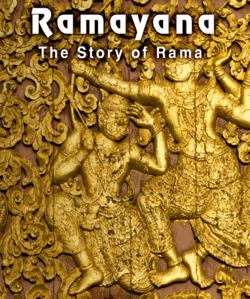
Two recent events, the removal of an essay on the many tellings of the Indian epic the Ramayana from the curriculum of Delhi University and the firebombing of a French newspaper for printing a cartoon of the Prophet in an edition devoted to a satirical look at the Shariat, share a surface resemblance. They have taken place in India and Western Europe, two diverse places but both places that take pride in a tradition of tolerance. While it is possible to read into the incidents the continuing religious intolerance for any examination of faith, it seems to make more sense to me to focus on the differences between the two events and what they say about the manner in which these two societies actually practice tolerance.
The essay removed from the curriculum at Delhi University was written by A.K. Ramanujan, at least in the Indian way of thinking a Hindu, drawing upon a long tradition in which the diversity within the faith is itself a source of tolerance. The opposition to this essay has come from the Hindu right, which is not a conservative but a radical force. It wants to historicize a tradition that is rooted in myth and storytelling. Uncomfortable with the elasticity of myth, they prefer the certainty they think history grants them. For them the figure of Rama, central to the epic, is not subject to the vagaries of storytelling and local lore, he is a historical figure with a kingdom and a birthplace.
This historicity is central to a version of Hinduism that goes by the name of hindutva and shores up the main opposition party in Indian, the Bharatiya Janata Party (BJP). Irrespective of its antecedents (it is a modern idea, born in the early twentieth century) it has come to command enough of a following to influence the norms that actually mediate tolerance in India. By tolerance, I do not just mean intellectual tolerance which however important is only a part of a wider idea. By tolerance I mean the wider idea that allows diverse ways of living to coexist in a society.
In India this wider idea is not constructed just through some absolute legal or Constitutional guarantees, it is a practical process that is mediated daily on the streets, but one that has always existed in some form or the other, because diversity has been the one constant in India society, well before the advent of Islam in the eighth century AD. Any description of this tolerance must be taken for what it is, a description of actual facts on the grounds that is not circumscribed by any order that such a description seeks to impose. The order is after the fact.
To me this tolerance is predicated on the recognition that diverse ways of living by their very nature will place importance on different ideas and attitudes, and often these ideas and attitudes can be in conflict. Any society that then allows coexistence must at this point make a decisive choice at this point. It can either set down a set of values that it thinks are fundamental and which any individual must subscribe to, or it can say each group is welcome to its values and overarching norms must come into play only when there is the possibility of overlap and conflict. Through the centuries the Indian approach has been to emphasize the latter even though the Constitution now is largely framed around the idea of individual rights.
In practice what this has meant is that various groups (in the Indian context this largely implies castes) have followed their own norms and it is inter-caste interaction that is mediated. Clearly, this also means that injustices of the worst sort were permitted within castes, say on grounds of gender, as well as between castes, where even untouchability was one way of mediating relationships. But, it also meant that when a new group entered India from the outside, say as was the case with the Parsis or developed within India, as was the case with the Sikhs, or both, as was the case with Islam, in practical terms the group in question could then be treated as just another caste (which did not preclude the existence of further diversity again largely mediated as caste within some of these groups). When people talk of the resilience of Indian society, this structure lies at the heart of it, it is created out of an organizing principle that is decentralized, and is still internalized by a vast majority of people. The change of rulers, the dismantling of empires in Delhi has had very little effect on how society conducted itself.
It is the Indian Constitution which marks a real change and departure from anything in the past. In many senses it is an uneasy compromise between ending much of the inequity that prevails as a result of this social structure and retaining the tolerance that was inbuilt. Caste discrimination was made illegal but a common civil code was not imposed. In India birth, marriage and death rituals vary greatly among religions, and the state permits this diversity. The Sikh wearing a turban is allowed exemption from several norms that apply to all other individuals. The examples can numerous and in terms of religion India has interpreted secularism in a peculiar way to mean that there is no state religion, but the public space is not barred to religion, it just does not discriminate among them.
Perhaps, an example would make the practice of this tolerance clear, and it would also point to the dangers of hindutva. The Muslim artist M.F. Hussain who died recently had often painted Hindu goddesses. In a traditional sense this would not have been problematic. The depiction of Hindu gods and goddesses in erotic poses has taken place time and again, and a Muslim has never been precluded from exercising the freedom the tradition allows. It would not occur to anyone, Hindu or Muslim, to paint or depict Muslim religious figures in the same way because tradition prohibits it.
Hussain had to spend the last years of his life in exile after proponents of hindutva attacked his exhibition on the grounds that if he cannot depict figures from his own religion in this way, how can he depict Hindu goddesses so. It was an alien way of thinking and while it was couched in terms of Hindu and Muslim, it actually indicates hindutva’s great problem with diversity. This new idea desires a society where even Hindus would not depict goddesses so. The proponents seek a casteless Hinduism with canonical religious figures common to all Hindus. These figures must not be subject to myths which can take many forms, which can involve them in the pursuit of the erotic, the comic or even what would be described in other traditions as evil. They must rather be idealized figures from history. Hussain was an enemy in their view, like all Muslims, but even more so he was an enemy in their view because he was an artist who exercised the freedom that myth allows. This is why they attack a Hindu writer’s freedom to examine the Ramayana, it takes away from their desire to historicize Rama, the hero of the epic, and the deity that lies at the heart of their reinvention of Hinduism.
This traditional version of tolerance as opposed to how hindutva sees things exercises a notion of morality or ethics that is contextual, as Ramanujan, the author of the essay on the many Ramayanas, pointed out in another key essay – `Is there an Indian way of thinking?’. The freedom of depiction of goddesses is not an absolute one, it depends on which and whose goddess you depict. In this way of thinking the self-imposed restriction on the depiction of the Prophet out of respect to Muslim sentiments would be much like the self-imposed restriction on the consumption of beef out of respect to Hindu sentiments in much of north India. Tolerance then is about give and take, of voluntarily renouncing certain freedoms out of a consideration for others who live with you.
In this way of thinking, the act of publishing cartoons in Denmark or the special edition by a French newspaper seems perplexing. It would never occur to anyone in India to attempt such feats. There, is of course, a European history of rejecting the imposition of indignities in the name of religion. But from an Indian context, it is because Islam and Christianity cherish different values that it is possible to argue for the mockery of Christian religious figures and argue against the same freedom when exercised against Islamic religious figures. Certainly, it is not as is freedom of expression is absolute anywhere in Western Europe. I imagine a cartoon or satire which was racist, anti-Semitic or sexist would not have been published by either newspaper.
This is not meant to even remotely justify the response to the cartoons or the satire. It is only to suggest that there are certain ideals which will be in contradiction. A tolerant plural society and an absolute freedom of expression cannot be simultaneously achieved. Even more problematically, the European way of thinking fails to understand the need to make distinctions based on differing group values that lie at the heart of any diverse society. To make rules that impose the same constraints and allow the same freedoms for various religious groups is to avoid facing up to the fact they are different to begin with.
It is also true that the same question gets far more complicated when we talk of a book such as the Satanic Verses. I would only suggest that a novelist’s freedom is of a different order than a journalist’s. The latter is already constrained by issues of libel or for that matter sexism, anti-Semitism and racism in ways no novelist can or should be.
But to return to where I started, it does seem to me that arguing from history, imagined or otherwise, can give rise to what may seem to be very differing demands, in France to defend the right to offend Muslims, in India to ask for a ban on the depiction of Hindu goddesses by Muslim artists. These demands though are not very different in their insistence on uniformity; for the proponents of hindutva either everyone should have the right to paint all religious figures in any way they choose or no one, and in particular a Muslim, should have the right to depict their goddesses, for the secular (as understood in France) fundamentalists of Western Europe, everyone should have the right to mock every religious figure. In each case the desire is for a certain uniformity that does not respect context or diversity. It seems even more problematic when both demands, however differently they may be espoused, seem to have the same target group. Perhaps, we must constantly examine the ease with which we use the word tolerance to defend what we hold dear, and intolerance for the defense of what others may hold dear.
Posted by Hartosh Singh Bal at 12:40 AM | Permalink


Comments
Hartosh:
You should have let your readers know that MF Hussain's paintings weren't exactly in the devotional idiom - the kind found in temples and palaces. He was using the figures of naked Hindu goddesses instrumentally (as any sophisticated modern artist would) to make aesthetic, political, and lest we forget, roaringly commercial, statements :) While these works may have seemed like harmless novelties to Hussain fanpersons like you and me, they did offend many believing Hindus. And it is not accurate to imply that only Hindutva types were offended. I know many (especially elderly) believing Hindus who actively loathe the Hindutva types, ritually vote for the Congress in every election AND who were deeply offended by Hussain's depictions of their gods.
I say this only because your whole notion of tolerance seems to derive not from the standard western "right to offend" model, but from some communitarian state of affairs that existed among the non-Hindutva Hindus of ancient and medieval India. The kind of tolerance that was based on mutual respect and a regime of good manners that precluded critique of any kind.
When you say:
The depiction of Hindu gods and goddesses in erotic poses has taken place time and again, and a Muslim has never been precluded from exercising the freedom the tradition allows. It would not occur to anyone, Hindu or Muslim, to paint or depict Muslim religious figures in the same way because tradition prohibits it.
Are you not indirectly saying that art has a place in Indian society only so long as it is in consonance with Hindu/Muslim traditions? Are you not then rejecting any art that repudiates or critiques Indian religious traditions? Perhaps that is why even you don't seem fully convinced by your attempted defense of Rushdie's Satanic Verses.
Getting back to your indigenous notion of tolerance: Tolerance then is about give and take, of voluntarily renouncing certain freedoms out of a consideration for others who live with you.
If so, what prevents us from giving due respect to the community of Hindutva Hindus and just dropping the offense-causing Ramanujan essay? RSS/BJP/VHP supporters are after all a sizable chunk of the Indian population. Their party even ran the union government once. Our community of AK Ramanujan readers, on the other hand, may number in the thousands at best. We can have our "mythical Ramayanas" in our libraries and study circles; let them have their "historical Ramayana" in the classrooms. It's a valid give and take out of a consideration for others who live with us, right?
Posted by: M73 | Nov 7, 2011 10:17:07 AM
As an atheist, I could care less about who's being portrayed how. The right to say or publish anything is paramount of course, but it seems Europeans,not all but some, seem to get a lot of pleasure bordering on the sadistic by picking on Muslims and pissing them off. Just a lack of common decency and human respect in my view.
I am really interested in finding out how pissed off some Italians would get if the Pope is depicted humping a nun or two. Or what the Irish would have to say upon seeing St Patrick sitting on a giant shamrock getting it on with three women. For the Germans and Swiss, just think up something with Luther or Calvin....
Posted by: Shahzad | Nov 7, 2011 10:43:27 AM
Popes humping nuns have definitely been published, as have all sorts of shamrock cartoons. You would probably piss off some people (that is probably the point) but it wouldnt be huge news. There is a lot of very crude anti-Christian, anti-founding father satire in America, mostly on the fringes. Its not very big news. Occasionally something like "Piss Christ" will become news, but its certainly been done and will be done again and again...And Muslims are going to get used to it too. There is a Mohammed image archive on the internet (google it) that pretty much takes care of the possibility of completely stopping this sort of thing. Firebombing is not going to stop people from doing such things..in fact, it will probably encourage some of them.
Posted by: omar | Nov 7, 2011 11:59:05 AM
"A tolerant plural society and an absolute freedom of expression cannot be simultaneously achieved."
I don't see why not. The only thing needed is to accept such freedom as one of the pluralities. (That all can partake in, if they want.)
And indeed it is the secular contribution to a tolerant plurality, to be able to tolerantly criticize a subject without criticizing the individual.
Posted by: Torbjörn Larsson, OM | Nov 7, 2011 12:40:48 PM
Bal's pendulum predictably swings left after his earlier swipe at Roy and the naxalites. Hussain's paintings are a convenient straw-man to bash those Hindus whose sentiments were offended by his misappropriation of their divinities. Not that I condone the violent protests by Hindu lumpen (which were relatively tame in comparison...), but neither do I believe that he was just exercising his "artistic" freedom; a freedom that curiously stopped with nude Hindu religious icons in salacious poses. His subsequent action in quickly removing his ridiculous self-produced movie following mild protests from a few Muslim groups only confirms that his notion of artistic freedom was very selective.
Just as Bal's whipped-up sanctimonious ire falls short of the coordinated angry protests from Indian Christians over The Last Temptation of Christ and their hounding of the Malayalam writers P.M. Anthony and Paul Zachariah for their "blasphemous" writings on Christ. Or his own Sikh community who are far more reactionary and fundamentalist than anything that the Hindutvadi's have concocted.
He could start by vociferously championing Harinder Singh's freedom for his book on Guru Gobind Singh, Vanity Incarnate, or even contrast the "tame" reception to Gurpreet Bhatti's play, Behzti, set in a Gurdwara of infamy, with how poor Hussain was unfairly hounded by the dastardly Hindus. And while he is extolling "tolerance" to his fellow Sikhs, Delhi University should uphold its "secular" principles by including The Satanic Verses and the above mentioned books along with Ramanujan's essay on the Ramayana in their curriculum.
Posted by: Sam | Nov 7, 2011 4:36:16 PM
I really enjoyed this piece, Hartosh. Your representation of the differences between Western and Indian styles of tolerance really ring true to me.
Posted by: Usha Alexander | Nov 7, 2011 4:40:16 PM
@Omar
Yeah, I agree there's stuff out there. It's the lack of civility that pisses me off, these sort of things of course can't and shouldn't be legislated against, but newsrooms should just use some common sense and show some decency.
On a further note, I've always found it ironic that you can be prosecuted for not beliving in history in Europe, yet free speech reigns supreme when it comes to Muslims. This selective sensitivity to some and not others is what irks me.
Posted by: Shahzad | Nov 7, 2011 6:02:09 PM
Indian intellectuals are so preoccupied with being liberal that a strange hypocrisy exists now where a minority community is exempted from the exacting standards of tolerance that it demands from the majority. You can have, in the same issue of a national newspaper, two articles, one demanding that the perpetrators of 1984 riots be brought to justice, the other expressing sympathy for a khali who terrorized the Hindu minority of his province in the years leading upto the riots.
Posted by: onm | Nov 7, 2011 7:25:29 PM
Shahzad, laws against holocaust denial are a mistake, but they are by no means universal even in Europe. There is no such law in the United States. As far as history is concerned, it is (now, not in the past) more common to casually (and frequently, unfairly or without context) attack colonialism, White privilege, Christian crusades and European invaders than it is to accuse non-White groups of historical crimes. This sensitivity may be regarded as a kind of justified reverse discrimination (course correction?), but it means that one cannot accuse mainstream academia or media of widespread insensitivity towards Muslims and their historical figures.
Posted by: omar | Nov 7, 2011 9:06:02 PM
Onm, the perpetrators of the savage '84 pogrom of Sikhs indeed should be brought to justice. The only reason that they are given a pass by Indian secular liberals, and not hounded by the media, is because the chief perp and the current leadership of the Congress party that he belongs to are "minorities". There is a certain Animal Farm quality to Indian secularism; all minorities are good, but some minorities are better than the others.
Posted by: Sam | Nov 7, 2011 9:49:32 PM
Hartosh, what an excellent, thought-provoking essay. I particularly like how you describe Indian tolerance and how it has historically been nourished by diversity. Amartya Sen has called the Indian tradition of tolerance swikriti—or "'acceptance', in particular the acknowledgement that [others] are entitled to lead their own lives"—which differs from modern western tolerance.
Indeed, I think pluralism and liberalism have a built-in tension between them that often cannot be resolved to a liberal's satisfaction. I addressed this at length in a previous 3QD essay.
M73 raises an interesting point that Husain's paintings may have also offended Hindus other than the Hindutva types. If this is true, it would be harder to mount a defense of Husain in the name of traditional Indian tolerance. Could some have experienced his paintings as akin to a member of one caste desecrating the symbols of another caste, amounting to a violation of swikriti? On the other hand, if the ringleaders of Hindutva (a modern/radical force) had not publicly attacked Husain, would his work have provoked the non-Hindutva Hindus? I am not so sure.
What does seem clear is that Husain was actively defended by modern liberals (like many of us here), who stood up for his individual right to self-expression—part of liberalism's universal ideal. If liberals take pluralism seriously, they need to humbly acknowledge that their view of Husain's right to artistic expression is one of many views of him in India. And about the only real option such a liberal has is to persuade others to see it his way. Also, as part of the give-and-take that is the hallmark of tolerance, I can imagine voluntarily ceding ground on my liberal ideals—including on Husain, Ramanujan, and Rushdie—but the context of that concession is quite important. Even though—to respond to M73—the Hindutava types add up to a lot of people, ceding ground to them (vs. to other Hindus) will NOT serve traditional Indian tolerance. On the contrary, it will only feed Hindutva's hunger to push for more uniformity of discourse and further shrink pluralist tolerance. As a liberal, why would I want to readily cede ground on my liberal ideals, as well as contribute to the demise of pluralist tolerance?
This is why liberals in India must continue to resist Hindutva, for Hindutva is a living force, a clear and present danger in India. Rallying for justice for their past wrongs, such as the Gujarat pogrom, is effectively a means of keeping this toxic force in check. Such a force did not result from the 1984 anti-Sikh pogrom, which has become "merely" a historical event that demands justice. It's tiresome that whenever liberals criticize Modi for Gujarat, some folks always pipe up, seemingly in his defense, "but what about 1984?" The two horrendous events resemble each other, but in terms of the risks to the future, the folks behind one of them clearly require far more vigilance today.
Posted by: Namit | Nov 8, 2011 3:17:03 PM
"Hindutva is a living force, a clear and present danger in India"
And Islamofascism isn't? Based on the frequency of events and the size of the casualties, Islamic terrorism has claimed more victims in India than it has in Europe and the US combined, where it is recognized by their governments as a clear and present danger to their respective secular societies.
The Gujarat "pogrom", where a third of the victims were Hindu, but presumably self-inflicted just as liberals believe to have occurred with the immolated train victims at Godhra, and the "merely historical" Sikh pogrom where all of the victims were Sikhs, as per the definition of the term, only differ in which political party headed the local government.
In terms of risks to the future in India, there is nothing greater than establishment hypocrisy and continually promoting a one-sided travesty of what it means to be secular. Like the craven reversal of the Shah Bano judgment or the continuing absence of a uniform civil code, or the banning of The Satanic Verses and the hounding of Taslima Nasrin while simultaneously extolling the artistic freedom of Hussain. Pluralist tolerance does not mean a selective and unidirectional tolerance.
Posted by: Sam | Nov 8, 2011 4:57:45 PM
Hartosh,
Appreciate your arguments on pluralism.
Here is my peeve
"The depiction of Hindu gods and goddesses in erotic poses has taken place time and again"
True but these belonged to different times and space. From Bhakthi movement onwards such things were rare. Devotion trumped everything else. Shringara rasa tenuously prevailed in Natya and once divine dancers became reviled prostitutes. Add to this a residual layer of victorian puritanism you get contemporary 'Hindu' sensibility. True you get tones of eroticism in bhakthi lit of Mira or Aandal but these were subtle metaphors for devotion. MF's art was outside the context of such devotion.
I am all for MF's art whatever it maybe but not your defense based on long gone traits in Indic culture.
Posted by: MegaJaga | Nov 8, 2011 5:18:38 PM
There is a fable popular among certain sections in suburban north India: when a Hindu schoolboy returns home bruised after a fight with his Muslim classmate, he is further chastised by his mother for reacting to the Muslim's taunts.
Hindu liberals have inherited the attitude of their mothers. A mindset of "defeated people", as Naipaul remarked, who instead of using their intellect and dealing with the complicated and painful reality, rush behind the comforting haze of borrowed and misapplied Western ideals.
Posted by: onm | Nov 8, 2011 6:33:45 PM
I am reminded of the 12th Edict of Aśoka, ca. 260BC:
"Beloved-of-the-Gods, King Piyadasi, honors both ascetics and the householders of all religions, and he honors them with gifts and honors of various kinds. But Beloved-of-the-Gods, King Piyadasi, does not value gifts and honors as much as he values this -- that there should be growth in the essentials of all religions.
"Growth in essentials can be done in different ways, but all of them have as their root restraint in speech, that is, not praising one's own religion, or condemning the religion of others without good cause. And if there is cause for criticism, it should be done in a mild way. But it is better to honor other religions for this reason. By so doing, one's own religion benefits, and so do other religions, while doing otherwise harms one's own religion and the religions of others. Whoever praises his own religion, due to excessive devotion, and condemns others with the thought "Let me glorify my own religion," only harms his own religion. Therefore contact (between religions) is good. One should listen to and respect the doctrines professed by others. Beloved-of-the-Gods, King Piyadasi, desires that all should be well-learned in the good doctrines of other religions."
Posted by: panopticonopolis | Nov 10, 2011 2:03:41 PM
Post a comment