
by Gautam Pemmaraju
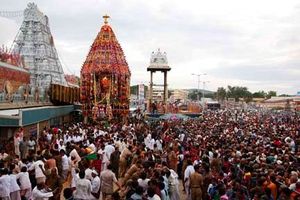
He is also a patron of the historic temple in the hills of Tirupati, in southern Andhra Pradesh, bordering Tamil Nadu. With a prominent guesthouse there, he is known to be an avid devotee of the resident god Venkateshwara (also Balaji, Srinivasa), and has never been shy with either devotion or largesse. Newspaper reports abound that every new aircraft of his first takes a flight of obeisance around the Tirumala hills where the temple is located, before ferrying passengers.
A former BJP minister of Karnataka and mining baron, G Janardhan Reddy, who is now in jail on charges of illegal mining, had donated to the temple a ‘2.5 foot long, 30 kg’ diamond encrusted gold crown worth over $10 million then in 2009. Recently the temple administration (the Tirumala-Tirupati Devasthanam trust or TTD) stated officially that there was no question of returning the gift in response to demands calling for its return. Political parties and other groups led protests against the ‘tainted’ offering, claiming that it “polluted the sacred ambience of the sanctum sanctorum”. Earlier this year, the now incarcerated politician and his brother (known as the Reddy brothers – partners in the controversial Obulapuram Mining Company) donated yet another diamond studded crown, gold laden garments and other ornaments worth around $3.5 million, to the deity at Srikalahasti temple, which is at the foothills of the main temple.
A rather entertaining news report by a regional TV station in April last year, informed viewing public that the reason for the Mumbai Indians cricket team loss to the Chennai Super Kings in the IPL final was due to a transgression by the owners, Mukesh and Nita Ambani. The temple remains closed between 12 AM and 2 AM, giving a chance for the industrious god to rest a bit. It was apparently during these hours, the wealthiest man in India and his entourage paid a private visit to the temple to pray for his team’s victory. Angered at the intrusion, the resident god, according to locals, in an act of divine annoyance, caused Ambani’s team to lose. Quite emphatically at that.
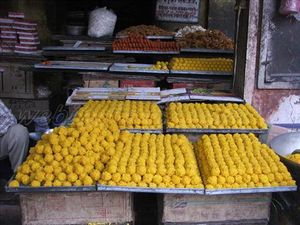
Scores of people visit the temple everyday, and year round. It is in fact, the most visited place of worship in the world and is one of the wealthiest (for stats see here). All kinds of people flock there – from Bollywood stars and producers, cricketers, politicians, expat Indians, to peasants, schoolteachers and lowly clerks. Every day, hundreds of people have their heads shorn ritually, thousands stand in line for hours on end to catch a glimpse of the resident god in the sanctum sanctorum, eat at the temple canteen which provides free food, and take back with them the famed Tirupati Laddu, a consecrated sweet. A few years ago, a scientist and patent rights activist in Kerala filed a public interest litigation in the Supreme Court against the temple trust obtaining a Geographical Indicator (GI) tag for the laddu from the Indian Patent Office. He argued that such a patent would set a precedent of “private appropriation of religious symbols”. He has also petitioned the Registrar of GIs and the Intellectual Property Appellate Board for the removal of the tag.
*
The mythological story behind the collection box is, to say the very least, pretty entertaining and somewhat ironic in its contemporary parallels. The lord of the temple, Venkateshwara, Srinivasa, Govinda or Balaji as he is more commonly addressed across India, was to wed his consort Padmavati. Not having enough cash, he is said to have borrowed the money from the god of wealth, Kubera, and pledged the collections as interest repayments. And it is his divine profligacy that devotees now repay, in perpetuity.
Myth has it that the resident god of the temple is an incarnation of Vishnu, one of the holy trinity of post-Vedic “Synthetic Hinduism”. Dating back to the 1st century C.E, early Pauranic sources explains his presence in the region due to a somewhat quotidian incident – a domestic dispute, albeit divine in nature. Laxmi, the consort of Vishnu the Protector, lay resting in his chest while he assumed a restful yogic sleep. A traveling sage Bhrigu (on a mission to ascertain the most divinely steadfast of the trinity of Brahma, Vishnu and Shiva) angered by what he saw as a serious dereliction of divine duties, kicked Vishnu in his chest, who then was quick to awaken and offer his sincere apologies. The missus however, not happy at what she perceived to be an insult and a failure of husbandly duties, left the heavenly abode in anger. Bereft of his consort, Vishnu then made inquiries as to a suitable retreat for some much needed R & R. The seven hills of Tirumala-Tirupati were where he took his abandoned divine self, eventually manifesting himself locally.
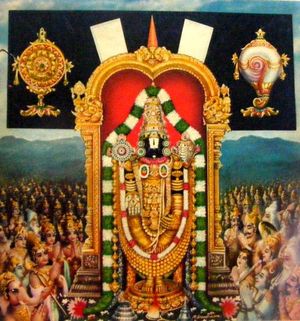
Tirupati is a bustling town at the foot of the seven hills of Tirumala, the last peak of which is Venkatadri, home to the main temple. Several other temples dedicated to both the lord and his consort speckle the hills and the area surrounding the town of Tirupati. Its origins are a matter of debate but it finds mention in scripture of antiquity, and in Classical Tamil literature, popularly known as Sangam Literature. It is said to have gained great prominence during the medieval rule of the Vijayanagara Empire, particularly during the reign of Krishnadevaraya. (Robert Sewell’s A Forgotten Empire containing accounts of Portuguese travellers Domingo Paes and Fernão Nunes is interesting.)
Most of the historical detail of the temple relies on a large number of inscriptions collected by the Devasthanam department of epigraphy during the last decade of the 19th century. This is what Krishnaswami Aiyangar relies on partly, in his two volume History of Tirupati (1939), wherein he writes of the shrine’s “probable date of foundation about the beginning of the Christian era down to practically the end of the 18th century”. Aiyangar was denied access to colonial records, he informs us. What is interesting here is Aiyangar’s source material. The inscriptions have bearing on the period of Ramanuja (10th and 11th century CE), the Vaishnava teacher, “whose connection with the temple and his actual services to it had long been a fruitful subject of controversy”, Aiyangar says. For the anterior period before Ramanuja, Aiyangar further explains, Tamil and Sanskrit sources provide references to Vengadam, the traditional name of Tirupati. Vengadam was to the north of Tamil land and beyond, we learn, was the land of the non-Tamil Vaduku, or the Telugu. The classical Tamil work of the 12 Vaishnava Alvars, who composed between 6 – 9 CE, also mentions the shrine. The classical grammar of the Tamils, or Tolkappiyam, provide us with a reference to the boundaries of Tamil land, Aiyanger explains, which lies between the hill Vengadam on the north and Southern Comorin (Kumari) on the south. Intriguingly, citing the Tamil poet Mamunalar, Aiyangar offers that in poem 311, “he refers to the good country of Pulli [a regional chieftain], and the desert past it, and describes the feature that the people were accustomed to eating rice prepared with Tamarind, on teak leaves”.
Tamarind rice is a prominent preparation across south India and is offered at the temple.
Aiyangar asserts the Vaishnava (a tradition of devotional Hinduism related to the worship of Vishnu) character of the shrine by invoking all sources, but he does point out to critical periods of dispute, particularly during Ramanuja’s time. The then patron and ruler Yadavaraya invited the theologian/thinker to present his arguments and was duly persuaded, but the dominant Saivas of the region, Aiyangar informs us, claimed prejudice against them and that the ruler was swayed not by Ramanuja’s arguments but “by some kind of an occultic influence which they actually averred Ramanuja exercised over him”.
There are a few assertions that it was originally a Buddhist shrine. Tirupati Balaji Was A Buddhist Shrine by K.Jamnadas stakes this claim by invoking the few prominent works on the history of the shrine, including Aiyangar’s account. This is a murky debate and it is suffice to say that historical sources point to competing religions during this time. What came before and what after is contested. Pointing to the fact that it was with the Vijayanagara reign that the shrine entered a ‘modern’ period, Aiyangar states that prior to that its history “would be more or less of the nature of imperfect documents” and collation of “disjecta membra of information”. Also,
Having regard to the circumstances of the time and of prevailing religious customs, we can state it with confidence that the period was one in which people were making an effort to provide for worship for the masses of people, possibly with a view to wear them from attachment to, and the attractions of, other contemporary religions such as Jainism and Buddhism.
*
Recently, the famous shrine has been beset with many problems and controversies. Last year, a clerk working with an officer of the trust committed suicide allegedly under pressure from higher ups. Amongst the many allegations of a wide variety of corrupt practices, including illegal ticket sales, illegal sale of gold coins made from offerings, there was most prominently the issue of missing jewels and artifacts dating back the Vijayanagara period. Internal vigilance reports had apparently pointed to the collusion of officials, and one report had specifically pointed to fake jewelry being put in place of original ones. Many point to the fact that politicians control the governing board. Prominent bureaucrats also feature and it is always a matter of speculation as to their administrative freedom and discretionary powers.
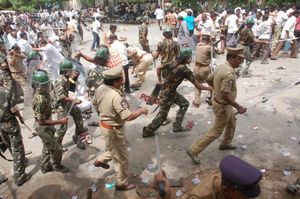
There has been a Maoist presence in the Chittoor district for quite some time, and the entire southern region of Rayalseema is famous for its factional violence, which dates back a few centuries. Country made bombs are in abundance and there is even a Telugu film genre known as ‘faction film’, which graphically mines the bloody history of the region. Thomas Munro (kids are still named after him and there is a temple ritual in his name), the collector of the ceded districts (the Nizam had ceded them to the British), is credited with breaking the power struggles between the poligars as the village chieftains were known, in the first decade of the 19th century. This factionalism has found political patronage over the decades (see this article on factionalism by Dr Gautam Pingle). There are criminalized elements in the region, all along the political spectrum, that deal in smuggling of red sanders, illegal mining, extortions, illicit liquor, land grabbing, amongst other gruesome stuff.
Earlier this month, police in the foothill town of Kalahasti arrested four men accused of throwing a bomb into the house of a fertilizer dealer last year. Apparently the men had obtained the bomb on the pretext of chasing away pigs that were ruining crops in their village, but in reality, they had hatched a plan to extort money from the dealer. On his refusal, they threw the bomb into his house, which, incredibly, only exploded when his pet dog tried to eat it.
The smuggling of red sanders in the forests surrounding the hills is an ongoing problem. Deforestation of the region is a big issue and has been pointed out time and time again. An elephant-human conflict is also ongoing. Earlier this August, a herd of 11 wild elephants ran amuck laying waste paddy fields, mango orchards, and generally, frightening the sweet local lords’ name out of the villagers.
*
The problems that beset the temple have never really interfered with the steady flow of devotees, the wealth and business they bring, and the hair they leave behind. Following the journey of the ritually shorn hair of a woman in Tirupati, this Der Speigel article tracks its passage through Bangalore based STDC exports on to Nepi, 50 kms from Rome’s Fiumicino airport where the world market leader in real hair extensions – Great Lengths – receives it. The temple hair floats in a depigmentation bath initially, only to be later dyed to “color tone No 1, deep black, the colour the customer from Munich has requested”. The owner David Gold and his two children are the only ones who know the secret formula of the osmosis bath apparently (see this Al Jazeera documentary on Tirupati Hair). ‘Indian Temple Hair’ has found some serious marketing in the west over the last decade. Gold says in the aforementioned piece,
This is happy hair. The people who donate it are happy to sacrifice it; the hairdressers who buy it are happy to be able to work with it; and the women who receive it are happy because they look better with it than without it. What could possibly be wrong about that?
This year, the temple has generated an income of over $ 30 million in hair sales alone. This is one hardworking god.
*
All across the four states of southern Indian, every morning just before sunrise, one can hear the chant in praise of the resident god of Tirupati – the Venkatasa Suprabhatam, composed by 10th century theologian and teacher Ramanuja, mentioned earlier. The version most prominent is by the late grande dame of Carnatic classical music, M.S.Subbulakshmi. The chant's ubiquitous presence not just reflects the popularity of the shrine and its god, but also the singing style, for MS Subbulakshmi is much loved and revered. Coming from a devadasi family of Madurai in Tamil Nadu, her marriage to Congressman and freedom fighter Sadavisan in 1940, and her subsequent ‘sanskritisation’ and ‘brahminisation’ that ensued, is wonderfully explored in TJS George’s excellent biography MS – A Life In Music. Her edification as a symbol of purity and piety is fascinatingly accounted for in George’s book, which contextually offers pretty incredible insight into the influence of Brahmin orthodoxy in Tamil Nadu during that period, challenged as it was by the Dravida movement.
Subbulakshmi’s background, both social and cultural, embraced a long tradition of artistic eroticism or sringara – a prominent feature of devotional bhakti. The Tirupati temple chant too offers a bit of naughty stuff, often de-eroticised by orthodoxy. In a general sense, literalism is selectively applied. When it comes to miracles and manifestations (or even flying in the air) it is fine to believe such things are possible, but when it comes to sex, it’s all clever metaphor and imagery. The second part of the chant, the Venkatasa Stotram, begins with a colourful description (excuse the pun), of how the lord Venkatesa’s dark skin is rendered red due to contact with the vermillion decoration on the breasts of his consort.
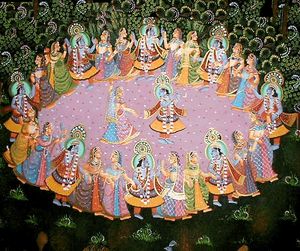
Such eroticized descriptions abound in scripture and Bhakti literature and Jayadeva’s lyrical work Gita Govinda is often cited for its highly graphic descriptions of ras-lila, or the divine love play between Krishna and Radha (see here for discussion on the music traditions of Gita Govinda; for further reading see The Divine Consort: Radha And The Goddesses of India).
There are no clear figures for the music sales of MS Subbulakshmi’s recording, first released in the 1960’s. Several music companies own licensing and distribution rights and no one has been able to make an estimate of how many units could possibly have been sold in pre-internet piracy days. The late singer had pledged the sales of the album to the temple but this data is not in public domain. It is popularly believed to be one of the most prominent and long selling recordings in India. There is a bronze stature of M.S.Subbulakshmi to be found in a prominent part of the temple town.
Devotional/spiritual and now ‘wellness’ music products is a huge category for music companies. Whatever the general trends in other categories may be, industry experts say that the sales of devotional music remain steadfast. One of the pioneers in this area is the late Gulshan Kumar, founder of the music label T-Series, who, ironically, was murdered in 1997 outside a temple in the northwestern suburb of Andheri in Bombay. Believed to be an extortion based contract killing by gangsters, investigating authorities accused a popular Bollywood music composer Nadeem, of having issued the contract. India has attempted to have him extradited from the UK, where he now lives.
Digital sales of devotional ringtones, ringback tones and mobile radio products is yet another major revenue stream.
*
The industrious god has been making money for a very long time now. Under the control of the Nawabs of Arcot in the 18th century, a leased management system was devised wherein the lessee Brahmin Amuldars paid a large sum in exchange for revenue collection at the temple, acquired via auction. It was next the East India Company that wrested control and secured the finances of the temple in 1748 CE. The company established newer administrative rules to streamline revenue collection. The changes that happened during the post-Vijayanagara and colonial period remained till the current temple trust was established in 1932. (See A Panorama of Indian Culture, Kusuman, KK 1990 and Burton Stein’s paper based on his doctoral research work, The Economic Functions of a Medieval South Indian Temple, 1958).
The power and influence associated with the temple is enormous. A complex blending of historic social and religious practice, the patronage of the rich and powerful, colonial administrative reform, and contemporary politics has bestowed the temple with incredible influence and power. To the faithful, it is the temple and the resident god that draws them there. Recently, the Tamil film superstar Rajnikanth offered prayers in thanksgiving following a bout of ill-health. The disgraced Kannada film actor Darshan, jailed for beating up his wife, is apparently planning a visit to alleviate his troubles. And bizarrely, the embattled ex-Samajwadi politician Amar Singh, also beset by many problems including ill-health and corruption charges, announced that he planned to ritually have his head tonsured at Tirupati to seek divine intervention on account of the fact that his astrologer had pointed out similarities with Adolf Hitler in his horoscope.
Faith is a complex matter. And a personal one. But as tales of venality and corruption appear on a daily basis, one can only wonder as to how cheaply we seek absolution. As to the surreal nature of public life in India – that's another story.