
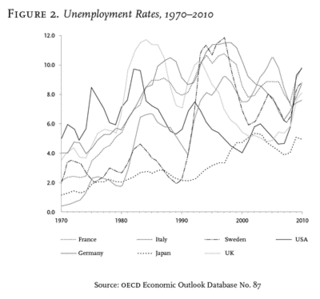
The collapse of the American financial system that occurred in 2008 has since turned into an economic and political crisis of global dimensions. How should this world-shaking event be conceptualized? Mainstream economics has tended to conceive society as governed by a general tendency toward equilibrium, where crises and change are no more than temporary deviations from the steady state of a normally well-integrated system. A sociologist, however, is under no such compunction. Rather than construe our present affliction as a one-off disturbance to a fundamental condition of stability, I will consider the ‘Great Recession’ and the subsequent near-collapse of public finances as a manifestation of a basic underlying tension in the political-economic configuration of advanced-capitalist societies; a tension which makes disequilibrium and instability the rule rather than the exception, and which has found expression in a historical succession of disturbances within the socio-economic order. More specifically, I will argue that the present crisis can only be fully understood in terms of the ongoing, inherently conflictual transformation of the social formation we call ‘democratic capitalism’.
Democratic capitalism was fully established only after the Second World War and then only in the ‘Western’ parts of the world, North America and Western Europe. There it functioned extraordinarily well for the next two decades—so well, in fact, that this period of uninterrupted economic growth still dominates our ideas and expectations of what modern capitalism is, or could and should be. This is in spite of the fact that, in the light of the turbulence that followed, the quarter century immediately after the war should be recognizable as truly exceptional. Indeed I suggest that it is not the trente glorieuses but the series of crises which followed that represents the normal condition of democratic capitalism—a condition ruled by an endemic conflict between capitalist markets and democratic politics, which forcefully reasserted itself when high economic growth came to an end in the 1970s. In what follows I will first discuss the nature of that conflict and then turn to the sequence of political-economic disturbances that it produced, which both preceded and shaped the present global crisis.