November 29, 2011
Giving thanks for error bars
Sean Carroll in Cosmic Variance:
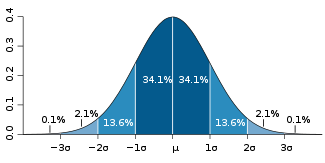
Error bars are a simple and convenient way to characterize the expected uncertainty in a measurement, or for that matter the expected accuracy of a prediction. In a wide variety of circumstances (though certainly not always), we can characterize uncertainties by a normal distribution — the bell curve made famous by Gauss. Sometimes the measurements are a little bigger than the true value, sometimes they’re a little smaller. The nice thing about a normal distribution is that it is fully specified by just two numbers — the central value, which tells you where it peaks, and the standard deviation, which tells you how wide it is. The simplest way of thinking about an error bar is as our best guess at the standard deviation of what the underlying distribution of our measurement would be if everything were going right. Things might go wrong, of course, and your neutrinos might arrive early; but that’s not the error bar’s fault.
Now, there’s much more going on beneath the hood, as any scientist (or statistician!) worth their salt would be happy to explain. Sometimes the underlying distribution is not expected to be normal. Sometimes there are systematic errors. Are you sure you want the standard deviation, or perhaps the standard error? What are the error bars on your error bars?
More here.

Posted by S. Abbas Raza at 09:59 AM | Permalink


Comments
The simplest measurement is to measure the straight line distance between two points. But even this example has errors. The errors first arise from the smallest division of the measuring rod, be it a crude ruler with lines every sixteenth of an inch apart, or a fancy laser beam. In the former example even the width of a line can become important if one is measuring a short distance. In general the error is always assumed to be at least plus or minus the size of the smallest division on the measuring rod. Often one can reduce this error by the process of estimation or interpolation.
Of course the measuring rod itself is subject to verification and in precision measurements must be checked or double checked or triple checked… against a known standard rod. The goal is to reduce the error to a small fraction of the measurement itself, say less than one ten thousandth of the measurement. But just because a device is used to measure with which reads out the result in a digital readout without errors noted, does not mean there are not errors; there always are uncertainties in every measurement, even ultimate quantum mechanical inherent uncertainties when small enough quantities are involved.
Posted by: WJAbbe | Nov 29, 2011 9:45:16 PM
In the above example, the distance measured was assumed fixed or motionless. More complicated situations arise when the quantity being measured varies with conditions and is not strictly repeatable under any circumstances. Human blood pressure measurements are such an example.
Here is a link to the definition of blood pressure in the human body: http://www.webmd.com/hypertension-high-blood-pressure/guide/diastolic-and-systolic-blood-pressure-know-your-numbers. Because the ordinary measurement of these quantities is based on qualitative estimates of sounds by a nurse or doctor listening on a stethoscope, this introduces errors into the results. Moreover, the results are reported in millimeters of mercury as calibrated on a dial instrument. These calibrations also introduce error into the measurement. One mm hg is a pressure at the bottom of a column of liquid mercury 1 millimeter high in a vacuum. For comparison, atmospheric pressure at normal T and P is 760 mmhg or 76cmhg.
Newer instruments for measuring blood pressure provide digital readouts of results with no mention of errors, but this does not mean errors do not exist in the measurements. For example, most instruments for measuring blood pressure state in instructions for their use for the patient to relax for about 20 minutes before making any measurements.
How many of you have been to a doctor’s office, asked to sit down, and the nurse or doctor immediately places the cuff on your arm to measure the blood pressure? They may even talk and expect you to respond while taking the blood pressure measurement. Most of the time these “professionals” don’t even follow their own rules. Such a measurement would likely give false excessively high readings because the doctor or nurse did not follow the correct instructions for making the measurement. Perhaps this is why so many people are diagnosed with high blood pressure today!
Posted by: WJAbbe | Nov 29, 2011 9:52:25 PM
Blood pressure is a constantly varying quantity with time. It rises almost instantly upon any physical activity of the body, even talking can increase it. Some patients even have “white coat syndrome”, and their blood pressure rises upon just the sight of the doctor or nurse in the room. Thus blood pressure, for all these reasons and the attendant errors associated with its measurement, is not a very useful quantity for medical diagnoses. Doctors have established various norms, such as 120 mmhg for the systolic and 75 mmhg for the diastolic or resting pressure of the heart, but these are only norms and must be used and interpreted with a grain of salt. Estimating precise error bars for a complex measurement of blood pressure is a very difficult and complicated problem and most medical “professionals” would not be up to this task. Ask your doctor if he or she could accomplish such a task next time you visit them.
To convert 1 mmhg to the usual units of pressure or force per unit area, the weight of a column of mercury a height H is the mass times the acceleration of gravity or the density times H times the area A times g the acceleration of gravity. The pressure is this weight divided by the area A; the result is H times density of mercury times g the acceleration of gravity. If H is in centimeters and density in grams per cubic centimeter, and g in centimeters per sec/sec, the result will be pressure in dynes per square centimeter. The pressure of 1mmhg is a relatively small pressure equal to 1/760 of a pressure of one atmosphere or normal atmospheric pressure under normal conditions.
Posted by: WJAbbe | Nov 29, 2011 9:59:07 PM
Post a comment