
| ABOUT US | ARCHIVES | LINKS | RSS FEED | MONDAYS | |

3quarksdaily

An Eclectic Digest of Science, Art and Literature

« Stephen M. Walt to Judge 3rd Annual 3QD Politics & Social Science Prize | Main | The Presidential Turkey "Pardon" as Dark Parody »

November 22, 2011

Egypt’s uprising happened when three distinct currents of protest—labor, professional, and popular—finally converged

Mona El-Ghobashy in the Boston Review:
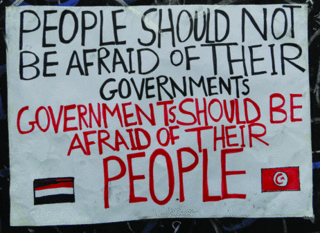
ScreenHunter_02 Nov. 22 11.07A revolution is inherently romantic, so it’s no surprise that Egypt’s has inspired exceptional narratives. Journalists saw something fundamentally novel in the eighteen days and the subsequent small-scale protests—“a new culture of street demonstrations,” said USA Today. The uprising became the defining event of Egyptian politics, a turning point separating before and after. Before, a brutal dictatorship maintained fear and silence. After, liberated citizens poured into the streets to exercise their freedom.

Against this temptation to cast the uprising as a watershed is the equally attractive idea that Egypt was ripe for revolt. In this telling, various public ills—rising food prices, unemployment, government corruption—are strung together into a neat chain that leads inexorably to social explosion.

But neither story does the revolution justice. The first erases the uprising’s pre-history; the second overdoses on the role of the past. Both conceal the very real contingency of the event, neither inevitable nor entirely alien to Egyptian politics.

Egypt’s was no cartoon dictatorship that indiscriminately banned protests. For at least a decade before Mubarak’s ouster, Egyptians were doing their politics outdoors. Citizens assembled daily on highways, in factory courtyards, and in public squares to rally against their unrepresentative government. Mubarak’s regime responded with a million-man police force that alternately cajoled and crushed the demonstrators. The goal was not to ban protests, but to obstruct any attempt to unify different groups and prevent sympathetic bystanders joining them.

Egypt’s uprising happened when three distinct currents of protest—labor, professional, and popular—finally converged.

More here.

Posted by S. Abbas Raza at 05:08 AM | Permalink

Comments

Post a comment


Subscribe to this blog's feed  

PayAnywhere with iphone credit card swiper

Android Tablet

Bluetooth Headset

2013 New Style Dresses

Compare Car Rental Prices

DHgate.com Wholesale

3QD on Facebook

3QD on Kindle

3QD by Daily Email

Receive all blogposts at the same time every day.

Enter your Email:


Preview 3QD Email

3QD on Twitter

Miscellany

Lijit Search

AddThis Social Bookmark Button

Add to Google

Recent Comments

Boursin on Why Rational People Buy Into Conspiracy Theories

Abbas Raza on Daniel Dennett's seven tools for thinking

X on Race Is Not Biology

Usha Alexander on Race Is Not Biology

jo smith on Mohsin Hamid: 'Islam is not a monolith'

araldo on Mohsin Hamid: 'Islam is not a monolith'

Dr. X, Ph.D. on Race Is Not Biology

jo smith on Physicists Create Quantum Link Between Photons That Don't Exist at the Same Time

jo smith on Mohsin Hamid: 'Islam is not a monolith'

omar on Why race as a biological construct matters

Dr. Smith on Race Is Not Biology

Sundar on Daniel Dennett's seven tools for thinking

Sundar on Daniel Dennett's seven tools for thinking

Sundar on Why race as a biological construct matters

Sundar on Race Is Not Biology

Joel Grant on Why Rational People Buy Into Conspiracy Theories

khaled on Evolution shapes new rules for ant behavior

musafir on Mohsin Hamid: 'Islam is not a monolith'

araldo on Mohsin Hamid: 'Islam is not a monolith'

JM on Physicists Create Quantum Link Between Photons That Don't Exist at the Same Time

SteveRR on Daniel Dennett's seven tools for thinking

jo smith on Mohsin Hamid: 'Islam is not a monolith'

Grace on Daniel Dennett's seven tools for thinking

Elatia Harris on Daniel Dennett's seven tools for thinking

Abbas Raza on Daniel Dennett's seven tools for thinking

Acclaim For 3QD


"I couldn't tear myself away from 3 Quarks Daily, to the point of neglecting my work. Congratulations on this superb site."—Steven Pinker, Johnstone Professor of Psychology, Harvard University.

"I have placed 3 Quarks Daily at the head of my list of web bookmarks."—Richard Dawkins, Charles Simonyi Professor of the Public Understanding of Science at Oxford University.

"Just wanted you to know I’m one of many who reads and enjoys 3 Quarks....almost daily."—David Byrne, musician, former lead-singer of the Talking Heads, artist, intellectual.

Read more here.

The 3QD Prizes

Subscribe to this blog's feed