November 07, 2011
An Indian-American in China
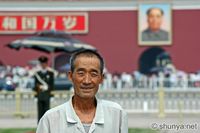
In a large mausoleum on Tiananmen Square, Beijing, lies a crystal sarcophagus containing the mortal remains of Mao Zedong. Every day, masses of Chinese citizens line up on this largest of the world’s public squares to view and pay tribute to him. An immense, framed portrait of Mao gazes beatifically upon them from the high walls of the once Forbidden City, a palace fortress at the edge of the square. A few years ago, I too had arrived hoping for a glimpse of the man—the spectacle of Mao’s refrigerated body held for me nearly as much morbid fascination as my interest in his legacy and place in the Chinese imagination.
As it happened, the mausoleum was closed for renovation. Disappointed, I mused that perhaps the real reason for closing the mausoleum was to hide the evidence that Mao had been turning in his grave of late: watching China grind from feudalism to communism to capitalism in a mere half century cannot be good for his repose. If “communism” means a classless society with a centrally planned economy in which the state owns the primary means of production, then poor old Mao—as the man who fought for it, forged it, and upheld it for decades—became irrelevant long ago. And though the frozen Mao may still be revered, the pulse of China throbs now to a different beat.
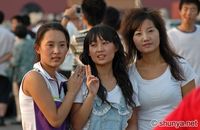
For some years now, the zeitgeist in China has been closer to what Deng Xiaoping, a successor to Mao, neatly voiced in 1993: “To get rich is glorious.” And today it seems that the only thing still communist about China is the name of the party that continues to rule it with an iron hand; for while China’s communist leaders have embraced capitalism with an astonishing zeal, they have not allowed the free flow of ideas and information within China. Ordinary citizens are actively kept in the dark even about the 1989 protests in Tiananmen Square. As I stood on the square, among the crowds of locals and holiday makers, flying kites or striking “I was there!” poses in front of Mao’s portrait, it struck me that most of the people around me—and most Chinese nationals under the age of 35—do not even know about the event that transpired there.
§
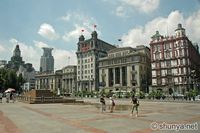
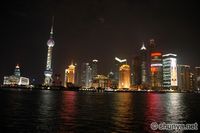
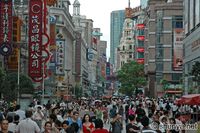
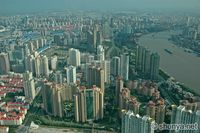
On the Bund in Shanghai, along the west bank of the Huangpu River, the morning sun illuminates the Victorian edifices from an era even before Mao’s time. These old buildings, once bold proclamations of European wealth and power, were the seat from which colonial men had exercised their commercial interests in China. England had made a killing pushing drugs, setting up opium dens, strong–arming the decaying, dissolute Chinese monarchy with firepower when they tried to outlaw the drug that was devouring their cities. Today those façades appear quaint and antique. Freshly scrubbed for tourists, they now overlook a wide pedestrian path that curves along the riverbank and hums with the traffic of families, lovers, and raffishly clad youths, chattering, snapping photos, sucking Coca-Cola, badgering their parents to buy all manner of trinkets and toys on offer, and generally basking in the glow of their emerging prosperity. Above them, shiny towers of glass and steel rise like a golden promise across the river in Pudong—which had been a sleepy farmland as recently as the 1990s—as if proclaiming the final victory of Chinese capitalist self-determination. After dark, the buildings become gargantuan video billboards and their spectacular display of lights over the river turns every Shanghai night into a gorgeous celebration of consumerism. Nearby on Nanjing Road, shoppers throng and bustle through the neon lanes. China’s pace and direction of change in the past few decades must surely astonish and bewilder all those raised under the shadow of Chairman Mao.
This was my first visit to China and, naively, I had expected it to look and feel more "Third World" and communist, and less like a shopping mall. Even after spending the first four days of the trip in Shanghai, I still believed that once outside this flagship city of modernity, the "real" China would present itself, someplace more like India: mired in insatiable poverty, broken and crumbling yet reverberating with ancient history and flamboyant diversity. But, in fact, none of this proved to be true—for better or for worse, quite the opposite.
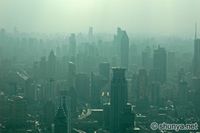
Travel in China is much more comfortable than in India: Roads are modern, wide, and in good repair. Buses are comfortable and dependable, usually air conditioned, and not over-stuffed. Trains are clean and relatively roomy, with proper waste disposal. In fact, everywhere we went, even in the smaller cities, there was little evidence of the physical decay one sees in India. China’s infrastructure is modern and fully-functioning; power is reliable; water is plentiful; though the air is quite foul with industrial pollution—probably worse than in India—city streets are free of trash and frequently lined with trees and bushes; stray dogs and livestock are nowhere to be seen.
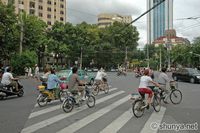
Gone are the days of those famous photos featuring four lanes of wall-to-wall bicycles crowding the city streets. The average Chinese urbanite today is far more likely to drive a moped or motorbike, or perhaps one of the tiny, three-wheeled cars fondly referred to as "mice." The streets of mid-sized cities are rapidly filling to capacity even with four-wheeled compacts of Chinese make, while Shanghai and Beijing brim with GMs and Toyotas. The Chinese automobile market (currently equivalent to that of the US and growing) is ten times that of India’s. Compared to India, the Chinese middle classes are huge; at least in the urban areas, they would appear to be the overwhelming majority. And while the middle-class Chinese still don’t have the purchasing power or living standards of the middle-class American, I found it far less common to see anyone begging or sleeping on the street than one ordinarily sees in any US city. But this turns out to be one of the "mixed blessings" of authoritarian rule, Chinese style: housing for migrant workers is strictly regulated, both ensuring a certain minimum civilized standard of living and preventing the development of slums while restricting the internal migration of citizens—something unimaginable in India.
Still, it’s true that the rural areas are a different world from the cities. For one, I didn’t see many cars in the agricultural villages we glimpsed along the highways between Xi’an and Beijing, a distance of at least a thousand kilometers (a similar distance from Bombay to Delhi or from Chicago to Washington, DC). On the other hand, I noticed only a single instance of anyone riding a mule-cart or any animal-powered vehicle. The otherwise bucolic countryside was also dotted with scores of belching factories and proud power plants: I counted what appeared to be half a dozen nuclear power plants just along the roads we took. Yes, there’s poverty in the villages compared to the cities, but in magnitude, depth, and desperation, it simply doesn’t compare with that in many Indian villages.
For me, the most enjoyable aspect of the trip was the challenge and opportunity presented to communicate with people across an immense language gap, for I speak not a word of Chinese and English has little penetrated China. Staring at Chinese writing without a key left me mystified, my mind twisting into knots trying to imagine how complex ideas are communicated through them.
But in the pursuit of a vegetarian meal, a bus ticket, or a night’s lodging, I got to experience the patient warmth and good–humored curiosity many Chinese displayed toward me and my partner, both as outsiders and as Indians. Wherever we went, people wanted to chat—or at least try. Ordering a meal in a restaurant typically provided amusement not only for the clutch of waitstaff who gathered around, but most other diners in the establishment, as well. We never were sure what we would get until it arrived at the table. Whenever we needed directions or assistance, bystanders patiently worked with us despite the communication gap. They all seem to have missed the memo that India and China are officially not on the friendliest of terms.
As an aside, I also noted the utter lack of suspicion against my dark skin color. Generally anywhere I’ve lived or traveled within the lighter-skinned world, I’ve sensed some level of reflexive fear or aversion to dark skin, some groupthink, subrational discomfort that usually persists below the awareness of those who possess it. Even when it’s not overt or aggressive, it’s nearly always there, a subtle anxiety. I’ve taken it as a given in the world. But in China, I sensed no such thing; this took me entirely by surprise. While the Chinese expressed a good deal of wonder toward us as Indians, their curiosity seemed untainted by primitive fears or unseemly stereotypes. Quite the contrary, it was surprising how many people simply related to India as the land of the Buddha, a figure clearly held in high esteem, despite whatever prohibitions there may be against religion.
§
India and China are frequently contrasted these days, as two emerging powers of a future age. On one side are always tallied the superior state of China’s infrastructure and literacy, its dependable electricity, smooth roads, clean cities, the ubiquity of women in middle-class employment, and the way even monumental public projects just get done—while India languishes in chaos and illiteracy, with bad roads, crumbling buildings, insufficient power and water, poor healthcare, obstructive bureaucracy, and much more limited economic opportunities for women.
On the other side are listed the near anarchic freedom of life in India, its free media, tolerance of dissent, and independent judiciary. The idea of using the vote to attain one’s ends and resolve disputes between groups is now deeply embedded in the Indian psyche, and a plethora of political parties compete for votes. Traditional culture and religion are allowed to flourish even as new ideas catch fire, fueling freewheeling social and political change—whereas, the Chinese government systematically uproots and squelches tradition (as in Tibet and with the Falun Gong), censors information from internet search engines and other media, silences its political dissidents, tightly regulates the movements of its citizens within the country, and inflicts draconian punishments—averaging 10-15 executions a day (down from over 25 a day in 2005), even for relatively small crimes.
Despite their shared cultural heritage, the two nations, far from being similar, are almost inverse images. But which is the positive and which is the negative will depend upon your perspective. I abhor the lack of free speech as much as the next person, but as an Indian friend who lives in China pointed out, sanitary public trains, reliable electricity, good roads, and adequate plumbing are not to be minimized as elements of the public good, perhaps more tangible to many even than India’s free speech. Indeed, one wonders if this kind of material comfort has ultimately worked as a palliative against a louder cry for democracy in China. How many Indians would gladly trade their lots for those of the Chinese?
What historical accidents might explain the divergence between these neighboring lands? How much can be attributed to Mao and the decades of communism that he infused into Chinese society? Can it be simply that China’s shiny exterior is a result of its centralized, authoritarian, top–down administration—one that’s not too squeamish to sacrifice a few heads as part of their structure of incentives and disincentives? Or is it more likely that their current realities reflect much deeper and more essential differences in their cultural substrates, forged over long stretches of history, making facile comparisons meaningless? What is certain is that these two ancient peoples are on very distinct paths, politically and culturally. Both journeys will be fascinating to witness.
_____________________
Usha Alexander is a writer, instructional designer, and erstwhile student of anthropology and natural sciences, and currently lives in the San Francisco Bay Area. Only the Eyes Are Mine is the title of her first novel.
Posted by Namit Arora at 12:25 AM | Permalink


Comments
A strange experience reading this. There is so much information available on China, that it's surprising what the author is surprised at. But innocents have been travelling to China for centuries upon centuries and misreading what they think they are seeing. It comes off a bit quaint, this innocence. But I almost don't want to argue with her perceptions/misperceptions--I was young once too, and travelled.
Posted by: amalia | Nov 7, 2011 9:47:53 PM
Is there really a trade-off between personal freedom and clean toilets? Somehow, the conclusion sounds rather naive. On a recent visit to China I came away with a different impression - young people were freely discussing Tianenmen Square incident and were even criticising the Cultural Revolution. I also heard about the execution (of corrupt politicians and civil servants) How I wish we could borrow just that one bit of reform - I bet we will have good roads and clean toilets!
Posted by: R Paniker | Nov 8, 2011 1:43:36 AM
R Paniker,
Ignorance and misinformation about Tiananmen is very real in China, even in Beijing. Check out this article too, which claims that "the country itself is almost entirely unaware of [the Tiananmen massacre] ever taking place, as the authorities have extinguished close to all information about it from the internet". Or check out this short video clip from PBS's The Tank Man.
Have you read Smoke and Mirrors by Pallavi Aiyar (2008)? She was a journalist in Beijing for many years, taught university students, and speaks fluent Chinese. An account of her time in China, the book brims with perceptive observations of people across many walks of life. For a TV story, she "spent hours interviewing a random selection of ten students" on the Tiananmen protests.
And how did you conclude that the essay is suggesting "a trade-off between personal freedom and clean toilets", rather than talking about some differences between India and China as they are?
Posted by: Namit | Nov 8, 2011 3:13:36 AM
"Once again, I was confronted with a situation in which my brightest students presented what was in fact official propaganda as self-drawn and carefully considered conclusions of their own"
There is an exact parallel here with the mainstream acceptance of the "official propaganda" regarding 9/11.
Posted by: J. Hawkins | Nov 8, 2011 10:52:19 AM
To Chinese people, their country suffered greatly from the invasion of foreign countries, civil wars, famines and cultural revolution with millions of death. A MERE political unrest of 1989 is NOT worth of reminding everyday! Not to mention that the unrest was secretly organized by the western countries (mainly US) with an evil intention to take down China as they did to Soviet Union during the same period of time. Fortunately China stood firm and united. Ordinary Chinese people can't imagine what China would be like if the Western backed political riot succeeded in 1989.
Posted by: Coolcharm | Jan 4, 2013 10:46:56 PM
@Coolcharm. Is there any evidence of US backed conspiracy? Or is this more of the Party line? I feel it is perfectly reasonable to see a US hand involved, but I am more inclined to think a margin of Chinese society wanted to see real reforms and democratic change. To simplify it in such terms is to belittle the Chinese people. It's really no different than the brainwashed masses of USA painting all of the Middle East, Saddam Hussein, Osama Bin Laden, or Iran as some how the axis of evil. It is the scarecrow--the external terror--designed to divert attention--pay no attention to the man behind the "red" curtain.
@Usha Alexander. I don't know where you went in China, but you clearly deny the China I see everyday. The streets are disgustingly littered with trash, and the trains are filthy. The toilets deplorable. Stray animals are everywhere, neglected, and often abused. I've seen animals butchered, drowned for fun, kicked around as footballs in bags, pet dogs flogged with slaver-type whips, and most often, tied by the neck to extremely short ropes and forced to hang-sit day in and day out in the same place, as pets, in front of shops. I suggest taking a few steps off the tourist polished streets of downtown areas, and leaving such cities as Shanghai and Beijing. Most of China is filthy--not just the air and water. The food is inedible--contaminated. Shoelaces in the yoghurt, for example, or industrial salt used for table salt in processed foods such as pickles. These are not flukes but normal, commonplace, and widespread. The street is used as the trash heap and they are perfectly fine living in it. Cockroaches scurry over diner plates in public eateries. Rats are kicked around by chefs in cafeterias/food courts, utensils completley unwashed. I've witnessed babies encouraged to urinate and defecate in restaurants on the floor beside me. The street is commonly used as a toilet in public by children, babies, and adults. Gobs of mucusy spit decorate the streets, and public buildings, most prominently on staircases in any public building, administration building, office building, mall, etc. I've watched countless times as Chinese tourists deliberatley throw plastic rubbish into "scenic beauty spots" of natural areas they paid enormous fees to see. Nature preserves littered with the same trash one finds in the urban junkyards. It always amazes me how Chinese enthusiasts in the west apologize for China continually and never see what is front of their faces, choosing only to glorify what really doesn't exist. This article could easily have been written by a fledgling journalist parroting mainstream cliches without ever having set foot in China. I suggest living here for more than a few weeks at a time. See China, not the stage presented for you.
There is a lack of empathy in China that is astounding. And those that choose to reach out in their communities are shut down by the government.
Plagiarism is mainstream and original work is unheard of and discriminted against--censored and discouraged. There is No academic culture whatsoever. Academics are given qoutas--publish 8 articles a year, but the so-called academics dont actually write the articles--they pay ghostwriters to originate ideas, develop the thesis and write the article, even publish it--with magazines that the writer pays to published in. Everyone is doing it and everyone is aware of it and nothing ever changes. It's an industry of fraud and money is being made by everyone except the academics (unless you consider the money they make dipping their hands in the government cookie jar for "academic projects" which never manifest--except in the form of BMWs for lowly teachers.
Fascism is once again creeping into mainstream thought, and "academic" journals. It is everywhere, but always so cleverly disguised.
Posted by: Hóng kuākè | Mar 24, 2013 1:50:50 AM
Post a comment