
October 22, 2011
Should Occupy Wall Street Go Rawlsian?
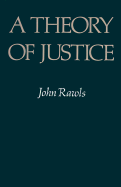
Steven Maize argues the case in the NYT's Opinionator:
To their credit, protestors have recently begun debating which specific demands the movement should make, but their conversations appear to be unguided by any deeper wisdom. A perfect intellectual touchstone would be the work of John Rawls, the American political philosopher who was one of the 20th century’s most influential theorists of equality. Rawls named his theory “justice as fairness,” and emphasized in his later writings that its premises are rooted in the history and aspirations of American constitutionalism. So it’s a home-grown theory that is ripe for the picking.
Despite providing a remarkable venue for what Al Gore called a “primal scream of democracy,” Occupy Wall Street is leveraged too heavily on the rhetoric of rage rather than reciprocity. Rawls would argue that Occupy is fully justified in its criticism of the political and economic structures that propagate massive concentrations of wealth; he saw the “basic structure” of society as the “primary subject of justice.” But Rawls would lament the tendency of the “99 percent” to misdirect their energies into hatred of individuals in the 1 percent. He would have them save their hostility for the policies and institutions that have permitted only the wealthiest to enjoy significant gains from the past two decades of economic growth.
Rawls’s boldest claim — that inequality in society is only justified if its least well-off members fare better than they would under any other scheme — could provide a lodestar for the protests. Rawls was no Marxist: this “difference principle” acknowledges that a productive, free society will be home to at least some degree of inequality. But the principle insists that if the rich get richer while wages and social capital of the poor and middle class are stagnant or falling, there is something seriously wrong.
Posted by Robin Varghese at 07:36 AM | Permalink


Comments
"But Rawls would lament the tendency of the “99 percent” to misdirect their energies into hatred of individuals in the 1 percent. He would have them save their hostility for the policies and institutions that have permitted only the wealthiest to enjoy significant gains from the past two decades of economic growth."
The legal fiction of calling corporations "people" was recently in the news, and is counter to the American concept of justice that individual people should be held accountable for their own wrongs, not for any wrongs of other individuals.
Only those of the 1% who have done wrongs are targets of OWS in that sense, which would equate to some of them rather than all of them.
The hypocrisy of institutions like the press, which is composed of individuals, that hawk a plutonomy as the best in the world is manifest now.
Those individuals should be fingered for their personal wrongs, such as the Murdoch gang. Don't throw the institution of the free press out with the dirty Murdoch bath water.
A February 2010 issue of the Journal American Behavioral Scientist indicates:
"The first step toward SCAD [State Crimes Against Democracy] detection and prevention is facing up to the nature and magnitude of the threat. Recently, many mainstream scholars and journalists have concluded that American democracy is becoming increasingly corporatist, imperialistic, and undemocratic ...
However, mainstream authors have seldom considered the possibility that authoritarian tendencies in American politics are being systematically engineered by top-ranking civilian and military officials. Rather than thinking in terms of high crimes, their diagnoses have blamed abstract institutional weaknesses or isolated failures of leadership."
(State Crimes Against Democracy). Targeting institutions has its purpose, but holding individuals accountable is a fundamental principle of democracy that makes it work.
Posted by: Dredd | Oct 22, 2011 9:47:17 AM
We were also curious about this question, so we sat down with Professor Joshua Cohen of Stanford to talk about John Rawls and Occupy Wall Street. You can hear the discussion at http://occupytheairwaves.com/ep6
Our podcast is also on iTunes.
Posted by: Occupy the Airwaves | Nov 8, 2011 9:37:45 AM
Post a comment