
by Hartosh Singh Bal
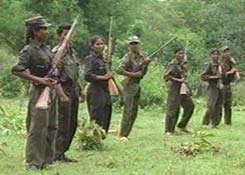
Till recently the outside world had paid little attention to this conflict which stretches through a large part of the forested belt of central India, a belt also occupied by forest-dwelling tribes subsumed under the label `tribals’. As narratives of an emerging, liberalizing India have lost their novelty, correspondents both foreign and Indian have suddenly discovered a counter-narrative in the Maoists. Unfortunately though, the tribals already badly done in by the Indian state and the Maoists are being used again, as props in stories that show them as noble savages rescued from exploitation by gun-wielding Marxists.
The problem with such a description is not what it says about the Indian state. An incompetent and arrogant minister in-charge of internal security P. Chidambaram, who enjoys the confidence of the Indian Prime Minister Manmohan Singh and more importantly the leader of the Congress party Sonia Gandhi, has over the past year planned and implemented a campaign against the Maoists. While the Army has been kept out, paramilitary troops, ill-trained and ill-equipped for jungle combat, have been thrown against the Maoists. Easy targets for the guerilla fighters, they have vented fury against local tribals who they believe may be helping the Maoists.
In a complex arrangement mandated by the Indian Constitution, these forces have had to work in coordination with local police forces who do not report to the national government. Responsible for normal day to day law and order, the local police have often invoked serious charges such as treason to pick up activists under flimsy pretexts. In the Indian state of Chattisgarh, which is at the heart of the conflict, the local administration has backed the formation of a local tribal militia to combat the Maoists. The militia has since been declared illegal by the Indian courts. All these three forces, paramilitary, local police and the militia have been responsible for numerous incidents of rape and cold-blooded murder.
All this put together makes for a damning portrait, and much of the criticism on this count is not only correct, it is necessary. The problem though lies in how this same criticism has often tended to view the Maoists and the tribals.
The Maoists have committed every crime the security forces have and worse. Decapitating and mutilating bodies, training and using child soldiers, assassination of civilians who are then dubbed `collaborators’, setting up and running kangaroo courts where summary executions are carried out, yet they retain a romantic appeal for a certain section of activists and intellectuals.
This though has always been true of left-wing atrocities over the past century. Left-wing dictators and murderers have always generated far more sympathy among intellectuals than barbarism of any other sort. While the idea of revolution has run its course in most places, Indian intellectuals and activists still owe a great debt to their Marxist training. Even when their avowed intention is to work for rights guaranteed by the Constitution, the idea of the revolution remains a constant attraction.
Much of the current discourse on the Maoists derives from accounts such as the one Arundhati Roy penned for the Indian magazine Outlook and the UK daily Guardian. It is worth looking at the report in some detail.
The account commences, “The terse, typewritten note slipped under my door in a sealed envelope confirmed my appointment with India’s Gravest Internal Security Threat. I’d been waiting for months to hear from them. I had to be at the Ma Danteshwari mandir in Dantewada, Chhattisgarh, at any of four given times on two given days. That was to take care of bad weather, punctures, blockades, transport strikes and sheer bad luck. The note said: “Writer should have camera, tika and coconut. Meeter will have cap, Hindi Outlook magazine and bananas. Password: Namashkar Guruji.”
Throughout the length of this account what is missing is the simple acknowledgement that only select journalists and activists are `invited’ on such a journey into Maoist territory. Their records are scanned, their commitment to the cause checked, their ideology vetted before such an invitation arrives. It does not matter if a journalist has been critical of the government, what does matter is that the journalist must have demonstrated visible sympathy for the Maoist cause.
The journey into Maoist territory is made under armed escort, a pre-determined route is followed, independent conversations with tribals in the absence of the Naxal armed escort rarely if ever take place, which is why it is no surprise that Arundhati’s reportage contains less skepticism than pieces written by embedded journalists with the US Army during the invasion of Iraq. It is easy to look through her writings before this report to see how she only managed to confirm what she had already come to believe before venturing into Naxal territory. It is difficult to imagine that over 60,000 sq km there did not exist a single tribal who was not a Maoist or did not have a critical word to say about them.
Even more problematic though is how the relationship between the Maoists and the tribals is described. It is made out as if the Maoists entered this area to protect the tribals from exploitation. It is true the exploitation of tribals in the regions where the Naxals are operating is no myth. The Naxals have systematically used this to build up their strength, at the same time setting up a parallel government that survives on money extorted from corporates and businesses operating in these areas which contain some of the richest reserves of mineral ore.
But for the Naxals, much like the corporates, the tribals are merely another resource to be used. There is ample Naxal literature available and their constitution is rather clear: ‘The ultimate aim or maximum programme of the party is the establishment of communist society…. Encircling the cities from the countryside and thereby finally capturing them will carry out the Protracted People’s War. Because the armed struggle will remain the highest and main form of struggle… hence armed struggle will play a decisive role.’
Their literature contains only stray references to tribals. The Naxals themselves do not see themselves as defenders of tribal interests. For them the category tribal does not have a meaning. According to their constitution, ‘Marxism-Leninism-Maoism is the ideological basis guiding its thinking in all the spheres of its activities.’
Despite thirty years of the Naxals operating in the tribal regions, enough time to educate two generations, the decision making cadre of the Maoists is almost entirely non-tribal. It is the the foot-soldiers, the people who die in their battles with the state who are almost all entirely tribal. And even this fact conceals another truth, a majority of the Maoist may be tribals, it is not even close to true that a majority of the tribals are Maoists.
To separate the tribal story from the Maoists requires stepping back and taking a much wider view. The problems though begin with the use of the very term tribal, the tribes so defined have no larger sense of being `tribals’. They differ significantly in terms of language and culture. In central India alone tribes speak language spread across three major language grouping – Indo-European, Dravidian and Austro-Asiatic.
The tribal story is many different stories. Consider the case of just one single story. The area of Chattisgarh where Arundhati ventured is largely inhabited by the Gond tribe. Again tribe in this context can be a misleading word for people who bring notions from other parts of the world. The Gonds in Chhatisgarh alone number more than two million and another four million inhabit the neighbouring state of Madhya Pradesh (MP).
In the thirty years of Naxal presence in Bastar the region has gained little, which as Naxal sympathizers argue does not absolve a government which had done nothing in the thirty years before the Naxals gained control. But the problem with such an argument is that it denies the possibility that the Gonds in this time may have moved to wield more control over their immediate surroundings as they have done in neighbouring MP.
In the past two decades the Gonds have virtually come to control democratic politics in the regions of southern MP where they are a majority. The national parties such as the Congress and the BJP field Gond candidates and Gond leaders now are becoming far more of a presence in the party hierarchy. A party of their own called the Gondwana Gantantara Party (GGP) has grown substantially sending a few legislatures to the state assembly. The same local police and businesses once seen as oppressors now often do the bidding of Gond politicians. There is a cultural resurgence and a renewed assertion of Gond identity in this region.
The Gonds here once ruled a large section of this region, building forts and establishing kingdoms much in the pattern of their neighbors. This exchange over centuries had meant that the Gonds of Madhya Pradesh who first encountered the Mughals and then the Marathas were better prepared to cope with the outside world as compared to the Gonds of Bastar who tend to retain an anthropological `authenticity’, though it is worth asking what tribal authenticity can mean when it is laced with `Marxism-Leninism-Maoism’.
But the linkages between the Gonds across the region remain strong and such a process could have been aided by what had happened in southern MP. It was not the government that stood in the way, it was the Naxals. The GGP has no liking for the Naxals and it is this Gond resurgence which in great measure has virtually stopped the spread of the Naxals upwards into the contiguous regions of southern MP where the Gonds constitute over 60 per cent of the population.
Much of this is never reported and remains news to commentators in Delhi. The stories that get play are the kind Arundhati has reported, the ones where reporters paradrop into the situation and report with sympathy on romanticized rebels. The big picture is about slow change and small gains, it yields no front pages, no publicity and perhaps worst of all it questions the very idea of revolution.