
by Maniza Naqvi
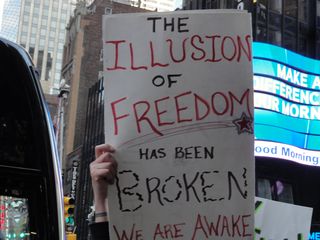
“@Time Square.”
Brian texted back: “Also.” But we were on opposite sides of the street and the police barricades were making it impossible to crossover.
The police, in their blue uniforms, wielding batons and shields, wearing bullet proof vests and helmets and even mounted on horseback strutted up and down several block of Broadway at Times Square as though they were on a catwalk of power showing off to the crowds their latest toys for holding back the crowds. Why on earth would they be on horseback in this day and age if not to show that they were capable of trampling people the good old fashioned way? “Beachwear!” Someone in the crowd shouted invoking the Wendy’s ads from decades ago which poked fun at the totalitarian State of the Soviet Union and its lack of imagination. I looked up at the hundreds of dazzling almost blinding electronic billboards over Time Square and realized the joke went even further. The Billboards overhead were selling only one product—discontent—eat this—drink this, wear this—listen to this, watch this—consume, consume, spend—spend–spend and you will be happy!
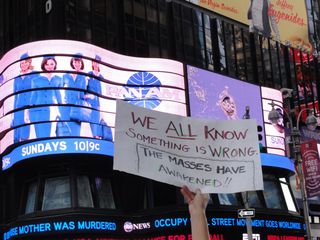
The protesting crowd good naturedly teased the posturing of the police “Join us! Join us!”Some of the cops smiled back awkwardly others pretended to be unfazed and tough, while others in white shirts looked as mean and tough as they were. In age and anxiety they mirrored the protestors. Whether a protester or a policeman—it seemed clear here that everyone needed to earn a paycheck. The men and women constituting the police force and the protesters shared the same issues of eroding salaries, pensions, social security and rising costs of mortgages, taxes and health insurance. The cops in their blue shirts or white shirts—outfitted with guns, batons, taser guns, pepper spray, plastic and metal handcuffs, walkie-talkies and the protestors accessorized with cardboard placards, American flags, cameras and ideals seemed equally like puppets in an elaborate street theater: as if all were bit parts in an overwhelming landscape of billboards flashing, blinking and winking while the ticker tape circling above announced “Occupy Wall Street Protests Goes Worldwide.” Thousands of cameras were flashing along with thousands of cell phone and video cameras and cameras of all sorts. Security surveillance cameras were everywhere in probably the most densely monitored, square in the world. A giant billboard in fact was flashing back our filmed images on a screen across from us along with a clothing advertisement. In itself, it was a slogan for the privatization of the State’s writ on infringement of privacy.
People, protests, property, parks, public, private, police, prisons, press, politics and permits. To those who are tone deaf these sound like disparate slogans. But the Occupy Wall Street protest movement across the country and across the globe has shown that these are all issues that can be funneled into one or two over arching concerns.
An overarching issue is the public versus private ownership in everything from police to politicians to parks to property all over the planet in its cities and its villages. Whether it is a military or it is police the purpose seems to be to serve this end of privatization.
The reaction by the law enforcement agencies to the protests have proven that people protesting the occupation or privatization of public property are viewed as criminals by the privately owned 21st century state. In Times Square it felt like the eleventh hour in terms of urgency with people protesting this alarming trend. In the eleventh hour of the 21st century in Times Square: I watched the police pushing the barricades even further in on the sidewalk cramming the demonstrators even further on an already narrow space and creating a potential crisis if the crowd got jammed in and someone fell or a stampede broke out because of all the police on horseback. The police steadily pushed back the barricades and diminished the space where protesters could stand and it seemed that the cops by doing this were forcing the crowds to overflow onto the street and creating the pretense for arresting people for not remaining within the designated area for the protests. As I watched this situation at Time Square I thought of all the fences and blockades and barricades in other parts of the world where people are squeezed off of their lands—their homelands—their homes razed to the ground and bulldozed turned into private properties—while the people are forced into dangerous environments—flood basins or coastlands or unwelcoming hostile cities in their own or foreign countries—in the path of disaster—or into cities where they have no chance of incomes—living in ghettos—begging, living on the streets homeless—only to be further abused and harassed by police and militaries.
This is a global trend of a not so slow and steady move of diminishing public space, this creeping movement to eradicate the public. Now it’s all about this isn’t it: the privatization of public goods and the use of police to protect private property? The protesting of this without a permit is considered a crime.
“The greatest thing in the world is happening in the greatest city in the world!” I said to a rookie cop who looked as though he was seventeen and had just been pressed into service at the last moment. He seemed unsure and nervous as he faced the crowds—plastic handcuffs in bunches dangling from the hooks on his belt, on the ready. He smiled tentatively, nodded “Yes!” He said as if awestruck. “Yes!”
“How many people do you think are here today?”
He replied: “Thousands and thousands—a lot!”
I kept an eye on the police line on the other side of the street where the cops were steadily pushing the barricades further into the crowd steadily increasing their space while narrowing the space allowed to the protestors. I thought back to a overcast Spring day eleven years ago when I first learned that in the US a permit was required to protest. It came as a shock and as a ridiculous idea—why would anyone protesting, have to first get a permit—what if they were protesting the State? I realized that freedom of speech and freedom of movement required a permit if you planned to protest. It was a weekend in Washington DC—and on my way from my office I had stopped to watch protesters on Pennsylvania Avenue. Demonstrators were protesting against many issues including the IMF and the World Bank. This particular protest, on April 15, 2000, was against the Prison Industrial Complex. The police was so heavy that the protesters were forced off of Pennsylvania Avenue and away from the IMF and World Bank building on to 20th street between I Street and K street. I walked on the sidewalk alongside the protest march onto 20th street. Kids with multiple tattoos, and multiple colored hair dyes were dancing to the beat of multiple drums—it was delicious—a gorgeous sight. I was thrilled. Suddenly I noticed that a police line in riot gear–helmets, batons, guns in holsters with a wall of shields in front of their bodies were blocking off the entrance to the street from Pennsylvania Avenue—a similar line was forming at the entrance to K Street. I kept asking “What’s happening? What’s wrong?” I was told by the protesters that they didn’t have a permit to protest on this street. The protesters were about to be arrested on this technicality that they were in a space—for which they did not have a permit to protest. They had a permit for Pennsylvania Avenue but not for the side streets. The police had managed to force them on to the side street and then corral them in.
I and over 700 other people had been imprisoned in on 20st street. I made my way through the protesting, cheering, dancing crowd towards the K street line of police and as I approached the line a policeman barked at me: “Stand back! Don’t take another step forward! Get back!” He raised a baton towards my head as though he was going to strike me. It was a frightening moment for me. I backed away instantly —astonished and scared. A couple of hours passed by as I sat in the middle of the street talking to a group of kids about my work on community development and safety nets. We talked about how important it was to have such street protests which were vital to those people even on the inside who wanted to reform an entrenched system. Then I noticed that the young protesters were beginning to pass around marker pens and were busily writing phone numbers and names on their forearms. I asked them in a panic what they were doing and they told me that they were writing the phone numbers of lawyers. They would be allowed one phone call each once they were arrested.
“Arrested! Arrested?” I protested—“This will be a disaster for me!” I’m not a citizen! I work for the World Bank” I pointed towards the buildings nearby.” And much as Mr. Wolfensohn will love my mingling with you guys, I could get into big trouble!” The young protesters I had been talking to looked at me worriedly. One purple haired guy said, “C’mon lets go explain your situation to the police, do you have any identification on you?” Luckily I had. I walked back to the police line accompanied by the young man and again as we got near enough a baton was raised. “Wait” I shouted “Wait!” I thrust the blue identification document forward. Immediately the baton was lowered, the shields parted and the same arm that had raised a baton aimed at my head now was put protectively around my shoulders and I was yanked forward away from the young protester who had accompanied me and onto the other side of the barricade. Now a fastidious—solicitous tone more appropriate to a nanny was applied to me: “Ma’am are you alright? What were you doing getting caught up in there like that? You could have been hurt in there…you should have identified yourself sooner!”
The protesters who were protesting the Prison Industrial Complex had been imprisoned on their street in their capital and were about to be arrested there for protesting. I stood in astonishment watching more than 700 kids being arrested and put on waiting buses. I stood on the sidewalk with members of the British press—we laughed about how the DC police chief had effectively created 700 committed protesters and how tonight new loves would start and heroes would be made. Many of us watching seemed to be looking on nostalgically but I stood there repeating the same question: “You need a permit to protest?” A decade later those very kids and bystanders won a class action suit against the DC police in the amount of US$13.7 million or about US$ 18,000 each for the entrapment that day of pushing them off of Pennsylvania where they had a permit to 20st street where they did not. The class action suit was for the defense of the first amendment right to free speech. They won and got US$13.7 million or US$18,000 each.
Did the settlement in favor of those who were arrested, for protesting show that they system worked and it was okay? For the system, yes it was okay. The system worked—the system hired lawyers, who earned fees for winning cash compensation for those who were arrested. The system transacted in the manner it was set up for. However, would it not have been more important to not have argued or settled for a monetary compensation—but rather for freedom of speech and the abolishment of permits for protest?
Eleven years later, on a fall day in another season of protests with at least three wars underway overseas, and an economy in crisis, a private security guard forced a friend and me off of the steps of an adjacent building to the Zuccotti Park. I was reading a poem and Eva, a young film maker was filming me—Zuccotti Park was in the background. It was the day when the City, pleading hygiene concerns, had said the park needed to be cleaned by its private owners implying that the occupiers would have to leave it or be forced out. Earlier the two of us had been sitting on the steps discussing what to do—whether to interview random occupiers to create portraits of their concerns or tape my reading of a poem that fit the occasion.
Eva asked the guard “What have we done? Do all these people standing around here work in this building—where’s the law that says we can’t stand here—look over there there’s a guy with a camera and there and there and there—why aren’t you telling them to leave—and that’s guy?”
“Are you giving me attitude? Are you going to argue with me? Get out of here!” shouted the security guy.
“Come on Eva let’s move—don’t argue.” I said. Here we were with dozens of police cars and hundreds of policemen standing nearby focused on peaceful protesters as a private security man pushed us off of the steps at the exterior of a building next to Zuccotti Park. Could he do that? And while Eva was asking him to provide evidence that he had the right to stop us and push us off and make us leave—I was pulling at her while trying to placate this man.
“Can I read you my poem?” I asked him trying to soften his tone. Again I found myself flirting with power instead of protesting it. What was I going to do? Focus on a reading of poetry to this thug while he read us the Riot act?
“No!” He growled, “Leave right now! Get off this— get off this is private property, move right now!”
Eva stood her ground and repeated her demand of wanting to see the rules and signage that prevented her from being where she was and doing what she was doing. I grabbed her arm—and dragged her down the steps with me. As we crossed the street passed the line of police cars, passed cops, passed the police tower to the park–my knees shaking, I said to Eva trying to reclaim a level of self control and dignity, “Always flirt first with authority, try that first, it can be disarming.”
She glanced at me askance.
I went up to two cops in NYPD uniforms—I told them what had happened and asked them if we had done something illegal by standing on the steps—reading poetry, and videoing the process. No said the cops, then one of them waved at the protesters around us—and said—“It’s because of this—that’s why the guy didn’t let you stand there and do that—best for you not to do that there.”
Eva and I proceeded with our portraits—it was the afternoon of Thursday October 13, 2011. The protestors were facing eviction on the pretext and excuse that the park needed to be cleaned by Brookfield properties its private owner. The accuracy of this claim that the park was privately owned was brought to light as a result of this situation. It was unclear whether Zuccotti Park and other parks were private or public and how they had been transferred from being public spaces to private ownership. The occupation was entering its fifth week. The chances that they would face police brutality the next morning if indeed the eviction went forward as planned seemed to loom large and even if they managed to win the day and stay on which they did, they would face it another day. Then there was the fact of snow which surely would arrive soon enough as a natural evictor. What did the protesters expect to achieve? What were their demands? This was not the point in this moment. The point was what was already fully demonstrated by the protests and what had been revealed through this protest. What would be achieved was what was revealed. The protests would show the type of violent push back (“the oddity of a Marine who faced enemy fire only to be attacked at home” by law enforcement agencies) that becomes immediately visible from the law enforcement agencies, the laws and regulations and the entire apparatus of the State when the people protest and question its credibility. The protests would show how the entire system moves to discredit and denigrate a demand for accountability and how it insists on erasing dissent.
The protests have made evident the very severe and dangerous contradictions between what is etched in stone: for the people, by the people of the people versus the unaccountable privatization of everything from police to politicians to parks to property.
Also by Maniza Naqvi
Battle Songs: These Children Can't Be Bought
The Kreutzer Sonata in Addis Ababa
Battle Songs: These Children Can’t Be Bought
Hitched In History to Crimes Against Humanity
Imagining Lyari Through Akhtar Soomro
Rimbaud and Insider Information on Disasters Foretold
Expressing Fidelity Through Sorrow's Hope
Losing the Plot: Habits of the Heart (Complete Novel)
The Art of Resistance: Under Siege
The Leftist And The Leader (A Play)