
by Hasan Altaf
Looking back, I'm not sure how I got through my entire education, studying literature and writing, without ever really reading Greek drama; there was of course Shakespeare; Chaucer, at one point; I even have a vague memory of the Jataka tales, but no teacher or professor ever had me read or think about Greek tragedy. The stories we all knew, of course – Oedipus, Troy, Heracles, capricious deities – but we never actually read the material.
This did not strike me as a problem. Most people, after all, get through life just fine without Greek tragedy, and in any case it is hard to imagine literature more ancient and more removed from us; its relevance seemed questionable. A friend, however, recommend the poet Anne Carson's Autobiography of Red, a novel in verse that recreates the story of Geryon (in the myth, a many-headed monster Heracles kills to steal his cattle – one of the labors; in Carson's hands, an awkward, lonely child growing up), and I liked Carson's work, so I picked up another book of hers, Grief Lessons. Mostly I just liked the title, but it turned out to be a translation of four plays by Euripides. The book sat on my bookshelf for years, moving from Baltimore to Pakistan to DC, until I finally got around to it. Since then I have been oddly hooked; when you find yourself looking forward to comparing two translations of Sophocles' Elektra, you know something has gotten to you.
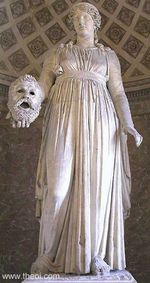
I am, obviously, no expert in this material; my knowledge of ancient Greece is essentially limited to what I remember of the myths and what Wikipedia tells me (among other things, that Melpomene, the Muse of Tragedy, was famous for her boots).
I think it is mostly the writer in me who enjoys these plays, because they are full of treasures for writers. There are turns of phrase that are unforgettable: “She is my city, my walking stick, my way on the road,” the devastated queen of Troy says of her daughter in Carson's version of Euripides' Hekabe. There is the way, in Carson's renderings, that the language twists and turns and reforms, condensing entire metaphors into a compound adjective: “No longer now out from veils like some firstblush bride/shall my oracle glance,” as Kassandra says in Agamemnon, and the way the symbol or trope of the city functions (“You made me an outcast with no city,” Oedipus says to his son Polyneikes). Add to that the virtue of flexibility – the language can become as grandiose or as colloquial as you want; just pick your translator.
There are also, of course, the stories themselves. They are always familiar, and we always know how they will end, but that doesn't matter – it's in part because they are so old and familiar that they are so welcome; we can reshape them however we want: Jean Anouilh's Antigone, for example, or Sarah Kane's brutal Phaedra's Love; even the entirely unrelated story of a murder in Queens can be seen as a version of a familiar story, in Janet Malcolm's Iphigenia in Forest Hills. These are archetypes, outlines not to fill in, but to put around our own stories, to delineate and clarify them.
Because so many of the plays involve the same characters, it's also kind of like living in a family; at times you sympathize with this person, at times with her enemy – compare the Clytemnestra of Iphigenia at Aulis to the Clytemnestra of Elektra. Towards the end of her Locas mujeres poems, the poet Gabriela Mistral manages to create sympathy for three characters of that saga – Clytemnestra, Cassandra, and “Electra in the Mist.” We can be Clytemnestra devastated or tyrannical; we can be clear-eyed Cassandra, single-minded Electra. There is a story for everyone, a character for everyone at every moment.
The thing I appreciate most about these plays, though, is what they have shown me about writing fiction, or at least how I think about writing fiction (which is by extension how I think about living my life). It seems to me that contemporary fiction, especially that which comes out of MFA programs like the one I attended, have developed a focus on process: Our work is concerned with how we get from one place to another, how we become the person we are from the person we were. This has always been difficult for me to convey – it’s something to struggle with, wonder about – and sometimes it is exhausting. Processes are like that; beginnings and ends are hard to identify, the intermediate stages are confusing, the result is never quite as definite as I would wish.
The Greek plays don't do this. What is important, in these plays, is moment, not process; the focus is on consequence, rather than the ambiguity or ennui of contemporary fiction. There is a weird kind of relief in this, and, more importantly, clarity: One may argue (as the characters do) whether or not Agamemnon was right to sacrifice his daughter to Artemis just so some boats could get going, but in any case the crime is punished, just a stop along the way for a long-term family curse that then goes on to touch his wife and their children.
In some ways these plays are like the holy books; perhaps this is what people seek in their religious texts. For me, it’s here, in these plays: clarity, finality, judgment and sentence. It seems to have become harder to touch such things in fiction today. “Simplicity” isn’t the right word for this material, but perhaps “starkness” is: There are gray areas, but the black is blacker and the white whiter, and you know the journey will always end in one or the other. And don't worry: If at any point you are confused, some god will come down to show you the way.