
| ABOUT US | ARCHIVES | LINKS | RSS FEED | MONDAYS | |

3quarksdaily

An Eclectic Digest of Science, Art and Literature

« uncanny valley | Main | Steve Jobs, Slavoj Žižek and "Good Capitalism" »

October 08, 2011

Identity Economics

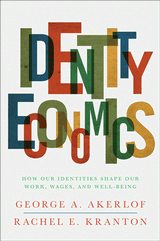
J9108 Chapter 1 of George Akerlof and Rachel E. Kranton's Identity Economics: How Our Identities Shape Our Work, Wages, and Well-Being, over at Princeton University Press:

Our work on identity and economics began in 1995, when we were both, by coincidence, based in Washington, DC. We had been together at Berkeley—George as a professor, Rachel as a graduate student. George then went to the Brookings Institution while his wife was serving on the Federal Reserve Board. Rachel was at the University of Maryland.

Identity Economics began with a letter from Rachel to George telling him that his most recent paper was wrong.8 He had ignored identity, she wrote, and this concept was also critically missing from economics more generally. We decided to meet. Quite possibly, we thought, identity was already captured in the economics of the time; perhaps it was already included in what we call tastes.

We talked for months. We discussed the research of sociologists, anthropologists, psychologists, political scientists, historians, and literary critics. We discussed the focus on identity: how people think they and others should behave; how society teaches them how to behave; and how people are motivated by these views, sometimes to the point of being willing to die for them. We worked to distill many ideas and nuances, to develop a basic definition of identity that could be easily incorporated into economics. And we saw that including identity would have implications for fields as disparate as macroeconomics and the economics of education.

This book builds an economics where tastes vary with social context. Identity and norms bring something new to the representation of tastes. Garden-variety tastes for oranges and bananas —to continue with the earlier example—are commonly viewed as being characteristic of the individual. In contrast, identities and norms derive from the social setting. The incorporation of identity and norms then yields a theory of decision making where social context matters.

Posted by Robin Varghese at 12:21 PM | Permalink

Comments

No doubt the identity of the economy is every bit as important as identity of anyone within that economy.

Otherwise one might use the tools and techniques of an alien economy to the demise of both identities.

Posted by: Dredd | Oct 8, 2011 2:59:30 PM

Post a comment


Subscribe to this blog's feed  

PayAnywhere with iphone credit card swiper

Android Tablet

Bluetooth Headset

2013 New Style Dresses

Compare Car Rental Prices

DHgate.com Wholesale

3QD on Facebook

3QD on Kindle

3QD by Daily Email

Receive all blogposts at the same time every day.

Enter your Email:


Preview 3QD Email

3QD on Twitter

Miscellany

Lijit Search

AddThis Social Bookmark Button

Add to Google

Recent Comments

Raza Husain on Why Steven Pinker Is Wrong

Bill on Why Steven Pinker Is Wrong

roger gathmann on Why Steven Pinker Is Wrong

Doogle on Why Steven Pinker Is Wrong

Kyle on Syria: Inventing a Religious War

Peter John on Gezi Park

dthoko on The History of Typography - Animated Short

Richard on John Gray’s Godless Mysticism

Abbas Raza on Why Steven Pinker Is Wrong

nogodrod on Syria: Inventing a Religious War

Lusine on Quest for 'Genius Babies'?

Bill on Syria: Inventing a Religious War

j_93 on Gezi Park

j_93 on Syria: Inventing a Religious War

Norman Costa on The Insanity Virus

Dave Ranning on Political Ideology and the Avoidance of Dissonance-Arousing Situations

Sundar on Quest for 'Genius Babies'?

Sundar on Syria: Inventing a Religious War

gaddeswarup on What is ‘smart’ and how does it fit our consciousness?

gaddeswarup on What is ‘smart’ and how does it fit our consciousness?

musafir on Syria: Inventing a Religious War

Lusine on Syria: Inventing a Religious War

Brad Wilson on Gezi Park

Raza Husain on Syria: Inventing a Religious War

Brad Wilson on The Insanity Virus

Acclaim For 3QD


"I couldn't tear myself away from 3 Quarks Daily, to the point of neglecting my work. Congratulations on this superb site."—Steven Pinker, Johnstone Professor of Psychology, Harvard University.

"I have placed 3 Quarks Daily at the head of my list of web bookmarks."—Richard Dawkins, Charles Simonyi Professor of the Public Understanding of Science at Oxford University.

"Just wanted you to know I’m one of many who reads and enjoys 3 Quarks....almost daily."—David Byrne, musician, former lead-singer of the Talking Heads, artist, intellectual.

Read more here.

The 3QD Prizes

Subscribe to this blog's feed