
ABOUT US | QUARK PRIZES | DAG-3QD SYMPOSIA | MONDAY MAGAZINE | ARCHIVES | FOLLOW US |

3 Quarks Daily Advertising


Please Subscribe to 3QD

Subscription options:

If you would like to make a one time donation in any amount, please do so by clicking the "Pay Now" button below. You may use any credit or debit card and do NOT need to join Paypal.

The editors of 3QD put in hundreds of hours of effort each month into finding the daily links and poem, putting out the Monday Magazine, administering the Quark Prizes, arranging the DAG-3QD Peace and Justice Symposia, and doing the massive amount of behind-the-scenes work which goes into running the site.

If you value what we do, please help us to pay our editors very modest salaries for their time and cover our other costs by subscribing above.

We are extremely grateful for the generous support of our loyal readers. Thank you!

3QD on Facebook

3QD on Twitter

3QD by RSS Feed

3QD by Daily Email

Receive all blogposts at the same time every day.

Enter your Email:


Preview 3QD Email

Recent Comments

Powered by Disqus

Miscellany

Design and Photo Credits

The original site was designed by Mikko Hyppönen and deployed by Henrik Rydberg. It was later upgraded extensively by Dan Balis. The current layout was designed by S. Abbas Raza, building upon the earlier look, and coded by Dumky de Wilde.

The banner images have been provided by Terri Amig, Carla Goller, Tom Hilde, Georg Hofer, Sheherbano Husain, Margit Oberrauch, S. Abbas Raza, Sughra Raza, Margaret Scurlock, Shahzia Sikander, Maria Stockner, and Hartwig Thaler.

« 53% & Life is Not Fair | Main | Man Reunited With His Childhood Friend Gorilla »

Sunday, October 23, 2011


How plants sense touch, gravity and other physical forces

From Physorg.com:

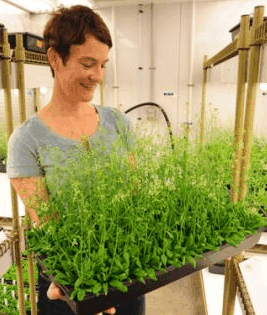
ScreenHunter_06 Oct. 23 11.50At the bottom of plants' ability to sense touch, gravity or a nearby trellis are mechanosensitive channels, pores through the cells' plasma membrane that are opened and closed by the deformation of the membrane. Elisabeth Haswell, Ph.D., a biologist at Washington University in St. Louis, is studying the roles these channels play in Arabdopsis plants by growing mutant plants that lack one or more of the 10 possible channel proteins in this species.

"Picture yourself hiking through the woods or walking across a lawn," says Elizabeth Haswell, PhD, assistant professor of biology in Arts & Sciences at Washington University in St. Louis. "Now ask yourself: Do the bushes know that someone is brushing past them? Does the grass know that it is being crushed underfoot? Of course, plants don't think thoughts, but they do respond to being touched in a number of ways."

"It's clear," Haswell says, "that plants can respond to physical stimuli, such as gravity or touch. Roots grow down, a 'sensitive plant' folds its leaves, and a vine twines around a trellis. But we're just beginning to find out how they do it," she says.

More here.


Posted by S. Abbas Raza at 05:52 AM | Permalink

comments powered by Disqus