by George Wilkinson
Animals have the remarkable capability of self-maintenance, including healing of and functional recovery from damage. In contrast, inorganic materials are degrade over time and must be repaired or replaced to maintain function.
 Self-healing materials are a class of smart materials, inspired by biological systems, which have the ability to repair damage autonomously. This idea occurs frequently in science fiction, from the Terminator to self-healing buildings. In present-day self-healing materials, physical damage alters the local properties of the engineered material, in many cases prompting a chemical reaction which re-forms the material at the site of damage. The promise of this type of material is that they would last longer, because damage could be preemptively and locally healed, preempting secondary damage and restoring the material’s strength. Self-healing would be a useful property in the paint job on a car; in prosthetic joints; or, in the future, on the exterior of spacecraft.
The Autonomous Materials Systems lab at the University of Illinois makes composite materials which incorporate microcapsules of liquid monomer. When the material is cracked, the liquid is released, flows over granules of catalyst exposed by the fracture, and begins to polymerize (see the link for movies of the concept). In next-generation materials, these engineers have extended this idea, providing the liquid in capillary systems that permeate 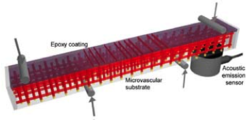 the material. These capillaries are connected to reservoirs, thus avoiding depletion of the healing liquid at frequently damaged sites. More recently—and most biomimetic yet– members of this lab have shown that active pumping of the precursor through the capillaries can yield even better efficiency, in terms of resilience of the material to repeated fractures and the speed at which damage is healed.
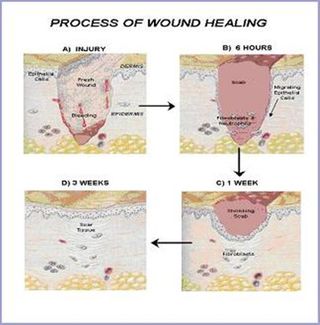 So what would a biologist look for as the next step in self-healing? Blood contains the components necessary to form a blood clot, all within a single vessel. Clotting and anti-clotting proteins are maintained in balance until an injury favors clot formation. In engineered materials, perhaps capillaries would contain liquid monomer and the polymerizing catalyst flowing together. Analogously to blood clotting, the polymerization would have to be held in check by an “anti-clotting” agent. Secondly, repair of animal skin is a multi-step process, in which a rapidly formed blood clot is later replaced by newly generated tissue. In the distant future, bio-mimetic materials might be similarly designed with multi-stage healing properties, with the first step driven by clotting of circulating fluid components, and later repairs implemented by replication of semi-autonomous compartments.
