
October 03, 2011
Ask a Scientist
by Meghan D. Rosen
Each year, the Science Communication program at the University of California, Santa Cruz accepts 10 students and, for nine writing-intensive months, teaches them how to become better science journalists. This year, I am happy to say that I am one of the 10. My nine fellow classmates come from a wide variety of scientific backgrounds (from marine biology to mechanical engineering to neuroscience). We have a self-proclaimed ‘fish guts scientist,’ a potato pathologist, a reality TV star with survival skills (from the Discovery Channel’s, ‘The Colony’), a raptor surveyor (aka ‘hawk lady’), and an agricultural writer who grew up on a dairy farm.
It’s a diverse bunch of people, with a broad set of experiences, and the best part is: they all like to talk about science. I think I’m in heaven.
One of our recent assignments was to answer a classmate’s question that was about (or loosely connected to) our field of study. The constraints: we couldn’t use any jargon in the answer, it had to be clear to a non-scientist, and we had to do it in 200 words or less. Here are some of the question ideas we kicked around: Why does a golf ball have dimples? How does a submarine judge depth? Why do tarantulas migrate? How does the brain form memories?
I liked the challenge – answer a could-be complicated question with clarity–, and the idea of directly connecting scientists with people looking for answers to life’s curiosities.
So, this month, I’m trying an experiment for the readers of 3QD. Do you have any burning science-based questions that you’d like answered? Do you want to know how something works? Is there anything that you wish was just explained more clearly? If so, leave a question in the comments. I’ll solicit answers from my classmates, and get back to you next month. To help us get us started, I’ve included my own question and answer below (and yes, I stuck to the word limit –I even had two words to spare!).
Question: Why are doctors now recommending fewer screenings for breast cancer?
The idea behind breast cancer screening is simple: the sooner you find a lump, the sooner you can fight it. Until two years ago, the standard for care was frequent screenings and aggressive treatment. We were constantly on guard (yearly mammograms) and ever ready to wage surgical war (lump or breast removal). Intuitively, it made sense – root out the cancerous seed before it sprouts. Early detection should save lives, right? Not necessarily.
In 2009, an independent panel of experts appointed by the U.S. Department of Health and Human Services found that mammograms didn’t actually cut the breast cancer death rate by much: only about 15 percent. But we were screening more women than ever. So why were so many people still dying?
The problem isn’t detection: mammograms are pretty good at pinpointing the location of an abnormal cell cluster in the breast. But not all abnormal cells are cancerous, and mammograms can’t tell the harmless ones from the dangerous ones. In other words, a lump is not a lump is not a lump.
Today, doctors are divided. Some think excessive screening forces thousands of women to undergo unnecessary surgeries. Others think one life saved is worth the cost.
Posted by Meghan Rosen at 12:15 AM | Permalink


Comments
Sounds like bliss indeed, and I did like your answer.
I wonder, would you mind giving yur opinion of Deborah Rhodes Tedtalk on breast-cancer screening? http://www.google.it/url?sa=t&source=web&cd=1&ved=0CC0QFjAA&url=http%3A%2F%2Fwww.ted.com%2Ftalks%2Fdeborah_rhodes.html&ei=52mJTo-HCMnM0QXs7LzcDw&usg=AFQjCNEs7ZOJ46SFIDCwaBHS6I2NiSHauw&sig2=GwMA1KYamAye3YQNU6pFIA
Posted by: Jeremy | Oct 3, 2011 3:54:48 AM
Answer this: Why are there more horses asses than there are horses? This inquiring mind wants to know.
Posted by: mr.ed | Oct 3, 2011 4:46:22 AM
How can an airplane fly upside down? The usual account of flight based on differential air pressure on the two differently-shaped sides of the wing seems to break down when an airplane flies upside down.
Posted by: David Bantz | Oct 3, 2011 11:09:21 AM
Why does a mirror reverse left-right but not up-down?
Posted by: David Bantz | Oct 3, 2011 11:10:07 AM
Great answer, beautifully done.
I'll think of a question . . .
Posted by: Sarah D. | Oct 3, 2011 12:47:41 PM
Many years ago Mel Brooks, aka the 10,000 year old man, asked the one question which had haunted him all these years: "Why, after I eat a few stalks asparagus, does my pee pee smell so funny?"
Posted by: John Garrett | Oct 3, 2011 1:22:20 PM
How can a thing both be and not be in Quantum Theory? e.g. "Schrodinger's Cat"
Posted by: James H. Amodio | Oct 3, 2011 1:59:54 PM
How do you connect the scattering framework of quantum field theory to an at-rest framework similar to ordinary quantum mechanics? I know you can use QM to work out scattering and show that you get the same result as QFT (in the low-energy limit), but how do I take QFT and work out the bound states of hydrogen?
Posted by: X | Oct 3, 2011 2:26:18 PM
How does reflection of light by a mirror work? I mean, how does a photon "know" what angle to bounce back at? The interaction of photon with the material certainly happens at a very small scale, and the orientation of the surface is only apparent at a much larger scale. Right? (At least I didn't ask "F***ing magnets; how do they work?")
Posted by: Stan | Oct 3, 2011 5:03:15 PM
What is general and special relativity ?
What exactly is space ?
Have yet to come across any explanations that a layman could understand and that are not mathematical.
Posted by: Shahzad | Oct 3, 2011 6:01:12 PM
Kurt Godel, incompleteness Theorem.
I have a hard time to understand it.
Please answer this for me.
Posted by: hadi moussavi | Oct 3, 2011 10:22:29 PM
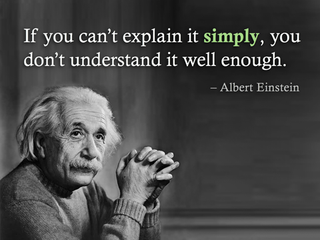
Just a nitpick, but that Einstein quote is probably one of many falsely attributed ones that gets circulated around--it appears in the 'misattributed' section of the Einstein wikiquote article which is pretty thorough, and if you do a google books search for the first half of the phrase, with the date range restricted to 1900-2000, there are no printed appearances of it before 1988. The wikiquote article says that fellow physicist de Broglie did report that Einstein once said to him "that all physical theories, their mathematical expressions apart ought to lend themselves to so simple a description 'that even a child could understand them.'" But I think that "mathematical expressions apart" bit is important, since a lot of theories in the natural sciences consist mostly of mathematical relationships. Compare with Feynman's answer to a question about "why" a particular physical phenomenon (magnetism) works the way it does...
Posted by: Jesse M. | Oct 3, 2011 11:39:48 PM
@ Mr. Ed- The world will never know...
@ Sarah D. - Thanks! I'll look forward to your question.
@ Jesse M. - Thanks for pointing that out, and for providing the Feynman link.
Posted by: Meghan D. Rosen | Oct 4, 2011 12:17:43 AM
Why does eating spicy food make my scalp itchy? And while we're at it, what does it really mean to feel itchy (as opposed to feeling dull pain)? What's the science behind this, and how do anti-itch creams (and pills?) work.
Posted by: Aatish | Oct 14, 2011 2:26:25 AM
"The usual account of flight based on differential air pressure on the two differently-shaped sides of the wing seems to break down when an airplane flies upside down."
The theory of lift based on differential air pressure above and below the wing is incorrect. It is Newton's third law that accounts for winged lift; basically the air gets deflected down when the wing is in motion (or in a wind tunnel the wing is stationary and the air is in motion) and there is an equal and opposite force pushing the wing up. The more that air (or any fluid) gets turned, the greater the lift on the object turning the fluid. This is why airplanes can fly upside down, if necessary.
"How does reflection of light by a mirror work?"
I was truly surprised to recently learn that light waves/photons get reflected back by a mirror at every conceivable angle, all of which cancel themselves out by interference except for the case where the incident angle exactly matches the reflected angle.
My own question, what are the scientific arguments against us being Boltzmann brains in an anthropic universe (a notion rather appealing from a Vedantic/Buddhist POV)?
Posted by: Sam | Oct 14, 2011 6:20:15 PM
Ive been powering things on water for some time now. Its far from perfected but works well even as is. I use only water, no salts, chemicals or acids. Im not sure who to tell so telling random people. Ive made a live cam page displaying 24/7 things Im running on water right now. Feel free to have a look, as all is explained on the page. Http://blinkyblue.zapto.org
Posted by: steve dickens | May 12, 2012 11:14:40 AM
Post a comment