
September 16, 2011
The Many Ways not to Believe
Jonathan Rée discusses the evoluton of atheist thought over the ages in New Humanist:
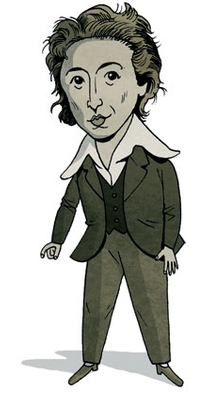
[Percy Shelley's] pamphlet on “The Necessity of Atheism,” published anonymously in 1811 when he was 18, got him expelled from Oxford and disowned by his family, but he stood by it all the same. He may not have been the first atheist to come out of the closet, but he was the first to flourish the title with bravado and panache. On the other hand there was less to his atheism than meets the eye. “It is a good word of abuse,” he said, and he deployed it to advertise his revulsion from the Christian idea of a god who created the world and established the distinction between good and evil. But strictly speaking he was not so much an atheist as a pagan theist. His denial of God, he explained, “must be understood solely to affect a creative deity,” while the “hypothesis of a pervading spirit co-eternal with the universe remains unshaken.” In reflective moments he preferred to call himself a deist.
If the world’s first celebrity atheist was a deist then the word “atheism” seems to be in trouble. Hence the rise of the term “new atheism” to distinguish atheists who really mean business from those who prefer to hedge their bets. Like “atheism” itself, however, “new atheism” began life with negative connotations. It can be traced back to the 17th century, when it – or rather its French equivalent – was used to alert Christians to the threat of Spinozism. But nouvel athéisme was itself a dark phrase, since Spinoza believed passionately in something called God, though he shocked the orthodox by identifying it with nature as a whole rather than a transcendent supernatural agency. During the 19th century, as Spinoza came to be viewed as a pious mystic rather than a raucous infidel, the “new atheist” tag was transferred first to proponents of the mutability of species, then to Auguste Comte and the positivists, followed by the indomitable secularists Harriet Martineau and George Holyoake, Spencerian evolutionists and Darwinian natural-selectionists, and eventually Friedrich Nietzsche and his enigmatic hero Zarathustra.
Posted by Robin Varghese at 09:10 AM | Permalink


Comments
A pretty dumb article. In his overview of the "evolution of atheist thought" Ree makes no mention of Diderot and D'Holbach--the latter being the first modern "new" atheist, and a titantic figure in any history of atheism. Either Ree is grossly ignorant of his existence, in which he has no business writing this article, or he intentionally leaves D'Holbach out so he doesn't have to admit that modern atheists were around long before Shelley. And if that is the case, then he is being flagrantly dishonest.
Posted by: IA | Sep 16, 2011 1:04:45 PM
IA:
With any historic essay, you have to start somewhere. I think Ree’s exclusion of the Diderot and d’Holbach is forgivable; in the history of irreligion, the two are famous, but not visibly influential. Very few annotated editions of their work have ever made it into English, and when they have it hasn't inspired much scholarship. Though the two are noteworthy for producing the most elaborate and rigorous arguments for an atheistic-naturalistic worldview the West had seen up to that point, their work doesn't seem to have made much of a splash. The anticlericalism of the French Revolution was Deist in character. Kant and Hegel were considered the end-all of philosophy later in the 19th century, and various iterations of idealism dominated the intellectual world, even among scientific types like the positivists and American pragmatists. Marx and Engles counted d’Holbach and Helvetius as ancestors to historical materialism, but their remarks on them are confined to a few pages. The naturalistic turn of the Victorian era seems to have been a confluence of positivism and Darwinism. Nietzsche, Marx, and Freud likely inspired most of the irreligiosity in the pomo crowd.
None of this is to disparage the Encyclopedia and “System of Nature” (or Diderot and d’Holbach’s underappreciated keepers like “D’alembert’s Dream,” “Jacques the Fatalist” and “Good Sense”.) They fought the good fight with the limited tools of their time. But the intellectual climate was antithetical to their project for at least a century after their deaths, so they were figures of only secondary importance. It apepars for much of their history, and probably more talked about than read.
Posted by: Joseph Clark | Sep 16, 2011 3:05:46 PM
Post a comment