
September 19, 2011
Is myth more comforting than reality?
by Quinn O'Neill
For parents wishing to introduce their children to a scientific worldview, two new books may make the job a bit easier. Daniel Loxton’s book “Evolution: How We and All Living Things Came to Be” recently won the 2010 Lane Anderson Award in the young reader category. It was also a finalist for the Silver Birch Award and is in the running for a third Canadian book award for children’s nonfiction. For the curious, the National Center for Science Education offers an excerpt here. The other book, Richard Dawkins latest, “The Magic of Reality: How We Know What’s Really True,” makes a clear distinction between myth and reality while explaining a range of natural phenomena. Both books are aimed at kids in the 8- to 13-year-old range but could certainly be understood and enjoyed by those much older.
Introducing children to current scientific thinking about human origins and other natural phenomena may seem like a no-brainer for many parents, but for others the idea may not hold much appeal. Jeremy Paxman interviewed Dawkins on the subject of myth and reality and raised what I think is an interesting question: are myths more comforting than reality? Or perhaps we should ask instead, "are delusions more comforting than reality?" since myths generally aren’t comforting unless one believes that they’re true. I think the answer is both yes and no.
On a psychological level reality isn’t comforting at all. We are, as Paxman points out, insubstantial specks in the cosmos. A scientific worldview would tell us that we have no divine purpose, we weren’t created by a kind and loving god and there’s no guardian angel watching over us prepared to step in to prevent traumatic events. We or our loved ones could be mangled in a freak accident or develop a horrible illness at any time. We live in an unpredictable and uncontrollable world full of suffering and injustice, where bad things happen to good people for no reason at all.
Reality isn’t always easy to deal with and delusion can help people to cope with feelings of uncertainty and helplessness. Comforting delusions can take a wide range of forms like good luck charms, superstitions, and astrology. Perhaps the most pervasive and personally aggravating example is prayer for divine intervention.
Requests for my prayers routinely go through my facebook newsfeed as if some critical mass of praying people will bring about a desired outcome, like the return of an abducted child. Prayers for very reasonable things, like food and relief from pain, go unanswered all over the world every day, but if we could just get everyone on facebook praying for this child's return, surely we could make it happen. Because maybe God’s watching over the rape of the abducted child right now and he’s willing to intervene but he’s holding out for just a few more Hail Mary’s and a Glory Be? Somehow I doubt it. There seems to be no rational way to reconcile a kind and loving, interventionist God with the observable horrors of the world we live in.
The God people pray to for intervention in their own lives is the same God that seems to have no problem sweeping men, women, and children of all moral persuasions to their deaths in a tsunami and no problem with the suffering of innocent animals in the wild. Some might argue that God has his reasons and that suffering has its place. Fair enough, I'm not criticizing non-interventionist varieties of gods here. But, if we believe that god has his reasons for such things, then we should refrain from prayer and rest assured that whatever fate should befall us or our loved ones - as hideous as it may be - it will be exactly what God intended and there'll be a good reason for it. But there is little comfort in this view.
I’d love to think that my life has some higher purpose, that there’s some great fate that I was put here to fulfill and that everything good or bad happens for a reason - this would provide comfort. But a bit of knowledge, reasoning ability and honesty prevents me from accepting such things as anything other than fanciful myths.
Nature is beautiful and spellbinding, but it isn’t comforting. It is a comedy, a drama, a horror and a feel-good story all wrapped up into one awesomely complex, unpredictable, uncontrollable masterpiece that’s writing itself. This may not be the story parents want to tell their children and in some cases I suspect even staunch advocates of rationalism would agree. If a dying child takes comfort in the belief that she’ll become a fairy princess upon death, who would take this from her?
Prayer and belief in God, delusional or not, are undeniably comforting. A recent study revealed a correlation between the percentage of people who "strongly believe in god" and a measure of suffering (based on rates of infant mortality, cancer deaths, infectious disease, and violent crime) across the 50 US states.1 Parents are also more likely to believe in God if they have a child with cancer.2 A sense that things happen for a reason and that suffering has a purpose can help us cope. So why not share such a powerful coping strategy with children?
On a practical level, reality offers much greater comfort than myth. Most of the comforts of modernity - flush toilets, electricity, appliances, medicine, and convenient transportation, owe their existence to science and to those who subscribe to methodological, if not philosophical, naturalism. The material comforts that we enjoy depend upon our understanding the world as it is and not how we wish it were.
Science can also offer a degree of certainty and predictability. There’s comfort in learning that a biopsied lesion wasn’t cancer and that an ailment has a name and an effective treatment. In a world where accidents happen and people get sick, it’s nice to know that medical science and technology offer ever improving odds of recovery.
Accepting reality can also improve our decision-making and planning. If we accept that natural disasters and accidents are inevitable, then we can plan for them effectively and minimize their harmful effects. We can also take concrete steps to reduce their likelihood. It might seem like a good idea to shelter children and keep them innocent of harsh realities, like child sexual predators, but educating them about these dangers may be the best way to keep them safe. Ignorance may be bliss but it can also be dangerous.
Of course, we don’t necessarily need to choose between the material comforts of science and technology and the psychological comforts of a non-scientific worldview. It’s possible to be a scientist and not always think like one. It’s also possible to think like a scientist and not be one. But, in an age of man-made disasters, extinctions, and climate change with predictable dire consequences for future generations, I think it’s critical that kids learn to think like scientists. It’s important to be able to cope with problems but it’s more important to be able to solve them. A good grasp of reality may ultimately be the best gift parents can give their children and the benefits may extend well into the future.
References:
1) Gray, K., Wegner, D. M. (2010). Blaming God for our pain: human suffering and the divine mind. Personality and Social Psychology Review, 14(1)7-16.
2) Spilka, B., Zwartjes, W. J., & Zwartjes, G. M. (1991). The role of religion in coping with childhood cancer. Pastoral Psychology, 39(5), 295-304.
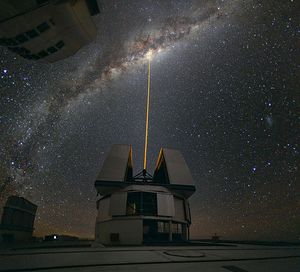
Photo Credit: European Southern Observatory
Posted by Quinn O'Neill at 12:10 AM | Permalink


Comments
When Bill Gates dreamed of Microsoft before it was the huge corporation it became, that was merely a dream. There was no way that anyone could be certain about how it would turn out, least of all Bill Gates.
He, as well as others like Steve Jobs of Apple, etc. had dreams (delusions?) of what the future would be like. They acted upon those dreams and created realities that were probably much different than their initial dreams.
Hypotheses are by-and-large fantasies: created in the belief that they will eventually turn out to be true, but without the certainty that they will turn out to be true.
Even from a purely rationalistic point of view it might be a good thing to encourage imagination in the young which can later be applied to the creation of useful scientific hypotheses, patents, products, corporations, government agencies, etc.
If kids are more excited about believing in Santa Claus, unicorns, leprechauns, and the like rather than neutrinos, quarks, and the unmeasurable curled-up dimensions of string theory then why discourage them?
Posted by: DAS | Sep 19, 2011 1:48:56 PM
I always felt a bit sleazy when I told my son there was a Santa Claus. I just have strong dislike of lies, I guess.
Posted by: J.Hawkins | Sep 19, 2011 2:21:56 PM
I always feel sleazy when I tell my nephews that scientists are mostly concerned with the search for the truth, rather than a paycheck or research grant.
Posted by: DAS | Sep 19, 2011 5:13:06 PM
In this vein, someone once said:
"The struggle against religion is, therefore, indirectly the struggle against that world whose spiritual aroma is religion.
Religious suffering is, at one and the same time, the expression of real suffering and a protest against real suffering. Religion is the sigh of the oppressed creature, the heart of a heartless world, and the soul of soulless conditions. It is the opium of the people.
The abolition of religion as the illusory happiness of the people is the demand for their real happiness."
Posted by: Robin Varghese | Sep 19, 2011 9:41:33 PM
He could write great prose...
Posted by: omar | Sep 19, 2011 10:01:22 PM
Perhaps being reared in an old-fashioned Southern religious household has left me prickly, but I tire of a growing patronizing condescension on the part of some the literati. After all, some of us grew up to be card-carrying atheists or agnostics anyway, and others learned early on of Pascal's Wager.
I'm keenly aware, maybe more so than observers at a distance, of the handicaps crippling that milieu. These people are as much a part of my daily life as enlightened minorities living among superstitious, ignorant people all over the world. As far as I can see, these are the salt of the earth masses that make the world go 'round. And until the dawn of Utopia they will always be with us, and very likely in the majority.
That said, I once asked my Folklore professor (Folklore was one of my undergraduate studies) how he defined myth. He said "Myth is the highest form of truth in any society."
It works for me. I only wish it worked as well for others.
Posted by: John Ballard | Sep 20, 2011 4:58:31 PM
Science, religion, mythology, poetry - all these and other things are not mutually exclusive! Human beings are complex creatures, do we want to explain love to our children in terms of attachment theory and neurochemical oxytocin? Or perhaps poets will have a better way of putting things together...
We are not simply biochemical machines. We are symbolic creatures, with different kinds of understanding simultaneously possible. I am a scientist, I do empirical research, yet I am fascinated by mythology, literature and sacred books. These things are not delusions, these are different ways of making sense of things.
Mythology is the most basic way of structuring the world around us, religion offers other ways of deepening the understanding of the existential dilemma, poetry teaches nuanced experiences, and, finally, science, explains things in terms of their mechanics. These things should be taught simultaneously, and not at the expense of one another.
Posted by: Liza | Sep 23, 2011 2:32:50 PM
Daniel Loxton, author of "Evolution: How We and All Living Things Came to Be"
http://ncse.com/files/pub/evolution/Evolution--KidsCanPress--FB.pdf
is also editor of Junior Skeptic, a youth supplement included in each issue of Skeptic, a magazine that "examines extraordinary claims."
So why is evolution the one subject skeptics aren't skeptical about?
From Loxton's book:
Page 13:
"On one island, the [Galapagos] finches had large beaks for cracking tough
seeds. On another, they had long thin beaks for catching insects and so
on. But if that was true--if one species could turn into several new
species--how did it happen?"
Jonathan Weiner ("The Beak of the Finch", 1994) said beak changes during a
severe drought (1977) was "evolution in action", even though the changes
were reversed after the drought ended, and no net evolution occurred.
Thebeak changes can be more accurately described as "minor variation in
action".
Page 21:
"Most of these insects [peppered moth] were light colored with dark
pepperlike speckles, while a rare few were dark all over....Within a
hundred years, almost all the moths were dark colored. A change in the
environment led to a physical adaptation in the moths. That's natural
selection and evolution in action!"
Edward Blyth, English chemist/zoologist (and creationist), wrote his first
of three major articles on natural selection--although not using the
specific term--in The Magazine of Natural History, 24 years before
Darwin's "Origin of Species" was published. Why then do evolutionists
think of natural selection as Darwin's idea?
As for peppered moths, did a new species emerge, or did it already preexist?
Page 44:
"How could evolution produce something as complicated as my eyes?....It's
just not true that eyes need all those parts [lens, iris, muscles, etc.]
to work. As Darwin pointed out, nature today is full of eye designs much
simpler than ours."
Ian T. Taylor writes: "If Darwin turned cold at the thought of the human
eye at the end of the evolutionary cycle, what, one wonders, would he have
thought of the trilobite eye near the beginning?" ("In the Minds of Men",
Fifth Edition, 2003)
For Loxton not to include scientific information that questions evolution
is to teach evolution as dogma.
See the article:
Evolution: The Creation Myth of Our Culture
http://www.trueorigin.org/evomyth01.asp
Posted by: David | Oct 10, 2011 3:35:16 AM
As for Richard Dawkins, he should be asked the same question he fumbled in a Sept. 16, 1997 interview:
Can you give an example of a genetic mutation or an evolutionary process which can be seen to increase the information in the genome?
See:
http://creation.com/was-dawkins-stumped-frog-to-a-prince-critics-refuted-again
Posted by: David | Oct 10, 2011 3:38:21 AM
Post a comment