
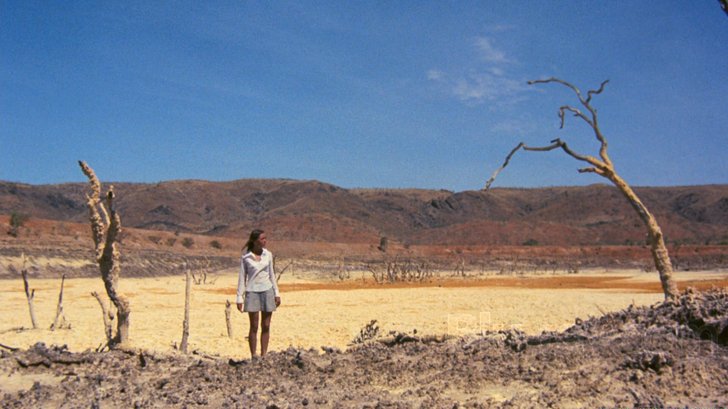
None of us really think about it anymore, especially if we grew up in Crocodile Dundee’s pop-cultural heyday, but… how weird is Australia? This land mass, just large enough to qualify for continent status, hanging out by itself underneath Asia? Starkly arid and desolate, for the most part, between its eastern and western edges? Ten thousand miles from England, yet full (in a sense) of Brits? Without a doubt, Australia makes the short list of countries that can freak you out if you think hard enough about them. It doesn’t sit at the top — stiff competition from Turkmenistan, Paraguay, and North Korea — but which filmmakers bother to actively engage with it? The Mad Max pictures grew more grotesque as they went along, but in a speculatively flamboyant way that didn’t really engage the actual weirdness. Baz Luhrmann seems to hold a grasp on some of his homeland’s deep askewness, but his movies tend to convert it into mere eccentricity.
But if we’re keeping it to high international profiles, we’ve got to talk about Nicolas Roeg. Despite suffering the apparent disadvantage of growing up in London and not, say, Alice Springs, he nevertheless managed, in his solo directorial debut Walkabout, to deliver an Australia never seen before — or, for that matter, since. More specifically, he delivers an Australian outback, and a drama in it, never seen before or since, dropping a sixteen-year-old schoolgirl and her six-year-old brother right into the thick of it. Cinephiles, or even enthusiasts of modern myth, know the rest of the story: the uniformed, near-albinistically white siblings — credited only as “Girl” and “White Boy” — just about succumb to dehydration when they come across a young Aboriginal tribesman — “Black Boy” — who ultimately leads them back to their civilization, though only after a series of fatal failures to communicate.
That plot opens up a minefield of potential cinematic embarrassments, including but not limited to telling the story with a standard “survival” movie or, worse, telling it with a standard “noble savage” movie. The Girl and the White Boy owe their lives to the Black Boy, true, but Roeg doesn’t convey it with a broadside against Western civilization, colonial arrogance, excessive whiteness, or what have you, even though those seem like tacks the film has to take. I’d dragged my feet on seeing it for the first time because of my fear that Roeg, who had become one of my favorite filmmakers immediately after I saw The Man Who Fell to Earth, would succumb to obvious moralistic clichés. How foolish of me; watching any given Roeg film should assure you that, even when he uses time-worn components of plot or character — and he usually does — he fits them together with a box of tools all of his own cockeyed invention.
How do we know Walkabout won’t put us through a typical plodding spectacle of uptight urbanites reluctantly chomping down on sticks, leaves, and bugs at the urging of cautious but giving sun-browned natives brimming with simple wisdom from generations of close communion with Mother Earth? The signs come early and often, starting with the way the brother and sister wind up stranded so far into the outback in the first place. We see their buttoned-down father express squinting, frowny displeasure at his job, home, and family, and it feels like the brim of a very old hat indeed — until he drives the kids out into the country, tells them to set up a picnic, and then pulls out his revolver and opens fire on them. They run; he keeps missing, perhaps deliberately. By the time he’s set fire to the car and done himself in, the Girl and the White Boy have nowhere to go but away, as far and as fast as they can manage.
Before introducing the Black Boy, Roeg depicts the youngsters’ disoriented wandering with not just images of their physical struggle but extended gazes at the vast, dry landscape, at variously bizarre forms of outback life, and at that naked, terribly oppressive sun. And speaking of nudity, the Girl heroically summons the propriety to feel discomfort at the Black Boy’s arrival, despite the life-and-death situation in effect by the time he shows up. While the White Boy remains relatively easygoing throughout everything and even finds ways to communicate with reasonable clarity to the Black Boy, it’s just a bit too late for the Girl; society has stamped her. Though she eventually reaches surprising heights of liberation in nature — in her skinny-dipping scene, behold the stuff cinematic history is made of — Roeg nevertheless keeps her in thrall, on some deep level, to her culture’s meaningless standards. (This movie entered production, bear in mind, less than a decade after The Bulletin ran with “Australia for the White Man” on its masthead.)
Another tiresome way to make Walkabout would have these characters play out a lesson about the enlightenment found only in cultural relativism. You can just imagine it, can’t you? Observing the clash between the Girl’s starched skittishness and the Black Boy’s jubilant machismo, we learn that All Norms Are Bullshit — except the native norms come out a nose ahead, of course, on account of they’re more “natural.” Basic incompatibilities between the communicative instincts installed in them create the film’s propelling conflict, but the kids’ similarities give us more to think about than do their differences. They’re young, they’re still forming, and they’re cast into the wilderness at the hands of their grown-ups. As Roeg himself has said, “All that exists is the human being.”
Though temporarily separated from his tribe to go through the Aboriginal coming-of-age ritual of the film’s title, the Black Boy takes it upon himself to show the Girl and the White Boy the way back to theirs. But this takes time, and if you put two sexually compatible teenagers through a harrowing experience together, don’t be surprised if complications arise. When the Black Boy appears to display a certain not-especially-aggressive interest in the Girl, the Girl, spooked, rebuffs him. Here the misinterpretation gets serious, and the Black Boy, thinking his very existence rejected, begins spiraling into self-imposed oblivion.
But between the father’s end and that of the Black Boy, an entire journey rolls out in a fashion only Nicolas Roeg has ever mastered. The film builds the wilderness into a living, breathing, alternately benign and malevolent organism with images of not just the characters’ path but flora, fauna, and visions more abstract captured all throughout the country. When the trio spots a group of camels, we see the White Boy’s storybook vision of Arabesque riders followed by the Black Boy’s death-obsessed vision of the animals’ corpses. When the Black Boy hunts, sudden, unexpected freeze-frames fix on his targets’ springy escape attempts and his own joy at the chase. When he slaughters a kangaroo, Roeg drops in surreal yet businesslike footage of a modern, “civilized” butcher chopping up the merchandise in his shop — shots you never quite feel prepared for, even if you’ve seen the movie before. Fallen animals, slain by rifle-wielding hunters in the Black Boy’s memory, rise eerily up again through shots run in reverse. And how even to explain the near-slapstick interlude with nearby Italian meteorologists or the grimmer one in a village which seemingly contains nothing more than a kangaroo-figurine factory and a white prostitute?
Roeg tells the story with these and other unconventional but somehow ideally suitable visual means in only 100 minutes from a script that, so cinematic lore has it, barely reached fourteen pages. At the close, we see the White Girl years later, grown up, slathered in early-seventies makeup, waiting for her man in an apartment uncomfortably resembling the one in which she grew up. Her husband, a close fit to the workaday type her father fit cleanly before his psychotic break, returns home with tales of office politics. But something in the adult White Girl’s eyes betrays her memory of her time in the outback — her own walkabout — and the inoculation against total complacency it gave her. For any serious filmgoer, Roeg’s pictures do the same. He poisons our cinematic complacency by regularly venturing into an uncommonly large patch of the medium’s creative space, a space as large as the outback and even less explored. Most filmmakers, like the Girl and the White Boy at the very beginning of Walkabout, haven’t left Adelaide.
All feedback welcome at colinjmarshall at gmail.