
| ABOUT US | ARCHIVES | LINKS | RSS FEED | MONDAYS | |

3quarksdaily

An Eclectic Digest of Science, Art and Literature

« perceptions | Main | Being Like America »

August 01, 2011

Pushing the right beliefs, for the wrong reasons

by Julia Galef
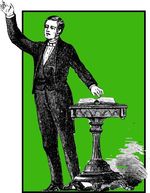
Orator2 For a crash course in the tactics of persuasion, you can’t do much better than religion. Religious rhetoric is thick with arguments that win people over despite being logically flawed. Just a few of the most common:
Appeals to authority: “Believe in God, because your parents and teachers tell you to.”
Appeals to consequences: “You should believe in God because without Him, people would be wicked.”
Anecdotal evidence: “I prayed for my mom who had cancer, and she recovered.”
Ad hominem: “People who don’t believe in God are wicked.”
Appeals to fear: “Believe in God, or you will suffer for eternity.”

Atheists, skeptics, and rationalists complain about arguments like these, and rightfully so. None of the above constitutes good evidence for the existence of a God. But there’s a reason religions use those appeals to authority, consequences, and fear -- they work. The unfortunate truth is that people seem to be more susceptible to certain irrational arguments than they are to rational ones, which raises a troubling question for those of us who would like to combat false beliefs in society: Should we make the argument that constitutes the best evidence for the true claim, or the argument that’s most likely to persuade the person we’re talking to?

To be clear, I’m not talking about lying. I’m talking about making an argument which is true but which isn’t good evidence for the claim you’re trying to advance. So for example, let’s say I wanted to convince a Catholic of the truth of the theory of evolution. My first instinct might be to lay out the evidence for the theory, showing them examples of natural selection at work, pointing to examples of transitional fossils, and so on. If my goal is to change their belief, however, I’d probably be better off explaining that the Vatican’s position is that evolution is consistent with Catholic dogma. That appeal to authority is going to be more persuasive, for someone who already trusts the authority in question, than an appeal to the relevant evidence.   

Alternately, let’s say I want to dissuade someone of certain right-wing political views. I could lay out the empirical and logical evidence for why I think she’s wrong about, say, Obama being an alien or about the Democrats trying to impose “death panels” on the country. Or I could tell her about the sordid personal life of one of her favorite right-wing idealogues, like Rush Limbaugh, in an attempt to discredit his political views. It’s an ad hominem attack, but given the degree to which people’s views are influenced by those of people they like and trust, it might well help change her mind.

Another conflict between an argument’s quality and its persuasive power that I face all the time is the use of anecdotal evidence. For most people, a single compelling story is more convincing than a statistic. (“One death is a tragedy; a million is a statistic,” said Stalin; he may not be the sort of fellow you’d like to invite round for tea, but he was right on this count.) That’s why charities have learned that instead of trumpeting the statistics about the hundreds of thousands of people dying of civil war or malaria or malnutrition, it’s much more effective to give the public a compelling story about a single suffering person. The average amount of money people are willing to contribute “to save one child” is consistently larger than the average amount of money people are willing to contribute “to save eight children.”  

So if I want to persuade someone to vaccinate her children, I might be tempted to use arguments about how the original paper showing a connection between vaccines and autism was fraudulent, about how subsequent research has failed to find any evidence for such a connection, about how the removal of thimerosol (the allegedly offending ingredient in vaccines) was followed by an increase in autism, not a decrease, and about how rates of diseases like mumps and measles are skyrocketing because of parents’ refusal to vaccinate their children. Those are all good arguments, epistemically. But I might have more success if I simply told a poignant story about a child who died from the measles because of the decline in vaccination rates.

Of course, tactics like anecdotal evidence, ad hominem attacks, and appeals to authority, aren’t as ethically problematic as outright lies. But I think there’s still some implicit deception occurring when you try convince someone to believe a claim by making an argument which is true but which is not a good reason for believing that claim. Simply by virtue of the fact that you’re making a particular argument, you’re arguably implying that you think it’s a good reason for believing the claim in question. So if I cite the Pope’s support of evolution or Limbaugh’s hypocrisy in dealing with drug addiction, in an attempt to persuade someone to believe in evolution or disbelieve in right-wing ideology, I’m implicitly saying that I think the Pope’s support is a good reason to believe in evolution and that someone’s personal hypocrisies are a good reason to disbelieve in a political view he happens to hold. And that would be a lie.

But even if you're not concerned about the ethical questions surrounding these persuasive tactics, you should at least be concerned with the tactical questions. For one thing, opting for a persuasive argument over a good one means you’re passing up the chance to make a case for critical thinking. If I convince someone not to believe in astrology because there’s no evidence for it and no scientific basis for the theory, then I’ve reinforced in him the understanding that he should judge claims on evidence and scientific logic. But if I convince him not to believe in astrology by saying, “You know that famous astrologer? She denounced the field last year,” then I’ve reinforced in him the understanding that he should listen to authority figures.

Also, if you take the approach of convincing someone with the evidence that is more convincing to him personally, but which isn’t the real reason you believe the claim in question, then you’re setting yourself up for failure if that evidence turns out to be false. So, for example, I know a lot of people who make the case against discrimination of gays by arguing that homosexuality is innate. And judging from the ubiquity of that argument, it does seem to be one of the most persuasive arguments for gay rights as far as the general public is concerned. 

Yet while I agree that the evidence is overwhelming that homosexuality is innate, I’m loath to make that argument, because in my opinion that’s not the real reason we shouldn’t discriminate against homosexuals. The real reason, as far as I’m concerned, is that it’s none of our business if consenting adults want to sleep with each other, as long as they’re not hurting anyone else. By making the “homosexuality is innate” argument, I’d be staking my anti-discrimination case on an empirical question which, if it unexpectedly turned out to be false, would seriously undermine what is actually a very worthwhile case.

But it’s possible that’s a risk worth taking. All of the issues I’ve discussed, and many of the issues I find myself debating publicly and privately, are more than mere academic questions. There are real and often serious consequences to people’s beliefs about God, evolution, vaccines, astrology, homosexuality, and politics – both for the people themselves, and for the rest of us. That means pure idealism about how we choose to persuade is a luxury we probably can't afford. I’m not at all certain where to draw the line on the spectrum of persuasion, from smiles at one end to lies at the other. But at the least, I think it’s important to recognize that there is often a tradeoff between a good argument and a persuasive one, and to ask ourselves what our goal really is: improving people’s beliefs, or improving the processes of reasoning that they use to arrive at their beliefs? 

Posted by Julia Galef at 12:32 AM | Permalink

Comments

julia: this is a beautifully succinct tour of the old aristotelian rhetorical categories (and their consequences for understanding and thinking). if you have no objections, i might pass this on to my freshmen writing students for discussion.

also makes me think of Norma McCorvey's arrest a couple of years ago at an anti-abortion protest. if we required jane roe's endorsement of safe, legal abortion we'd be sunk.

Posted by: kara | Aug 1, 2011 12:44:58 PM

I think it is also important to stress that (as you say) "passing up critical thinking" carries a greater cost than it appears. The "wrong" reason may motivate someone to act in the "right" way in one instance - but that false belief can also motivate "wrong" actions. See, for example, religious charity and then religious persecution of heresy. In that sense, "improving people's beliefs" is a short-term bandaid with unknowable and risky side-effects.

But what if our "processes of reasoning" are physically limited? The world is not composed of independent, simplified axioms. Yet that's how we understand the world around us, because we are (or may be, neurology hasn't made any concrete declarations, yet) physically unable to grasp the world as a single, enormously complex idea. Can we say "the truth matters" if we are physically incapable of really understanding and internalizing any real, complex, interconnected truths? There is an obvious path here to paralysis. But we must still live.

I take this very friction as an example. It simply might be the case that the question you pose ("what is our real goal?") is not answerable. Or, the answer might be, "it depends." And the factors on which it depends may be innumerable: on what does it depend? Well... It depends. If we try to abstract away the dependent factors and reduce the problem to a single, simplified axiom (a process that I think is VERY useful and powerful, don't get me wrong) we are no longer dealing with the truth.

Posted by: hairlessOrphan | Aug 1, 2011 12:59:51 PM

I think appeal to authority is the biggest specious argument entertained by religious zealots, who have traded in their secular authorities for ecclesiastical rule. Some seem to believe that every word of the Bible is "the Word of God" and are fanatical in their appeal to this authority. Yet at the same time, they seem to find nothing amiss in combining their skewed visions of Christianity with Ayn Rand individualism and a wish for the privatization of everything now public. Virulent hatred of dysfunctional government, or corporate-controlled government, fuels such contrary visions.

Posted by: Louise Gordon | Aug 1, 2011 1:04:25 PM

Is your post in support of corporate-controlled governments Louise?

Posted by: Carlos | Aug 1, 2011 1:15:32 PM

No. I don't know why you would think that, Carlos.

I am against corporate-controlled governments, in favor of David Korten's suggestions, the Move to Amend movement and other suggestions to return democracy to the people - including Ted Nace's ideas in Gangs of America (free online book). Of course, if people default on citizen responsibilities, we have corporate government by default.

I simply find it ludicrous that some people who consider themselves devout Christians can't seem to decide if they're praying to God the Father or John Galt. Perhaps they even mistake Objectivism, Rand's ersatz "philosophy," for Christianity.

Posted by: Louise Gordon | Aug 1, 2011 1:27:34 PM

Efforts to encourage critical thinking are fine, but I think the evidence shows that the number of people who will ever be able to think critically and independently will always be very small. The last thing economic and political elites want is for people to be able to think critically. Luckily for them, there is little danger of this.

Posted by: J.Hawkins | Aug 1, 2011 1:27:57 PM

"So if I cite the Pope’s support of evolution... in an attempt to persuade someone to believe in evolution..., I’m implicitly saying that I think the Pope’s support is a good reason to believe in evolution... And that would be a lie."

You are only releasing someone from the burden of knowing all the permissible actions (under the system he belongs to) and reducing the amount of work he has to do accepting or rejecting every part of the explanation, because a trusted authority has vetted it in advance. It's not the authority itself, it's the vetting that authority is perceived to have done.

Like geometric theorems are taken as givens, shortcuts to having to work through all the details yourself. Pythagoras says it's ok to determine the length of the ramp by squaring the height and the distance and square rooting the sum. Well OK then.

Posted by: Carlos | Aug 1, 2011 1:35:04 PM

One of these days I'm going to have to read Atlas Shrugged.

Posted by: Carlos | Aug 1, 2011 1:43:31 PM

I don't know why you believe that, J. Children aren't stupid to start with. They become that way, thanks to the inadequacies of public schooling (obedience training), PR manipulators like Edward Bernays and all the other forces in our society that conspire to make people want to buy instead of think. After all, consumption has to keep up with mass production.

Posted by: Louise Gordon | Aug 1, 2011 2:01:18 PM

Does this still apply if the question changes? That is to say, if a religious person (let's say Christian) wants to know why they should believe in evolution, then the dilemma arises. But if they want to know how or if they can reconcile that belief (whether or not they yet have it) with their faith, then appealing to the authorities of faith makes perfect sense. Thus, you may have persuaded them to believe in evolution without ever implying you think that part matters.

Posted by: Chana Messinger | Aug 1, 2011 2:35:34 PM

"Children aren't stupid to start with" strikes me as an uncritical statement. They are absolutely stupid: they stick their hands in fire, they put anything they can find in their mouth, and they can't read, write, or add. They're kids; we don't judge them for it. But lack of experience and lack of knowledge are just as vital components of stupidity as lack of curiosity and lack of critical thinking.

I'm not highlighting the semantic argument, here. I'm highlighting the appeal to emotion, another short-coming of human thinking. It is not the case that "public schooling" is The One to Blame (though to be sure it is inadequate for its own stated purposes). Nor is it Edward Bernays, who merely exploits an existing weakness. Nor is it the ominous "They" of "society," which is nothing but the conglomeration of "Us," the society's people.

In other words, we are not "stupid" *because* school didn't teach us to be smart. School needs to try to teach us to be smart because we are already "stupid." We are simply "stupid" because we're "stupid." The Enlightenment myth of the purely rational human needs to be accepted as a myth. We are driven by shortcuts in thought, by first-order or inferential thinking, by emotional judgments, poor estimation abilities, anomalies such as future discounting, and by a peculiar ignorance to our own limitations in reason. Transcending these weaknesses is a lot of work for minimal gain. That's why J.Hawkins makes the accurate (if cynical) assessment of our future; it is an honest view of our current state, with no intellectual movement analogous to Renaissance or Enlightenment thought, extrapolated into the future.

Posted by: hairlessOrphan | Aug 1, 2011 2:43:53 PM

hairlessOrphan

I was going to say pretty much the same thing, but probably not as well. Schools certainly play lip service to teaching critical thinking but how many actually do it? Are high school students asked to compare health care systems around the world to see how the U.S. for profit system measures up? Are they asked to debate the effects of unlimited corporate funding of politicians on the democratic system? To question the morality of taxing hedge fund managers with incomes of 3 billion a year at 15% while teachers pay double that? Do they learn in history about covert actions of the U.S. government to overthrow democracies to install corporate-friendly regimes? I don't think they are. Children may very well be bright, creative and have amazing memories, but they are not critical thinkers by nature. That has to be taught, and schools have no incentive to encourage it.


Posted by: J.Hawkins | Aug 1, 2011 3:14:04 PM

Hairless,

I strongly disagree with your cynicism and assessment. Babies and children lack adult experience and knowledge, but they are very curious and learn very rapidly.

What you're ignoring is the interest that "economic and political elites" have in keeping people away from critical thinking. Thus obedience training in school and other institutions, Edward Bernays-like manipulation and many other things to keep the uncritical conformists conforming.

Posted by: Louise Gordon | Aug 1, 2011 3:24:19 PM

It is true that children learn rapidly. I don't believe this is something inherent to *childhood*, but rather something inherent to *human necessity*. The same thing happens to adults who are introduced into radically new environments in which they must survive. See, for example, the effects of contact with the western world on native New Guineans.

What that seems to imply is that human beings - regardless of age, culture, or societal norms - will learn when they are emotionally motivated to learn (for example: when their survival instinct tells them they must). And they will continue to do so right up until they are emotionally convinced that they know enough to survive in their new world.

My assessment isn't particularly cynical. It only sounds that way. Human reason, in it's naturally developed state, is inherently flawed. That's the reality, and you can see it in economic reasoning, or you can see it highlighted in cognitive science (a big, flashy name right now is Hugo Mercier, and his recent work is worth reading). It would be cynical if I said we couldn't transcend it. I believe we can, but to do so requires an objective assessment of our natural abilities and tendencies, an abandonment of our faith in the Enlightenment or Objectivist ideals of perfectly rational humans, and most importantly an abandonment of blaming outside "societal" forces (as pressing as they may be) and a focus on our inherent failings as emotional, experiential creatures. In other words: stop blaming other people. They are not blameless, but we need to recognize all they're doing is exploiting weaknesses already present within us. Don't treat the symptoms. Treat the causes.

Posted by: hairlessOrphan | Aug 1, 2011 3:38:06 PM

Another big impediment to critical thinking is the strong desire most people have to conform. No doubt this had survival value when we lived in small tribes. This desire to conform and not rock the boat is what Bernays exploits. Religious, political and economic elites exploit it. Most people are very uncomfortable going against the majority opinion as handed down to them by authority figures.

Posted by: J.Hawkins | Aug 1, 2011 3:51:35 PM

To put it simply, the need to conform trumps most people's desire for truth. This is the basis for propaganda's success.

Posted by: jared | Aug 1, 2011 4:06:07 PM

Conformity also has its place for most people. This is absolutely important to remember. It can act as recognition that the group's judgment may be better than the individual's - for example, if the individual is not smarter than everyone else in the group (I don't mean they're the dumbest person in the group, I just mean literally they are not smarter and therefore do not know better than everyone else combined. Remember that this is something we don't necessarily recognize rationally. See: Dunning-Kruger). It can also be a social force that motivates us to act in concert with the group even if we disagree with it. A bad plan executed well can achieve better results than a good plan executed poorly. One only needs to play a team sport to realize this.

I only say this because while conformity can act as an impediment to critical thinking, we can't afford to abandon it entirely, either. This is not to take away from your statement, but rather to quietly reinforce the idea that the world cannot be reduced to simplified axioms. Life is hard.

Posted by: hairlessOrphan | Aug 1, 2011 4:08:45 PM

In my opinion, we have more to lose from too much conformity than from too little. And when someone "conforms" to rational and reasonable ideas that have been thought about and reflected on, that's not conformity - that's critical thinking. Certainly an individual would have a hard time figuring things out all by him or herself. Luckily there are enough thinking people in the world that they can swim against the current of unthinking conformity. But critical thinking does take a lot of work and a certain skeptical disposition. And a love for truth.

Posted by: jared | Aug 1, 2011 4:21:24 PM

Circling back to authority:


Stanley Milgram

"With numbing regularity good people were seen to knuckle under the demands of authority and perform actions that were callous and severe. Men who are in everyday life responsible and decent were seduced by the trappings of authority, by the control of their perceptions, and by the uncritical acceptance of the experimenter's definition of the situation, into performing harsh acts. A substantial proportion of people do what they are told to do, irrespective of the content of the act and without limitations of conscience, so long as they perceive that the command comes from a legitimate authority." (1965)

"It may be that we are puppets-puppets controlled by the strings of society. But at least we are puppets with perception, with awareness. And perhaps our awareness is the first step to our liberation." (1974)

"The social psychology of this century reveals a major lesson: often it is not so much the kind of person a man is as the kind of situation in which he finds himself that determines how he will act." (1974)

Posted by: Louise Gordon | Aug 1, 2011 4:25:24 PM

Louise, We are a species prone to appeals to authority, anecdotal evidence, poor reasoning etc. In fact your attack on schooling may be an example of such poor reasoning. Schooling has its downside (yes, I have read pedagogy of the oppressed) but its not like we are freaking geniuses and critical thinkers without schooling....In fact, I challenge you to find ONE person (in ANY society)who has never been to school and who can replicate your argument against corporate elites and schooling without being tutored by someone who has gone to school.
This argument is itself found only among the schooled(left wing schooling?). Home schooling, incidentally, seems to lead to good Republicans at an even higher rate than public schooling..for whatever thats worth.

Posted by: omar | Aug 1, 2011 5:55:57 PM

Omar,

I reject your premise. Perhaps you are not intimately familiar with the environment in today's public schools. I fail to see how teaching to the test teaches critical thinking. Nor do zero tolerance policies inspire critical thinking:


Cevin Soling's the War on Kids


Zero Tolerance

You might expand your reading to include A. S. Neill's Summerhill, together with the work of John Holt, Alfie Kohn or Daniel Greenberg, founder of the Sudbury Valley democratic school. Learning does not have to be confined to that which takes place in schools.

It is unfortunate that the homeschool movement is associated with Republicans, many of whom homeschool for religious reasons. However, there is a wide spectrum of alternative education options outside the noisy religious right niche.

"In fact, I challenge you to find ONE person (in ANY society) who has never been to school and who can replicate your argument against corporate elites and schooling without being tutored by someone who has gone to school."

That might be difficult, unless I found someone who was educated through private tutoring.

You may have enjoyed your school days, but classes separated by bells, desks lined up in rows facing the blackboard, homework assignments, tests and more tests, authoritarian teachers, being a target for Ritalin or Adderall dosing, etc., create barriers for many students that preclude instead of encourage learning.

I hope that charter schools will be one means of creating greater freedom to learn - and to learn to think critically.

Now, Omar, as your authoritarian instructor, I must tell you that you should take greater care with your friend the apostrophe. (I stole that from Alfie Kohn, who began teaching long ago by telling his students about their friend the adverb or the semicolon.) I realize you may have written your response to me in haste. Nevertheless, such carelessness interferes with the reader's ability to comprehend exactly what you are trying to convey. Further, if you continue to make such careless errors, it will affect your grade. Without good grades in this class, you cannot expect to be accepted to a good college. And if you can't go to college, well . . . we may have to give up hope for your future.

Fortunately, we are in a northern school. Otherwise, you might get a thrashing:


NoSpank.Net

Posted by: Louise Gordon | Aug 1, 2011 7:25:21 PM

"Teaching to the test" doesn't inspire critical thinking. And yet it is clearly a fallacy to believe this phenomenon arose like a phantom from the concrete and bricks of the school, as if "Schools" are built haunted with stupidity.

These are human tendencies.

The same thing happens, in the abstract, with money managers (mutual fund managers or hedge fund managers) selling off value stocks to make their end-of-quarter numbers, it happens with soccer moms berating the coach to get their kid more playing time, it happens anytime humans confront a complex system with a simplified outlook, i.e. chasing the incentive and ignoring the telos. In the vernacular, I believe it's called "not seeing the forest for the trees."

You didn't answer Omar's premise at all - you attacked a strawman argument that public schools promote critical thinking (and then went for his grammar. Why? There's a neurological answer to that, but maybe we're getting off-track). But all Omar said was, "its [sic] not like we are freaking geniuses and critical thinkers without schooling." I think Omar's point is that the problem isn't simply limited to Public Schools. The problem is that Public Schools are run by human beings. The system - like mutual funds or high school soccer - isn't an inhuman automaton that exhibits emergent flaws alien to human nature. Its flaws are our flaws.

Posted by: hairlessOrphan | Aug 1, 2011 8:19:04 PM

Hairless,

I didn't "attack" Omar's grammar. In the role of authoritarian instructor, I criticized his punctuation to illustrate how difficult it might be for people to learn in public school.

I never suggested that teaching to the test arose from the concrete and bricks of the school. It arises from the school bureaucracy that implements policies such as NCLB, and tries to measure intelligence and accomplishment through quantitative means versus performance.

I said that I don't think today's public schools inspire learning or critical thinking. Omar suggested that my criticism of public school was based on poor reasoning.

Public school "flaws," as you call them, exist in a system designed to churn out obedient automatons for the corporate maw. Under different conditions than exist in public schools, learning is not limited to that which is covered by standard curricula or standardized testing.

If you want to defend public schools and the flaws that go with them as if they were generic traits of humans, go ahead. I disagree with you. Public schools as we know them didn't happen by accident or here a flaw, there a flaw.


Peter Sacks


Alfie Kohn

Posted by: Louise Gordon | Aug 1, 2011 8:53:10 PM

It may be that a better school system will produce better students that are better at reasoning. I don't dispute that at all.

However, this isn't about the failures of the school system. This is about failures of human reason.

To point to the Public School system as the cause for these failures, it is insufficient to show how the system doesn't inspire critical thinking. You instead must demonstrate that human adults without public schooling are better at critical thinking. You see the difference, of course. The former only shows that the current system isn't the solution. It's the latter that shows that the current system is the problem.

I believe that is Omar's point about faulty logic. I don't think Omar (or I) would dispute that the public school system uninspiring. But that by itself doesn't logically point to public schooling as the problem.

Would you say that without public schooling, humans wouldn't default to obeying authority? I think several centuries of legal subjugation of the lower classes erodes that argument (and I don't mean modern lower-class America, which as horrific as it is doesn't hold a candle to the institutional slavery dating back to the dawn of civilization). Would you say that without public schooling, people would be more rational and less superstitious? Or that they would do better at logical tasks like the Wasson Selection Task? Do you think the uneducated are more resistant to confirmation bias? These are the arguments you must make if you want to say that humans are naturally smart and public schooling makes us stupid.

Posted by: hairlessOrphan | Aug 1, 2011 11:36:57 PM

Did I say that schools promote critical thinking?
I said that your fashionable leftish bullshit is itself ONLY possible in a society with schools. NO unschooled population, ANYWHERE, can produce the arguments you produced.
There.

Posted by: omar | Aug 1, 2011 11:59:44 PM

I gave the example of peppered moths to a friend of mine and one of her friends, both raised in Christian schools. I usually get people to chime in with...and THEN the trees were black, so the black ones were camouflaged, which moths did the birds eat? The black or the white?...Usually participation helps immensely. :) Both ladies subsequently agreed that 'survival of the fittest' made complete sense. But they still would not accept 'evolution,' despite my insistence that 'survival of the fittest' and 'evolution' are the SAME THING. So much for logic. I tried....too bad they aren't Catholic, you know, because the Pope supports evolution.

Posted by: Lauren Elbaum | Aug 2, 2011 12:35:27 AM

Well, my comment disappeared. I'll try again.

Hairless,

I think that societal institutions in general, including school, condition people into obedience to authority versus critical thinking. Certainly true of most workplaces, many families, the military and some religious training, which is where this began.

I was not saying that completely uneducated people would be better at reasoning. I was saying that education, not public schooling, would allow people to be better at reasoning. So maybe we have no dispute.

The conditioning to conformity, motivation through incentives, motivation through grades, carrots and sticks and other behaviorist conditioning do not foster critical thinking. I believe that intellectual curiosity can easily get drilled out of people.

"Education is what remains after one has forgotten what one has learned in school."
- Albert Einstein

Posted by: Louise Gordon | Aug 2, 2011 12:56:38 AM

Oh dear, Omar is annoyed. I don't consider it "leftish bullshit." Sorry you do.

Posted by: Louise Gordon | Aug 2, 2011 12:59:29 AM

I agree on both counts, first that education *could* help, and second that there are significant *external* factors that do not encourage critical thinking. (I'm choosing my words carefully - I could go so far as to say "discourage" but that is a different argument, and the distinction matters).

I would propose a second, more fundamental theory, though: all else equal (i.e. ignoring external factors), human beings are not naturally disposed towards an infinite intellectual curiosity. We are curious only when we simply can't fit what we observe into the narrative framework we've built to understand the world. At the point where the narrative is amended to sufficiently incorporate these new observations, our curiosity will naturally end. It takes a great deal of effort to maintain that curiosity (education *can* help in this, but it is not inherent to the process. There are, after all, people who are intellectually curious who went through public schooling, went through private schooling, went through home schooling, and went through no schooling at all).

We observe this curiosity in children, who (presumably) do not yet have a coherent narrative framework. But we also observe this in adults when their worldview is broken by exposure to significantly unfamiliar technologies. And then we observe the end of that curiosity in phenomena like confirmation bias, or when people surround themselves with others who are ideologically similar and form little thought-enclaves. These behaviors can be observed from people of all education levels and cultures, though they are most obvious in political (see: Omar) and religious (see: Lauren's Christian pair) "thinking."

I mentioned Mercier earlier because I'm (obviously) in line with his theories. I don't believe human reasoning evolved from a need to know the objective truth (insofar as that's even possible; the human mind is by definition subjective, and one only needs to look at stroke victims or other cases of traumatic brain damage to see how profoundly subjective our understanding of "reality" can be). I believe human reasoning evolved as a tool to help us survive as *social* *animals* - that is, as creatures with material requirements for survival (food, shelter) and as creatures that are not self-sufficient. While we may use reason to drive at the truth - in the way we might use the handle of a screwdriver to hammer in a nail - it is not the purpose reason was designed for, and that's why it's not particularly perfect for it. After all: to survive, we don't need to know the real truth behind the ridiculous (and non-critical-thinking) impulse to divide the entire world into political ideologies that we can alternately support or condemn. We just need to know enough to convince other people that we're right, that our plan is best, and that people should help us before helping others.

Posted by: hairlessOrphan | Aug 2, 2011 1:40:45 AM

My apologies for being annoyed. I should have given a more measured response.
I was not arguing FOR public schooling, or any schooling. I was trying to say that these are common human problems and they exist in all societies, schooled or unschooled. Schooling provides an opportunity to integrate more people into one particular worldview, but the background assumptions in your comment are what seemed like "leftish bullshit" to me. I will try again some other day with a more detailed and polite argument.

Posted by: omar | Aug 2, 2011 10:49:36 AM

That's OK, Omar. We can discuss it another time.

Posted by: Louise Gordon | Aug 2, 2011 2:32:42 PM

Hairless,

Thank you for your response. I don't know Mercier's work, but will look into it.


Posted by: Louise Gordon | Aug 2, 2011 2:36:15 PM

Post a comment


Subscribe to this blog's feed  

PayAnywhere with iphone credit card swiper

Android Tablet

Bluetooth Headset

2013 New Style Dresses

Compare Car Rental Prices

DHgate.com Wholesale

3QD on Facebook

3QD on Kindle

3QD by Daily Email

Receive all blogposts at the same time every day.

Enter your Email:


Preview 3QD Email

3QD on Twitter

Miscellany

Lijit Search

AddThis Social Bookmark Button

Add to Google

Recent Comments

Joel Grant on Why Rational People Buy Into Conspiracy Theories

Tomboktu on Why is Europe so Messed Up? An Illuminating History

Joe on Why Rational People Buy Into Conspiracy Theories

Jalees Rehman on The Science Mystique

Dredd on The Moral Status of Rocks

sjg on Why Rational People Buy Into Conspiracy Theories

Dredd on Why Rational People Buy Into Conspiracy Theories

Louise Gordon on Why race as a biological construct matters

Louise Gordon on The stories of two Palestinian villages: From Al-Araqib to Susiya

musafir on a pretty funny book

freddie on The stories of two Palestinian villages: From Al-Araqib to Susiya

freddie on The stories of two Palestinian villages: From Al-Araqib to Susiya

Junaida on Tuesday Poem

rafiq on Tuesday Poem

Raza Husain on the culture animal

Nebor on Tuesday Poem

Eleutheria on I am dust and ashes and full of sin

carlos on I am dust and ashes and full of sin

Joe on the culture animal

Sundar on the culture animal

Eleutheria on Positive Failure - a review of "The Power" by Rhonda Byrne

Eleutheria on Positive Failure - a review of "The Power" by Rhonda Byrne

Matt on The Science Mystique

Eleutheria on Why is Europe so Messed Up? An Illuminating History

Eleutheria on I am dust and ashes and full of sin

Acclaim For 3QD


"I couldn't tear myself away from 3 Quarks Daily, to the point of neglecting my work. Congratulations on this superb site."—Steven Pinker, Johnstone Professor of Psychology, Harvard University.

"I have placed 3 Quarks Daily at the head of my list of web bookmarks."—Richard Dawkins, Charles Simonyi Professor of the Public Understanding of Science at Oxford University.

"Just wanted you to know I’m one of many who reads and enjoys 3 Quarks....almost daily."—David Byrne, musician, former lead-singer of the Talking Heads, artist, intellectual.

Read more here.

The 3QD Prizes

Subscribe to this blog's feed