
| ABOUT US | ARCHIVES | LINKS | RSS FEED | MONDAYS | |

3quarksdaily

An Eclectic Digest of Science, Art and Literature

« The Urgency of Anthropological Time | Main | Tuesday Poem »

August 08, 2011

Okay, so truth matters (but what is it?)

by Dave Maier

In the wake of the 9/11 attacks we heard a great deal about the end of moral relativism, the point being that from now on we would all agree that some things are Just Wrong (and since to say so is Just True to boot, this means the end of irony, skepticism, and so forth as well). At the time conservatives were the ones to expound this point most enthusiastically, claiming that the events themselves refuted trendy liberal doctrines of multiculturalism and pluralistic tolerance of difference. Instead, they said, we must simply acknowledge what we all know to be true, such as [… well, actually, for some reason it remains unclear what should go in here, and this is our subject today].

Of course it was not only the political right who was pouring scorn on facile cultural relativism back then. Alan Sokal, of Sokal Hoax fame, had made much the same argument several years earlier. His target too was the political left, but as he reminded us repeatedly, he was himself a proud leftist, having taught mathematics for the Sandinistas in Nicaragua. What provoked his stunt, he told us, was that he was upset that what he had taken to be the left's characteristic commitment to, as they like to say, speaking truth to power, was dissolving into a puddle of wishy-washy jargon-ridden postmodern relatvism which scorned the very ideas of truth and rationality as imperialist dogma.
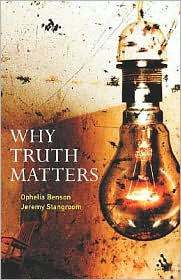
Benson This was all confusing enough as it was. A new wrinkle was added a few years later, when the events leading up to and during the 2003 Iraq war suggested to some that the right wing had its own problem with postmodernism in the ranks, or something at least very similar in its cavalier attitude toward truth and reality. Progressives pounced; and much real and virtual ink was spilled anointing the left as "the reality-based community," as opposed to the "right-wing postmodernism" in the White House, as well as to creationism, climate change denial, religion itself, and whatever else seemed to fit the bill. Philosophers have not missed this opportunity to prove their relevance to contemporary debate by writing books with the word "truth" (or "true" or "knowledge") in their titles, and in today's column I will discuss a few of the problems we run into when trying to make sense of these things, especially (paradoxically) when the target is such seemingly low-hanging fruit as postmodern gibberish.

In general I find myself ambivalent about these efforts. I do agree that (for example) most versions of creationism, such as "flood geology," are so very insane as to justify our rejection of it as due to our own relatively firm basis in reality, and it is difficult to make sense of the idea that we need not be concerned about whether what we believe is in fact the case. However, that very difficulty infects as well our efforts to make sense of the apparently opposite view. The philosophical controversy about the nature of truth may lurk behind these political and cultural controversies, but they are not the same. While some misguided souls seem to be denying plain facts, it is not at all clear that they are denying the status, as "plain facts," of those things they consider to be plain facts.

In other words, creationists and climate change deniers are not generally relativists or even skeptics. They're skeptical of particular scientific claims – that humans evolved from apelike ancestors, or that human activity has affected the climate – but that doesn't mean that they have abandoned the very idea of rational inquiry into the truth (however rong they may be doin it). They don't think that truth is relative, or even that we can't know the truth. Instead, they think that it is most scientists who are being irrational; that's why they use the terms "creation science" or "evolution skeptic" and "climate skeptic" rather than "denialist" (which after all no one self-ascribes). This means at the very least that we cannot point to the continued existence of such phenomena as showing the pernicious influence of relativistic philosophy.

Similarly, the Bush administration official (rumored to be Karl Rove) responsible for the term "reality-based community" does not seem to me to be defending a relativistic conception of inquiry, but rather using a poor choice of words to emphasize the relative importance of decisive action under uncertain conditions, on the one hand, over inaction due to the suspension of judgment provoked by such uncertainty, on the other. One might very well argue with this view; but to pick one side of that classic trade-off in a particular situation is not at all to abandon the very idea of objective inquiry into how things are. (I know this quotation acts as a proof-text for accusations of right-wing postmodernism, and that my relatively charitable reading is a minority view, but take another look and try it out.)

The term "postmodernism" seems in any case not to fit the conservative worldview. Conservatives are often sharply critical of what they see as the cultural decline of the "modern" world; but surely "pre-modern" is a better term for attacks on modernity from that direction. In the case of creationism, for example, one suspects that behind the skepticism of evolutionary theory lies religious dogma, and this aspect of our problem complicates matters considerably. On the one hand, as the word "dogma" suggests, religious doctrine is generally held by its adherents to be both true and known to be true, and is thus not the place to look for relativism and skepticism. On the other hand, the kind of access we have to religious truth (if such there be) is not what typical "reality-based" inquirers have in mind as "rational," and indeed there are a number of (in)famous denunciations of human reason in religious literature (e.g. Luther).

Bg_branding This latter aspect of religious doctrine is the sort of thing that really bothers the authors of one of these recent books. Ophelia Benson is the doughty proprietress of the website Butterflies and Wheels (or at least the Notes and Comments blog thereon, here), and with her co-author, philosopher Jeremy Stangroom, she wishes us to know Why Truth Matters. Postmodernism, relativism, and the rest are considered here as challenges to the intellectual tradition of (characteristically) Enlightenment rationality, and while the authors do not discuss religion in detail, this may be because they feel that it is too obvious a case of irrationality to deserve a chapter of its own. The introductory chapter tells us that "the crux of the dispute" concerns how to decide what to believe: should we follow "rational enquiry, sound evidence, norms of accuracy, logical inference" or instead "our wishes and beliefs, politics and morality, dreams and visions"? We are to see the sad result of the latter most obviously in "religion and related modes of thinking such as New Age, Wicca, paganism [and] the vaguely named 'spirituality'"; and when people defend such beliefs by reference to the happiness they bring, it seems that they do so "without apparently stopping to notice that there may be reasons to prefer true beliefs to false ones."

The bulk of the book comprises detailed examinations of particular cases. These are not chosen for their silliness, so that we may laugh. In each case the target is serious scholarship, or is at least taken seriously: "science studies," literary theory, multicultural anthropology, and "difference feminism" get lengthy treatments. The authors are for the most part scrupulously fair, and their critiques are generally convincing; although it remains unclear to this amateur how typical the cases are, such that we may condemn intellectual movements and even entire academic disciplines as infected by the virus of wishful thinking on the basis of these particular cases.

In fact it this very scrupulousness which, paradoxically perhaps, gives me pause. Part of the story on offer is the intellectual sources of, or (if contemporary) intellectual cover provided by, certain writers' resistance to the authors' preferred conception of inquiry into the world. To this end they introduce the ideas of a number of philosophers, past and present. The point is not to refute these thinkers, whose work is conceded to be serious philosophy, but instead to show where the otherwise inexplicably insane doctrines of postmodernist relativism came from – that is, of which ideas the authors' actual target is a possibly very distant and muddled echo. This is a wise decision, as a careful analysis of any of these philosophers' views would take a series of books by itself, and we would never get to talk about homeopathy.

In any case it's not their job to decide the deeper philosophical issues, but instead to see plain nonsense as the nonsense it is. As they put it after a brief overview of one philosopher (I have redacted the name to emphasize, as they do, the point's generality):

For thinkers inclined toward relativism, this kind of stuff is a gift. ________ seems to be suggesting that […] the notion of truth only makes sense in [a] restricted sense; there is no view from nowhere which will give us access to an objective reality that in some way exists outside our attempts to grasp it in language. However, this is philosophy, so no doubt _______ scholars all around the world flinch whenever they hear this kind of thing. But, in quite a strong sense, their flinching is beside the point. It is their job to worry about the nuances of ________'s account. But other people have other agendas, and it is just the case, rightly or wrongly, that ________ has been taken to be a relativist; that he has inspired other self-consciously relativist accounts; and that he provides aid and comfort to those who employ relativist arguments, even if these arguments are not explicitly _______an in form.

I'll let the barb ("aid and comfort," with its suggestion of treason) slide, as the stated intent here is to shift the brunt of the criticism away from such philosophers and onto those who exploit and (possibly) distort their philosophy for ideological ends. My worry is that the nature of this shift elides issues which may seem substantive only within philosophy, but are in fact crucial to our understanding of the wider phenomenon under discussion. What exactly is wrong with what _________ "seems to be suggesting"? Is what he actually said on the matter really "beside the point," even if we allow that our real targets have misunderstood him and are simply using him for cover? After all, that's why philosophers think these issues worth discussing in the first place: they affect our understanding of what it is and is not rational to say in real life.

Specifically, my concern is that connecting a disagreement about seemingly commonsensical matters to one about philosophical conceptions of truth and objectivity in this way simply begs the question about the conflation of "common sense" with what are in fact tendentious philosophical doctrines; and indeed comes down on one side of philosophically substantive questions without admitting to so doing. Given the nature of their critique, our authors' point cannot be to bypass philosophy entirely, but instead to peel off from the serious philosophical discussion an uncontroversial philosophical doctrine which we rational people can agree on, and which is all we need to ground our criticism of what thus turns out to be mere irrationality. And what could be more uncontroversial than common sense? Surely we all agree that there's a real world out there! As our president has rightly declared (I forget when, but I'm sure I saw him on TV saying just this), "you can't just make stuff up." Even most philosophical skeptics agree that it's rational to believe that this or that is true (their claim being best construed as that we have no real understanding of how this can be the case). So there should really be no problem in accepting what philosopher John Searle calls the "default position," which he calls "external realism," consisting of the truisms we have just stated: independent world, some (revisable) knowledge of same.

Unfortunately, things are not so simple. Consider how it is that philosophical controversy about truth and objectivity provides cover for ideologically motivated nonsense. We naturally say that our opponents equivocate, illegitimately sliding from a subtle, abstract philosophical distinction to a howler about real life. Accusations of equivocation by themselves, however, simply locate a disagreement; they do not resolve it. Instead, they are symmetrical: for if I seem to you to equivocate, you can seem to me to do the same in corresponding fashion. Here, some philosophers deny an objective world, but continue to speak of truth and falsity in an ordinary way. Are they equivocating? Or are we (as they claim) conflating uncontroversial talk of truth and falsity with a substantive philosophical thesis? Simply to describe the case is not to decide it. Or, rather, how one describes the case betrays the way one has already decided it. If I read that to deny an "independent" world (as philosophical idealists do, and they're not the only ones) is ipso facto to indulge in wishful thinking of the New Age, "you create your own reality, as quantum mechanics shows," variety, then I suspect our author is taking for granted, as flatly obvious, a decidedly contestable philosophical doctrine of metaphysical realism.

To deny this is precisely to take back the proviso that defenses of _________'s philosophy as not relativistic are "beside the point," as here the point just is whether what ________ said about our philosophical confusion about the concept of objectivity is in fact instructive, or instead to be dismissed with an offhand remark on the way to the real targets. In other words, if we say of our opponents that they are confusing philosophy with real life, they may reply that, in the (however well-motivated) absence of substantive philosophical argument to the contrary, we are confusing real life with philosophy (which itself concerns the relation of philosophy to real life). In other words, the construal of common-sense truths as uncontroversial philosophical doctrines is itself a controversial philosophical doctrine.

It's important to see where this leaves us (and we do indeed have to leave it here for now). The anti-relativist tried for a philosophical fait accompli, but seems to have taken some short cuts in so doing. This does not decide the case in favor of even respectable philosophical critics (such as ________, above) of Enlightenment rationality, let alone relativistic "science studies" or whatever else. Instead, it sends us back to the philosophical arena to figure out the hard way what we may say without offending common sense (or, if we do, whether we do so unnecessarily), or begging the question in favor of metaphysical realism (as we had before).

This may seem like a mere quibble, and I understand our authors' urge to ignore such niceties in their haste to beat back the forces of darkness. But I hope I can count on their agreement when I say that truth matters.


Posted by Dave Maier at 12:32 AM | Permalink

Comments

"... much real and virtual ink was spilled anointing the left as "the reality-based community," as opposed to the "right-wing postmodernism" ... climate change denial ..."

If people willingly become climate change deniers when it implicates the lives of much of civilization itself, it is not difficult to see why they would have other priorities out of kilter.

The dots are connectible now.

Posted by: Dredd | Aug 8, 2011 10:30:52 AM

That's right and if people willingly become climate change alarmists when it implicates the lives of much of civilization itself, it is not difficult to see why they too would have other priorities out of kilter as well.

Cheers

Posted by: klem | Aug 8, 2011 10:46:54 AM

Just a tiny factual clarification or confirmation: I am the proprietor of the website Butterflies and Wheels, not just the blog.

Posted by: Ophelia Benson | Aug 8, 2011 10:58:38 AM

klem,

I can see you have some difficulty with the notion of thinking for yourself, choosing to parrot instead.

That is, unless you are a child doing "I am rubber and you are glue, anything you say bounces off me and sticks on you."

In which case you should run for a position in the House T-Bag caucus when you get to be 21 years of age.

Posted by: Dredd | Aug 8, 2011 11:55:52 AM

Thanks Ophelia, I wasn't sure. (I almost said something like "and an ornery t*** she is!" but people wouldn't get the joke, not having followed t***gate obsessively like us. And then I would have been in big trouble.) You are doughty though, don't deny it.

klem, dredd: Each of you is wussier than the other, for not insulting each other manfully enough. Let's see some real bile!

Posted by: Dave M | Aug 8, 2011 12:16:12 PM

I wouldn't dream of denying it, Dave; I'm doughty and ornery.

Posted by: Ophelia Benson | Aug 8, 2011 1:03:43 PM

Dave M

I think you'd agree, Dredd is the wussier of the two of us.

Klem

Posted by: klem | Aug 8, 2011 1:09:25 PM

Dredd

Dave M says you're wussier than me. I win!

Klem

Posted by: klem | Aug 8, 2011 1:11:09 PM

klem, do you think all the climate scientists raising alarms about the dangers of global warming have their priorities out of whack too? And speaking of respect for truth, would you disagree that generally those who have spent years studying a particular scientific field are better positioned to judge the truth of claims in that field than those who have not studied it?

Posted by: Jesse M. | Aug 8, 2011 5:30:45 PM

Yawn. The "both sides do it" trope is so tediously wrung-dry as a frame for moralizing... It doesn't make you look "serious" or "balanced"; it just makes you look like either you a) can't tell shit from shinola or b) are so afraid of offending that you're willing to pretend you can't in order to avoid hurting someone's feelings.

Hint: Bothering about facts has a well-documented liberal bias.

Posted by: melior | Aug 9, 2011 3:28:56 AM

Well, facts matter. And maybe "truth" matters as well, though differently. Much of the time the words "true" and "truth" stand as red flags indicating that the user is actively lobbying for one belief or another, and typically without regard for the facts. I suppose that in this regard then, I must be in agreement with Karl Rove as depicted in the cartoon here: http://hinessight.blogs.com/.shared/image.html?/photos/uncategorized/bizarro_cartoon_1.jpg

Caveat: I have not read the book cited above. Perhaps I will. I've had a real problem with "truth" for quite some time.

Posted by: Ashley | Aug 9, 2011 5:39:24 AM

Dear Jesse M

“do you think all the climate scientists raising alarms about the dangers of global warming have their priorities out of whack too?”

Nope, not all of them.

“would you disagree that generally those who have spent years studying a particular scientific field are better positioned to judge the truth of claims in that field than those who have not studied it?”

Nope, I would not disagree.

Cheers

Posted by: klem | Aug 9, 2011 7:49:29 AM

mellon, your hint is insufficient, as I have no idea what your point is.

Ashley, thanks for the cartoon link. I wonder what Plato said in reply.

Posted by: Dave M | Aug 9, 2011 11:26:07 AM

Hello Dave,
I’m not sure if there’s a connection, but would be interested in your thoughts if you think there is one: I’ve become concerned recently that an increasing sense of my actually knowing something is, at least in part, indicative of a hardening of my position; that confirmation bias is gaining the upper hand and making it ever more difficult for me to see what’s really going on.
Thoughts?
Thanks!
Mark

Posted by: Mark | Aug 9, 2011 1:38:38 PM

Hi Mark -

Interesting question. If you have an "increasing sense of actually knowing" something, it must be something that people disagree about, because if X is just obvious, then I never really think about whether I know it; it just is. So the issue of whether or not it is true must keep coming up: people claim it's not, you think about it, and you find the evidence more convincing than ever. I assume this is what you mean.

Sometimes it is appropriate that your position "harden," as people believe all kinds of crazy things (that is, they disbelieve all kinds of truths, established six ways from Sunday) and we really have no time for such foolishness; but as you say, sometimes we come to wonder about the reliability of our evidence, and recognize that we cannot tell from within whether a) things are really that way and our evidence is good; or b) we are deceived and our evidence is faulty.

What to do? Well, short of becoming a philosophical skeptic (as this problem can be generalized to apply to every last one of our beliefs, individually or collectively), if you think you may be living in an echo chamber, then you need to change your location. Why would anyone believe the opposite of something so well established? Maybe your opponents are onto something after all. Try to understand their position. This can be very difficult, as often even when they do have a point it is hard to distinguish among all the rest of the things they still have wrong (and of course they're often just as wrong as you originally thought they were). Also, your friends will think you have lost your mind. But it's really just about all you can do.

By the way, as you suspected, this is not what I was talking about in the post. Your question concerns what to believe, or how to determine what is true and what is false. Mine is the philosophical question of what it means to say that something is true or false in the first place. Of course, when Pilate asks "what is truth?" he is clearly dodging the first kind of question by hiding behind the second, and this is what makes philosophers look like they are debating irrelevancies while Rome burns. But in the case of truth there isn't really any way around that.

Posted by: Dave M | Aug 9, 2011 4:39:30 PM

Klem,

"Nope, not all of them."

You think most have their priorities out of whack, then? Or would you disagree that most think that recent warming is primarily human-caused and that the risks associated with continued warming are very serious?

"Nope, I would not disagree."

Would you also agree that when a great majority of scientists in a field believe a claim in that field is strongly supported by the evidence, but a small minority disagree, a layman who decides the minority are right and the majority are wrong probably doesn't have a rational basis for that conclusion?

Posted by: Jesse M. | Aug 9, 2011 4:58:54 PM

I'm not sure who "mellon" is, but I think I detect a preference for the door marked "a)". That's encouraging; according to my observations ignorance is more easily cured than acquiescence.

Posted by: melior | Aug 10, 2011 2:22:09 AM

History is replete with examples of the most learned majority being wrong on any number of issues, many of them scientific. If there is a scientific consensus that seems political in nature (heavily partisan and making urgent policy recommendations), and it is based on models' preferential weighting over observations, ignoring (or misrepresenting) paleological evidence and even current trends that do not fit the story, is it irrational for a layman to be suspicious?

Posted by: Carlos | Aug 10, 2011 6:24:35 AM

Carlos,

A real question: do you have the slightest clue about climate science or do you think someone one day just noticed both CO2 and temp were rising and concluded that correlation equals causation? Or were you joking...?

Posted by: MattInOz | Aug 10, 2011 7:58:59 AM

Jesse M

"You think most have their priorities out of whack, then?"

Yes.

"Or would you disagree that most think that recent warming is primarily human-caused and that the risks associated with continued warming are very serious?"

I would not disagree that most climate scientists think that recent warming is human caused.

"Would you also agree that... blah blah... a layman who decides the minority are right and the majority are wrong probably doesn't have a rational basis for that conclusion?"

I would agree that the layman probably does not have a rational basis for that conclusion.

Cheers

Klem

Posted by: klem | Aug 10, 2011 8:35:12 AM

"History is replete with examples of the most learned majority being wrong on any number of issues, many of them scientific."

Here are a few from the last 20 years: http://discovermagazine.com/2000/oct/featblunders

They will ad anthropogenic climate change to that list within the next couple of years, guaranteed.

Cheers

Posted by: klem | Aug 10, 2011 8:44:39 AM

MattInOz

Who is Carlos?

Posted by: klem | Aug 10, 2011 8:46:25 AM

" is it irrational for a layman to be suspicious?"

I think this was poorly phrased. How about this: "...is it rational for someone to be skeptical about the extreme claims of either of the highly politicized groups, and be willing to fairly evaluate the evidence presented by both sides?"

So the only things I am skeptical about are: what does it say about climate sensitivity or the aggregate causes of the CO2 that Man is producing at an ever increasing rate but CO2 is only increasing at a linear rate while temperature is falling off? I don't think the couplings are quite as simple as the 3rd grade Mr. Science versions that are being presented.

And the other thing I am skeptical of is: if warming is in fact a really good thing, why are people trying to get us to spend sooo much money to stop it?


"A real question: do you have the slightest clue about climate science or do you think someone one day just noticed both CO2 and temp were rising and concluded that correlation equals causation? Or were you joking...?"

I don't have the slightest clue about climate science. Whatsoever. I'd put my lack of official credentials on this subject up against anyone elses, in a new york minute.

I have no issues with the following facts: Man is generating CO2 at an accelerating rate. CO2 absorbs specific wavelengths of light. Mauna Loa CO2 measurements show a steady linear increase ever since measurements began. Up until a decade ago it was getting warmer.

We have other facts from the paleoclimactic record: CO2 increases in the past seem to be a result of temperature increases, not the other way around. This is intuitive, as warmth drives the vegetation and decay cycle, which drives all the other biological cycles. In the recent past (Holocene) periods of warmth have occurred that are at least the equal of what we experienced at the end of the 20th century, and quite possibly surpassed it. Certainly surpassed it in duration. These events are notable for their beneficial effects on weather, rainfall, human civilization, etc. Before the politicization of the field, these were given names like: Holocene Climate Optimum, Roman Climate Optimum, Medieval Climate Optimum, etc

So I am not skeptical about the observations, but I do have some questions: What does it say about the CO2 temperature coupling (and the robustness of the models) that Man is producing CO2 at an accelerating rate, but CO2 is only increasing linearly, and temperature increases are currently flattened? Why are all the assumptions negative when this contradicts the paleo record? And lastly, why is it bad, ignorant, stupid, or foolish to consider these fairly uncontroversial pieces of evidence?

Posted by: Carlos | Aug 10, 2011 9:32:30 AM

melior (is that better?) - if you decide to enlighten us as to what you are talking about, we'll be here. Otherwise, have a nice day.

Posted by: Dave M | Aug 10, 2011 9:36:37 AM

klem, then can you elaborate on what you meant in your original message by "climate change alarmists"? Do you not think that the projections of these same scientists about what is likely to occur if warming continues are cause for serious alarm?

Posted by: Jesse M. | Aug 10, 2011 2:56:24 PM

can you elaborate on what you meant in your original message by "climate change alarmists"?"

Wipkipedia describes it niclely; Climate change alarmism or global warming alarmism is a critical description of a rhetorical style that stresses the potentially catastrophic effects of global warming to the point where the scale of the problem appears to exclude the possibility of real action or agency by the reader or viewer...


"Do you not think that the projections of these same scientists about what is likely to occur if warming continues are cause for serious alarm?"

Nope. Scientists can make all of the projections they want, they cannot support them. They are speculation only, the layperson believes they are more than that. I am a scientist, I work in science. I know what claims can be made and what can be supported. Anyone can make claims, the further forward in time the claim, the less serious and less alarming they are. Scare stories of melting glaciers and swimming polar bears are evidence of climate change only, they are not evidence that CO2 is the cause. The layperson believes they are because it fits with ones intrinsic beliefs that this is so, intuitively it fits nicely.

Cheers

Posted by: klem | Aug 10, 2011 3:36:45 PM

klem,
"Nope. Scientists can make all of the projections they want, they cannot support them."

So is this a general claim about not being able to trust "projections" of models in science, regardless of the model's successful predictions in the past and its ability to account for other past observations? Would you say we shouldn't trust projections of the trajectories of asteroids and other bodies which are based on Newtonian physics, for example? If not, what special features of climate models make you think that projections based on these models cannot be "supported"? (obviously the predictions of climate models are not as precise as those of Newtonian physics, but this is a matter of degree, and there are plenty of other areas of science where projections aren't as precise as those of physics either, like projections about the likely rate of spread of a disease outbreak)

"Scare stories of melting glaciers and swimming polar bears are evidence of climate change only, they are not evidence that CO2 is the cause."

Here we are not even talking about projections, but rather causal explanations for things that have already occurred. I noted in a recent post to Carlos (which seems to have completely disappeared now, aaargh) some of the evidence that climate models are fairly reliable (in particular see this graph linked to at the end of that page). You agreed earlier that most climate scientists do believe recent warming is primarily human-caused, and you also seemed to agree a layman cannot have much rational basis for disagreeing with a scientific claim that a hearty majority of scientists in the field accept, do you think you are somehow an exception to this rule, or are you not a "layman" in the field of climate science?

Posted by: Jesse M. | Aug 10, 2011 4:54:14 PM

OK, this is the second time I've tried to post a reply to Carlos, I got to a screen saying my reply had been posted, but then when I reloaded the page my comment didn't appear. Maybe because my comment is too long, or contains too many links? I'll try breaking it up into two parts to see if that helps...

"I have no issues with the following facts: Man is generating CO2 at an accelerating rate. CO2 absorbs specific wavelengths of light. Mauna Loa CO2 measurements show a steady linear increase ever since measurements began. Up until a decade ago it was getting warmer."

Although it's not totally certain it seems the evidence favors the view that it has continued to get warmer overall through the last decade, see this post from the blog realclimate.org, which is written by professional climate scientists.

"We have other facts from the paleoclimactic record: CO2 increases in the past seem to be a result of temperature increases, not the other way around. This is intuitive, as warmth drives the vegetation and decay cycle, which drives all the other biological cycles."

But photosynthesis involves plants taking in carbon dioxide and releasing oxygen, so on their own plants act to reduce the amount of CO2 in the atmosphere. Of course plant growth is connected to animal populations so it's possible this would balance things out, but I think plants being lower on the food chain have a greater biomass, so in any case I don't think this argument can be seen as intuitively obvious.

Also, I don't think many paleoclimatologists would say that CO2 increases in prehistoric times were simply a passive "result" of temperature increases, so I assume you heard this claim from some type of "climate skeptic"? There's a useful page called how to talk to a climate skeptic which gives a lot of short summaries of how mainstream climate scientists would respond to a lot of the most common arguments by climate skeptics, this particular claim is addressed in the section CO2 doesn't lead, it lags. You can read for yourself, but basically the point is that while initial rises in temperature after an ice age are probably driven by periodic changes in the Earth's orbit (which change how much sunlight it receives), the initial rise causes more CO2 to be released, and that leads to feedback effects where the CO2 contributes to further increases in temperature beyond what the Sun alone would create, and this drives further increases in CO2, etc. Included in that section is a link to this RealClimate post by a paleoclimatologist where he gives a little more discussion of the issue, and says "In other words, CO2 does not initiate the warmings, but acts as an amplifier once they are underway. From model estimates, CO2 (along with other greenhouse gases CH4 and N2O) causes about half of the full glacial-to-interglacial warming." The post also includes a link to this more recent post which discusses the feedback effects in even greater detail.

Posted by: Jesse M. | Aug 10, 2011 11:28:29 PM

Reply to Carlos, part 2:


"What does it say about the CO2 temperature coupling (and the robustness of the models) that Man is producing CO2 at an accelerating rate, but CO2 is only increasing linearly, and temperature increases are currently flattened?"

CO2 in the atmosphere does not appear to have increased "linearly" since the industrial revolution, look at this graph (from here). It might be true that since we began measuring it directly at the Mauna Loa observatory since the 1950s, the increase has been more linear (although looking at this graph it's not obvious whether a straight line or a curve would fit better). But then I don't know that it's true that amounts of CO2 emissions by humans have been "accelerating" since the 1950s either, look at this graph of anthropogenic CO2 emissions (from the carbon dioxide in Earth's atmosphere wiki page) where most of the curves appear at least close to linear since the 1950s.

Anyway, are you suggesting there's doubt about whether the rise of atmospheric CO2 is primarily caused by human emissions? I think that even educated "climate skeptics" don't really question this, it's so well-established. First there's the fact that atmospheric CO2 has skyrocketed since the industrial revolution, to levels completely unprecedented in the last several hundred thousand years according to ice cores--see this graph for an illustration. But there's more specific evidence as well, discussed on this page. The page notes the following:

1. The amount of extra CO2 in the atmosphere each year needed to account for the increase in CO2 levels is less than the amount known to be pumped out by humans each year.

2. The geographic distribution of CO2 levels in the atmosphere also supports the idea that it's caused by humans; as the page says, 'Most "new" CO2 comes from the Northern Hemisphere. Measurements in Antarctica show that Southern Hemisphere CO2 level lags behind by 1 to 2 years, which reflects the interhemispheric mixing time. The ppmv-amount of the lag at a given time has increased according to increasing anthropogenic CO2 emissions. [Schimel 94, p 43] [Siegenthaler]'

3. But perhaps most conclusively, the typical carbon isotopes found in CO2 from anthropogenic sources (an "isotope" is a carbon atom with a different number of neutrons in its nucleus) differ from the isotopes from natural sources, so it can be verified that the excess CO2 is mostly made up of isotopes typical of anthropogenic sources, not natural ones. See the three paragraphs on that page beginning with the sentence "Fossil fuels contain practically no carbon 14 (14C) and less carbon 13 (13C) than air." And for more detail on carbon isotopes and how they show the CO2 increase is mostly anthropogenic, see this post and this one from realclimate.org.

Posted by: Jesse M. | Aug 10, 2011 11:31:08 PM

reply to Carlos, part 3 (had to break it up into three parts because the board apparently won't accept too many links in a single post):

And when you say "temperature increases are currently flattened", that isn't actually what climate scientists believe to be true, see the first link above from realclimate.org. More generally, if you are doubting the that CO2 has a causal effect on temperature as suggested by your comments about paleoclimatology, look at this entry from the "how to talk to a climate skeptic" page which discusses some of the evidence that climate models do a good job of predicting the climatic effects from changes in "forcings" like CO2 and sunlight. In particular I think the last link on that page is a good illustration, it shows how climate models can be used to "retrodict" past temperatures over the last century or two based on known levels of both natural and anthropogenic forcings, and that if both types are included the model's predictions (in gray) are close to the actual temperature record (in red), but if you take out anthropogenic forcings the model doesn't predict a temperature increase over the last 50 years. For more on comparing climate models to actual temperature data (this time dealing also with what the models predicted in 2000 about what would happen over the next decade), see this post from realclimate.org, along with this one.

Posted by: Jesse M. | Aug 10, 2011 11:32:32 PM

Carlos,

It's funny, you know, because if you are truly skeptical and intrigued that your perceptions apparently don't match up to reality there is a cure for it - it's called research.

What you'll find is either your perceptions were wrong or, as Jesse has ably pointed out, there exist relatively benign answers to your 'conundrums', easily discoverable and easily understandable. Climate scientists aren't stupid and their understanding of the deficiencies in their knowledge far outstrips yours. The difference is that they can quantify it and that they actually go about rectifying it.

Question: would you change your mind or bother to do the hard reading if I showed you were wrong? Or are you happy thinking tens of thousands of the world's brightest minds have overlooked Carlos' Conundrums? A serious question.

As for Klem, he ably shows his ignorance of all things scientific and can be safely ignored.

Posted by: MattInOz | Aug 11, 2011 2:24:13 AM

Over and over, I hear how dire our situation is. Can someone explain why?


Paleocene-Eocene Thermal Maximum
(this is the only google result for Thermal Maximum. It was hot.
55 Million years ago
5-8˚ C warmer than today. Little if any ice anywhere. Much higher CO2 (thousands of petagrams of carbon were released into the ocean-atmosphere system). The results were an explosion of mammalian life forms (horses & primates, to name two), acidification did not harm corals, as is claimed today, abundant rain. No evidence of extinctions other than some deep sea foraminifera (tiny little critters whose shells make limestone) in specific areas.

http://en.wikipedia.org/wiki/Paleocene-Eocene_Thermal_Maximum

http://oceanacidification.wordpress.com

Holocene Climate Optimum
11,000-7,000 BC
Temperatures up to 2˚-3˚ C warmer than present
Substantially less sea ice than present.
Cradle of Civilization/Garden of Eden /Green Sahara

http://en.wikipedia.org/wiki/Holocene_climatic_optimum

Roman Warm Period Medieval Warm Period

Warmer than today. The usual good stuff. Grapes in Greenland. Sort of thing.
Really old clams

So all these hot spells. Nothing bad happened...

---

As a side note. Going back to the observed evidence that temperature spikes precede CO2 spikes by about 800 ± 200 years, it has been about that long since the Medieval Warm period.

Good for growing things. No surprise, but here is an interesting video.


So why all the dire predictions? Coming from scientists, no less! Where is their evidence and how does it stack up against the real world?

Posted by: Carlos | Aug 11, 2011 1:29:19 PM

Carlos, your link on the Holocene climate optimum page doesn't support the claim that either it or the medieval warm period were hotter than today, look at this graph from that page (with an inset that shows just the last 2000 years). Your link on the medieval warm period is from a climate denier site, and as far as I can tell the spin they put on the paper they discuss is totally misleading, the paper only talks about temperatures in the area of Iceland rather than global temperatures (there is a lot of local variability in climate and the claim that the global climate is warmer today than in past millennia doesn't imply every local area is warmer than it's ever been in that time...see "Myth #2" in this realclimate post).

If you acknowledge that you "don't have the slightest clue about climate science", why exactly would you trust climate deniers (most of whom aren't trained in climate science) over the majority of the climate science community? Just because it fits with your personal biases? Are you genuinely interested in hearing what climate scientists have to say about these matters (for example, did you look at any of the links I provided?) or are you just pretending to be open-minded but are really only interested in making a rhetorical case for the "climate skeptic" position? I could go into detail about why climate scientists are warning of dangers of rising temperatures (one obvious one is that carbon dioxide is way, way above anything in the paleoclimate record seen in ice cores, and CO2 is thought to have a delayed effect on climate, and all the climate models suggest that if CO2 levels remain at present levels or higher the temperature will get considerably higher than it is now), but I won't bother if you're not going to pay any attention anyway (as you apparently didn't to my point that there is abundant evidence current CO2 levels are from anthropogenic sources, like the ratio of carbon isotopes, since you didn't respond to that in any way and continue to suggest that it's natural with your argument "the observed evidence that temperature spikes precede CO2 spikes by about 800 ± 200 years").

Posted by: Jesse M. | Aug 11, 2011 3:28:17 PM

"Carlos, your link on the Holocene climate optimum page doesn't support the claim that either it ...[was]... hotter than today,"

I found this to be unambiguous. Can you explain your different interpretation?


"Of 140 sites across the western Arctic, there is clear evidence for warmer-than-present conditions at 120 sites. At 16 sites where quantitative estimates have been obtained, local HTM temperatures were on average 1.6±0.8 °C higher than present. Northwestern North America had peak warmth first, from 11,000 to 9,000 years ago, while the Laurentide ice sheet still chilled the continent. Northeastern North America experienced peak warming 4,000 years later. Along the Arctic Coastal Plain in Alaska, there are indications of summer temperatures 2–3C warmer than present.[5] Research indicates that the Arctic had substantially less sea ice during this period compared to present.[6]"

"there is a lot of local variability in climate and the claim that the global climate is warmer today than in past millennia doesn't imply every local area is warmer than it's ever been in that time"

True indeed. The proxies prior to the instrument record that are conflated to form Mann's hockey stick suffer from the same weakness. Overall, things could be warmer or cooler than the proxies indicate. And in fact even in the current instrument record, you will find some areas contribute more to the warming than others. One criticism of the Holocene proxies are that they show the warming was mostly in the Northern Hemisphere, but that is true of the GISS record as well.

Support for the Medieval warm period rests on far more than just that one link though. I just chose that one at random. The point about all the warm periods is that they are recalled fondly for their many benefits.

"If you acknowledge that you "don't have the slightest clue about climate science", why exactly would you trust climate deniers (most of whom aren't trained in climate science) over the majority of the climate science community?"

Well I wouldn't ordinarily if it weren't for these extreme claims of catastrophe that salt the politicized rhetoric. If I am going to look at both sides of the field (majority views are not really very compelling) there are bona fide climate scientists on both sides who all make interesting arguments. I would always trust measured evidence over opinion in either case. My real intent in confessing I “don't have the slightest clue about climate science” was to encourage anyone who is not a climate scientist on this thread to be equally forthcoming.

"one obvious one is that carbon dioxide is way, way above anything in the paleoclimate record seen in ice cores"

Fortunately, we have a means of calculating what the levels were during the PE Thermal Maximum. An estimated value for CO2 levels during the PETM 55 million years ago is 1700 ppm. That estimate is from a climate alarmist site, but I don't see a reason to exclude it for that reason.

Interestingly, they state in the supporting paper that even an increase of 700 ppm of CO2 over the base 1000 ppm would be insufficient to explain a temperature increase over 1-3.5˚

We are at around 392 ppm and will likely have consumed every drop of oil long before we get to 700, much less 1700. They claim they cannot account for the rest of the warming (that in any case we recall was pretty beneficial) so I assume from that that Milankovitch cycle orbital perturbations are ruled out..

Posted by: Carlos | Aug 11, 2011 4:27:24 PM

"I found this to be unambiguous. Can you explain your different interpretation?"

Yes, the quote you provide is only about various local measures, whereas the graph from the same page deals with reconstructed global climate, and shows that most reconstructions show the global climate to have been lower.

"True indeed. The proxies prior to the instrument record that are conflated to form Mann's hockey stick suffer from the same weakness."

Do they? You don't think climate scientists make an effort to compensate for local fluctuations by, say, looking at proxies from a large range of locations? It seems that despite your claim of humility earlier, you think you aremore fit to judge climate-related issues than scientists who have devoted many years to studying the issue.

"Support for the Medieval warm period rests on far more than just that one link though. I just chose that one at random."

Yes, I'm sure you can find many links as there are a lot of "climate skeptics" out there, just like you can find a lot of links from people who thinks vaccines cause autism or that the Earth is 6000 years old. Do you deny that the consensus view among climatologists is that the global climate was lower in the Medieval Warm period than today?

Well I wouldn't ordinarily if it weren't for these extreme claims of catastrophe that salt the politicized rhetoric. If I am going to look at both sides of the field (majority views are not really very compelling) there are bona fide climate scientists on both sides who all make interesting arguments.

I think when a strong majority of scientists takes a certain view of a claim in their field, that's a "compelling" reason for a layman with no real education in the subject to think it's a lot more likely a priori that those views are correct than the minority ones (see the recent 3quarksdaily story on Bayesian reasoning), and to at least be skeptical about claims that the majority view is flawed and spend time researching the majority response to these claims before blithely repeating them in online discussions...it's pretty obvious you haven't looked into the mainstream responses to your claims at all, as you don't even discuss the possible counters to them when you bring them up. So, I take it you would disagree with my statement above, and say that there is no reason for a layman to give any more weight to views supported by a strong minority than views supported by a small fringe, and that they also have no particular intellectual responsibility as rational individuals to carefully investigate majority responses to fringe claims before jumping on board with the idea that they cast serious doubt on the mainstream position?

Suppose you encountered a layman in biology making a one-sided argument about flaws in the theory that HIV is the cause of AIDS (like the arguments listed here), and quoting the molecular and cell biologist Peter Duesberg to support this. Suppose also that this person seemed unaware of mainstream responses to these arguments, or at least didn't mention them in their own comments. Would you say this person was behaving in a reasonable way, and had not in any way failed in their responsibilities as a would-be intellectual by not carefully researching the mainstream view before trumpeting fringe arguments?

"Fortunately, we have a means of calculating what the levels were during the PE Thermal Maximum."

I said that the CO2 levels were far above anything seen in *ice cores* which cover the last several hundred thousand years, I didn't say anything about them being higher than any time in Earth's history. I didn't bother to address your point about the Paleocene-Eocene being warmer because it's completely irrelevant to the concerns of people worried about global warming. No one is saying that warming is going to wipe out all life on Earth, or that life wouldn't be able to adapt over millions of years to a significantly warmer climate. But sudden large changes in climate are often associated with mass extinctions, even if new species arise to take their place over millions of years...see for example this article on the idea from ecology that many species are adapted to be able to survive within a certain "climate envelope" that the climate has stayed in over the last few million years, but would likely go extinct if temperatures significantly exceeded the upper bound. And that article also mentions this paper from the Journal of Mammalogy which specifically looks at the effects on mammal populations of previous warming periods (they don't go far back as the Eocene but they do look at the mid-Miocene climatic optimum from about 18 to 16 million years ago), and they find that periods with rapid rates of warming tend to be associated with extinctions. They conclude on p. 12 that if projections of continued warming over the coming century are correct, "Within a few decades, we can expect the rate of global temperature change to have exceeded the norm for mammalian history, even when interval length of measurement is taken into account. As Jackson and Overpeck (2000:193) astutely noted, this will present ‘‘unique challenges to the biota of the planet.’’ When that threshold is crossed, we predict that the 2nd-order response to climate change—extinction and dramatic geographic range changes leading to very different taxonomic compositions
relative to what now exists in given localities—will accelerate rapidly."

But even if there was no reason to think continued warming would cause any extinction or problems for the biosphere, it's still quite silly to conclude from this that everything will be A-OK, because many of the biggest concerns about warming concern its effects on modern human civilization (see the effects of global warming wiki article). For example, what about more tropical diseases spreading North? What about rising sea levels and the fact that so many cities are built on coast lines? What about the likelihood that continued warming would significantly increase the frequency of major tropical storms, along with other problems like increased heat waves? All these kinds of things could add up to a lot of deaths and a great economic cost (see the economics of global warming wiki article for discussion of various attempts by economists to model the effects of continued warming).

Posted by: Jesse M. | Aug 11, 2011 6:04:30 PM

I have a polite, sincere, and well considered request for the authors of formal papers.

Please stop using a 2 column layout unless you decide to publish in 1024x768 landscape format.

Thank you.
And tell your friends! You'll be making the world a better place.

Posted by: Carlos | Aug 11, 2011 10:23:01 PM

Carlos,

Just as I thought, your pieces are riddled with half truths, misunderstood musings and outright lies, all mis-interpreted through a prism of faux skepticism.

You neglected to answer my question. I didn't ask you to throw regurgitated and misunderstood denier sound bites at me, I asked, in all honesty, are you willing to change your mind if I show you, point by point, to be in error? After all, that is the sign of the true skeptic.... Or are you happy wallowing in the belief that you've got it covered?

I'm intrigued, I honestly expected more of someone with your intellect (notwithstanding a rational blindspot populated with the punchy poetry of the Nicene Creed..)

Posted by: MattInOz | Aug 11, 2011 10:43:47 PM

Sure MattIn. If in fact the Climate Scientist Consensus is comprised of tens of thousands of the world's brightest minds, I will consider your information.

Let's start there. How many?

Posted by: Carlos | Aug 12, 2011 5:38:09 AM

Carlos, your link to the survey says:

In our survey, the most specialized and knowledgeable respondents (with regard to climate change) are those who listed climate science as their area of expertise and who also have published more than 50% of
their recent peer-reviewed papers on the subject of climate change (79 individuals in total). Of these specialists, 96.2% (76 of 79) answered “risen” to question 1 and 97.4% (75 of 77) answered yes to question 2.

And question 2 was "do you think human activity is a significant factor in changing mean global temperatures"? It's true that the broader survey of scientists found a lower rate of responding "yes" to question 2 (82%), but only 5% of the broader survey were actually climate scientists, and only 8.5% of them said that more than 50% of their papers in recent years had dealt with climate change. So, this survey supports the idea that the overwhelming majority of specialists in climate science do believe human activities have been a significant contributing factor to recent warming.

On this subject, I hope you will have time to address the two paragraphs in my last post beginning with "I think when a strong majority of scientists takes a certain view of a claim in their field..."

Posted by: Jesse M. | Aug 12, 2011 12:04:40 PM

Jesse, I’m going to have to take your points one at a time

Let's start with your insistence that the Holocene Climate Optimum was not warmer than today.


“Yes, the quote you provide is only about various local measures, whereas the graph from the same page deals with reconstructed global climate, and shows that most reconstructions show the global climate to have been lower.

... The proxies prior to the instrument record that are conflated to form Mann's hockey stick suffer from the same weakness."

Do they? You don't think climate scientists make an effort to compensate for local fluctuations by, say, looking at proxies from a large range of locations?”


Well we can do that. In addition to the Western Arctic studies, and the Arctic Sea Ice findings there are these:

NOAA and the HCO

Chart showing many proxies exceeding 2004 values The average of them all (bold black line) seems clearly warmer than today.

Warming during HCO in Colorado

Pollen and plant macrofossil data demonstrate that from 9000 to 4000 yr B.P. the subalpine forest occupied a greater elevational range than it does today. Upper timberline was 270 m above its modern limit, suggesting that mean annual and mean July temperatures were 1–2 °C warmer than today. Intensification of the summer monsoon, coupled with increased summer radiation between 9000 and 6000 yr B.P., raised mean annual precipitation by 8–11 cm and allowed the lower limit of the subalpine and montane forests to descend to lower elevations. The lower forest border began to retreat upslope between 6000 and 4000 yr B.P. in response to drier conditions, and the upper timberline descended after 4000 yr B.P., when temperatures cooled to about 1 °C warmer than today.

Colorado in the HCO

Sweden (please not this is winter, not summer)
Pollen-inferred mean January air temperature indicates that winters may have been warmer by c. 3.0°C during the early Holocene, followed by a gradual cooling until 8500 cal. yrs BP (c. 1.0°C warmer than today) and a subsequent warming until 7000 cal. yrs BP (c. 2.0°C warmer than today). Since 7000 cal. yrs BP, a gradual cooling towards the present-day values is inferred.

Sweden in the HCO

Eurasia
8,000-7,000 14C y.a. By 8,000 14C y.a., forests in most areas of northern Eurasia were at least as thickly wooded as they naturally would be today. Conditions remained considerably warmer and moister than at present, with much greater vegetation cover in desert regions, northward extension of warm temperate forest belts in China and Japan (Winkler & Wang 1993, Petit-Maire & Gua 1996). There was probably greater forest extent in south Asia due to a stronger summer monsoon in India (suggested by both land-based and oceanic indicators of monsoon strength in the region; e.g. Cullen 1981, Zonneveld et al. 1987) and in Indo-China (e.g. Bishop & Godley 1994). Evidence from this time interval is discussed in detail on the main QEN review

6,000-5,000 14C y.a. Plant fossil and sedimentological evidence suggests that conditions remained moister and warmer than at present, with forest vegetation exceeding its present limits in most parts of Eurasia (Winkler & Wang 1993). Lake level evidence from widely scattered areas across Eurasia (western Siberia, Mongolia, Yakutia and China) also suggests moister than present conditions at this time (Harrison et al. 1996). Petit-Maire & Gua (1996) suggest that the paleosol record in north-west China indicates a relatively arid phase 6,500-5,500 14C years ago, though with a return to peak Holocene humid conditions 5,500-3,800 14C y.a. .

Klimanov (1992) has reconstructed February temperatures for the interval 6,000-5,50 14C y.a., based upon a range of biological and geomorphological indicators. He suggests that all of Siberia had winters at least 1 deg.C milder, with central Siberia being 2-3 deg.C milder. August temperatures from central Siberia northwards are also suggested as having been at least 1 degree higher, with a warming of 2-4 degrees along much of the northern coast of Siberia (Klimanov et al. 1992).

http://www.esd.ornl.gov/projects/qen/nercEURASIA.html Eurasia in the HCO

Morocco
Between 10 ka and 6.5 ka January and July temperatures were about 4 °C higher than the present.

Morocco in the HCO

I hope I have shown a sufficient distribution without using any "denier" links?

If I might anticipate your next move (being so informed by the How to talk to a skeptic site), let me point out that a) they are wrong, these numbers are not just summer, and b) the remaining objection, that this is only in the Northern Hemisphere (which I have not seen proven) really is a distraction, nor does it matter what caused the warming. The salient point, which I hope you will understand, is that the Northern Hemisphere was able to be so much warmer than today for so long without harm to, hell, even Polar Bears survived, and they could hardly have relocated north, right?

Posted by: Carlos | Aug 12, 2011 12:50:00 PM

Medieval Warm Period

Yes, I'm sure you can find many links as there are a lot of "climate skeptics" out there...Do you deny that the consensus view among climatologists is that the global climate was lower in the Medieval Warm period than today?

Well how about if we just focus on published papers and known points of comparison and not worry so much about consensus. If there is documented evidence, it does not matter so much what people claim, right?

We know it was warmer in some places than it is today. If you disagree with the (I think/hope) common knowledge that the Norse expansion during the MWP demonstrates North Atlantic temperatures were much warmer than today

Viking range of settlement

This set of links is about sequential settlement and abandonment of Greenland during periods of warming

Press Release
PNAS Abrupt Holocene climate change as an important factor for human migration in West Greenland
Appendix
XLS data

Is it just me, or does it appear from those charts in the appendix, that Greenland was briefly habitable during all of the warm periods in question: HCO, RWP, and MWP?

And while I can't assert that it was warmer than today elsewhere as it clearly WAS in the North Atlantic, the overall warming was significant enough to cause profound (positive) climate change and not restricted to the North Atlantic. Here’s a paper about warming during the period in question enabling agriculture in places that were previously too cold

Incan Warming Benefits

Note too the expansion and subsequent collapse of the Pueblo Indians during this time frame, as the rains from the MWP turned into the arid LIA.

Anasazi

I would suggest that Models are great, but the only way to know if your models are accurate is to get them to reproduce past conditions that we know about. So what we do know about the Medieval Warm period is that it made agriculture possible on the west coast of Greenland, on the high slopes of the Andes, and in the American Southwest.

I still don’t know from you Jesse, whether you are a climate scientist, or a scientist in some other field, or none of the above. Of course, as I have declared myself and suggested that I did so so that others would as well, I hoped that you would...

But regardless. Do you think it is unreasonable of me to want to know if any Climate Models have “predicted" The conditions we know existed at the 3 locations above? Do you know of one?

Posted by: Carlos | Aug 12, 2011 1:03:11 PM

"If you disagree with the (I think/hope) common knowledge that the Norse expansion during the MWP demonstrates North Atlantic temperatures were much warmer than today"


Sorry, fragment...should end with: ...can you please provide me with some evidence that explains why you disagree?

Posted by: Carlos | Aug 12, 2011 1:05:21 PM

"So, this survey supports the idea that the overwhelming majority of specialists in climate science do believe human activities have been a significant contributing factor to recent warming."

And that overwhelming majority, so far, is precisely 75 people...I'm sure there are more...but again, how many?

Posted by: Carlos | Aug 12, 2011 1:09:43 PM

"But sudden large changes in climate are often associated with mass extinctions"

That would be a good thing to look at.

Outside of Ice Ages, Can you give me some examples of past extinctions associated with sudden large changes in climate?

Posted by: Carlos | Aug 12, 2011 1:17:25 PM

Part 1 of reply:
Well we can do that. In addition to the Western Arctic studies, and the Arctic Sea Ice findings there are these:

When I said "You don't think climate scientists make an effort to compensate for local fluctuations by, say, looking at proxies from a large range of locations?", I didn't mean just picking an assortment of random locations and saying in a qualitative way "hmm, it seems like a bunch were warmer." I meant using some sort of quantitative mathematical/statistical technique to take all the available proxy data in the study and use it to infer global temperatures, presumably something more complicated than just an unweighted average. Again the question is whether you as a layman think you are better equipped to judge whether it was warmer by qualitatively eyeballing a few studies you happen to find (perhaps cherry-picked from a climate skeptic site) than climate scientists are with whatever quantitative techniques they have developed for inferring past global temperatures. The only studies dealing with reconstructed global temperatures you mentioned were the ones shown in this graph:

Chart showing many proxies exceeding 2004 values The average of them all (bold black line) seems clearly warmer than today.

Of course this just shows that you aren't bothering to look at the links I post on a subject before responding to me on that subject, since this is precisely the same chart I posted earlier in this comment:

Carlos, your link on the Holocene climate optimum page doesn't support the claim that either it or the medieval warm period were hotter than today, look at this graph from that page (with an inset that shows just the last 2000 years).

And no, it is not true that "The average of them all (bold black line) seems clearly warmer than today", the arrow pointing to the current 2004 temperature on the right of the chart is definitely higher than any point on the bold black line, go into a drawing program and draw a straight horizontal line from the 2004 value if you don't believe me.

It's true that individual proxies do show temperatures at times higher than today, although most of them are just brief "spikes" so I wonder if the scientists who created those charts would say individual spikes were likely to be trustworthy or if they were statistical noise. In any case I never said it was any kind of near-certainty that the Holocene optimum wasn't warmer than today, just that the page you linked to didn't really support that claim, since the average of proxy studies there showed it slightly cooler. Even if future work ends up revising this conclusion and deciding it was a bit warmer than today, this hardly means we should relax about global warming, because:

1) Climate models in a "business-as-usual" scenario generally show that the temperature will get much hotter than it is today, so even if the Holocene optimum was a bit hotter than today I doubt it would be as hot as the projections for 2100 in a business-as-usual scenario. Even if you don't trust the specific temperature predictions of climate models, the fact remains that ice core studies clearly show carbon dioxide levels today are much higher than they were at the Holocene optimum, again see this graph. So even if the specific detailed temperature predictions of climate models weren't trustworthy (though I've already given a few links which compare them with real temperature data and show they are pretty successful), for anyone who accepts the more general conclusions that CO2 is a significant greenhouse gas and has a delayed effect on temperatures, it should be intuitive that the temperatures are likely to continue to rise beyond present levels.

2) Human civilization in its modern form didn't exist during the Holocene climate optimum. As I said in a previous comment, even if global warming didn't have any real negative effect on the biosphere, there would still be all sorts of bad consequences to humans with continued warming, like more frequent and powerful tropical storms, rising seas posing problems for coastal cities, heat waves, increased range of tropical diseases, etc.

The same points can be made about the medieval warm period, although in that case I think the proxy studies are more strongly in agreement that the global climate was cooler than today, even if local regions like Greenland may have been warmer. For example, not a single one of the several proxy studies shown in this graph of the last 2000 years shows a medieval temperature higher than the 2004 temperature. And this paper has further discussion, noting that even in Greenland the warmer periods may have been rather short fluctuations: "estimates of temperatures in western Greenland from ice cores (relevant to the earlier discussion of the Norse colonization of Greenland) suggest anomalous warmth locally only around AD 1000 (and to a lesser extent, around AD 1400), and in fact, quite cold temperatures during the latter part of the 11th century." Qualitative arguments based on human settlement patterns are no substitute for quantitative data based on natural records like tree rings and ice cores. On the subject of temperatures in the Americas which you brought up, the paper also notes that "There is no evidence of unusual warmth in either tree-ring estimates of western North American temperatures or ice core based estimates of temperatures in the tropical Andes of South America."

I would suggest that Models are great, but the only way to know if your models are accurate is to get them to reproduce past conditions that we know about.

The models are intended to capture large-scale dynamics of climate, I don't think they're considered to be as reliable at local scales. P. 7-8 of this report on the medieval warm period discusses attempts to apply climate models to the past to try to understand what they call the Medieval Climate Anomaly (MCA), they did find at a global level that "All simulations tend to produce an almost globally warmer MCA" (here by "globally warmer" I'm pretty sure they mean relative to the preceding and subsequent period, not relative to today) but that "even if widespread warming is simulated in the MCA, the spatial pattern of temperature change is very heterogeneous and can vary considerably from model to model and even within simulations of the same model". That last part about variations within multiple simulations with the same model might suggest that local variation is more "chaotic" than global climate changes and thus intrinsically harder to predict, I'm not sure about that though (it may be the sort of thing they're talking about in the "conclusions" section when they refer to difficulties in modeling due to "internal variability", as opposed to difficulties due to inadequate understanding of "mechanisms of response to external forcing" such as the fact that the models don't do a good job of simulating "changes in the tropics like the enhancement of the zonal gradient in the tropical pacific").

Posted by: Jesse M. | Aug 12, 2011 3:42:36 PM

part 2 of reply:
I still don’t know from you Jesse, whether you are a climate scientist, or a scientist in some other field, or none of the above. Of course, as I have declared myself and suggested that I did so so that others would as well, I hoped that you would...

Why didn't you just ask me instead of hinting, then? No, I am not a climate scientist, nor a scientist in some other field, though I did get my undergraduate degree in physics and am planning to apply to graduate school in 2012. But I am not trying to make original arguments here, just to summarize my understanding of how the majority of climate scientists would see these issues. Again I would really like to hear your opinion on the more general epistemological issue of whether it is rational for a layman in a given scientists field to completely disregard the fact that a vast majority of experts in that field believe a certain claim when trying to evaluate that claim; as I asked in my last post, please address the two paragraphs in my earlier post (the one from August 11 at 6:04 pm) that begin with "I think when a strong majority of scientists takes a certain view of a claim in their field..." If you continue to ignore this request, and also continue to never acknowledge you might be wrong even about really obvious issues like the fact that most of the increased CO2 in the last century is due to human activities (a point on which I think few if any of the "climate skeptics" with actual degrees in science would dispute), that will incline me to think that you don't have the slightest degree of open-mindedness about this issue, and are just interested in making a lawyerly rhetorical case for the "climate skeptic" position by focusing only on the occasional studies which might be interpreted to cast doubt on some minor aspects of the debate (like whether Holocene or medieval temperatures could have been slightly higher than current ones) while avoiding the bigger issues which are the main reason people are concerned about warming (like the cause of the huge rise in CO2 and the effect of CO2 on global climate).

In the two paragraphs from the earlier post which I would like you to address, I made the analogy to the "debate" about whether HIV actually causes AIDS, noting that there are a very small number of professional scientists who think it doesn't, and linking to this page which has a good comment about the rhetorical strategies used by proponents of the "AIDS denialists":

The denialists almost never directly address or challenge the accumulated data that scientists use to determine that HIV is the cause of AIDS. Instead, they make reasonable sounding but tangential arguments, pointing out and often misunderstanding occasional anomalies, and dwelling on a few eccentric publications, while almost entirely overlooking the real body of data.

In my experience this sort of thing is common whenever one has a discussion with people who are strongly committed to some "fringe" view in science, whether creationists or relativity-deniers (who I come across often in online physics discussions) or "climate skeptics". If you want to show you're genuinely open-minded rather than a committed ideologue, try to avoid this sort of thing.

And that overwhelming majority, so far, is precisely 75 people...I'm sure there are more...but again, how many?

I'm just pointing out the results in the study you brought up, dude. And while this is not the best study to establish the opinions of climate scientists, a sample size of 79 actually does have some statistical significance if we assume it's a random sample, see the binomial distribution calculator which shows that if we imagine the true probability of a random climate scientist (out of all climate scientists, which I'll assume is a much greater number than 79 so the issue of sampling with replacement vs. sampling without replacement can be ignored) answering "yes" to a given question is something lower than 0.97, say 0.9, in that case the probability that a sample of 79 would give 75 or more "yes" answers is only 0.09. And if you lower that assumed probability for all scientists to 0.85, the probability that 75 or more would answer "yes" in a random sample of 79 becomes only 0.005 (i.e. if 85% of all climate scientists in the world would answer "yes", then if you got a bunch of random groups of 79 climate scientists and asked the question to each group, in only about 1 out of 200 of those groups would you find that the number who answered "yes" was 75 or greater). But aside from that one poll, some other evidence for the "consensus" claim can be seen in the IPCC report, which was designed to try to give a sense of the consensus view by involving a very large number of climate scientists and seeking consensus summaries of the field; this page discusses the process of generating the report, noting that "Experts from more than 130 countries contributed to this assessment, which represents six years of work. More than 450 lead authors have received input from more than 800 contributing authors, and an additional 2,500 experts reviewed the draft documents." The "Representing a Range of Expert Opinions" section discusses how "the IPCC provides several channels for input from experts along the entire spectrum of opinion, including global warming contrarians", and the final reports also require consensus from those involved, with the "Consensus Building within the IPCC" section saying that "Consensus is also sought among the scientists writing each chapter of the technical reports. Because it would be clearly unrealistic to aim for unanimous agreement on every aspect of the report, the goal is to have all of the working group’s authors agree that each side of the scientific debate has been represented fairly." Finally, one can also gauge what is mainstream opinion and what is fringe by looking at all the statements put out by various scientific bodies: see the wiki article scientific opinion on climate change. This page also lists some other attempts to do surveys of climate scientists in the section "Surveys of scientists and scientific literature".

Outside of Ice Ages, Can you give me some examples of past extinctions associated with sudden large changes in climate?

Read the paper from the Journal of Mammalogy I linked to earlier, it deals with past increases in extinction rates due to rises in temperature.

Posted by: Jesse M. | Aug 12, 2011 3:43:20 PM

Carlos,

Do you read any of what Jesse links to or is it too uncomfortable to entertain the possibly that you might not actually have delved below the surface of this issue?

I want you to be honest now and acknowledge that you have been completely wrong on several points and thanks to Jesse's patient explanations you have now been set straight and are reconsidering your position on this. To do otherwise is intellectually dishonest unless you have some information to present that climate scientists have overlooked...?

By the way, my name, as most people would've managed to deduce, is Matt (as in Matt-in-Oz) Ten points for guessing what country I live in.... I, for the record, DO have a degree in Applied Science (optics) and after 12 years in that field am enrolling next summer (it's cold down here right now), to do my Masters in Antarctic Science, specifically ice core species so am rapidly getting up speed on the basics.

I'd be intrigued to see you deal with the philosophical implications Jesse points out of what sources you rely on for your version of truth and why. And an admission of when you're wrong would go a long way to demonstrating some integrity too....

Posted by: MattInOz | Aug 12, 2011 9:42:09 PM

I honestly thought that by now I would have had you convinced that I was merely being reasonable, but instead you actually seem to be becoming angry at my position.

As for your response to my request for support for your claim that past extinctions can be caused by sudden climate change, I am almost afraid to tell you that I read the paper several times and I find no evidence of rapid climate change causing extinctions. I know we are not favorably disposed to be terribly impressed by single site studies, but even given that weakness to this study, these are my observations:

The only short-term climate event they discuss is the MWP. Here is what they say about it (in a nutshell:

Page 356: ”Data for the MWP came from the Lamar cave, 10,000 identifiable mammalian fossils were distributed through 16 stratigraphic levels”...Page 360: “100-year scale: MWP...No extinction is evident among mammals in the Lamar Cave Record.”

I am not suggesting no evidence, thereby, exists for your assertion, only that this study doesn’t provide any.

...And no, it is not true that "The average of them all (bold black line) seems clearly warmer than today", the arrow pointing to the current 2004 temperature on the right of the chart is definitely higher than any point on the bold black line.”

Sorry, my mistake, I was looking at the 2004 pointing at the vertical line and reading it as the end of the series. Since none of the proxies visually support the instrument record value, I didn’t make the connection.

“When I said "You don't think climate scientists make an effort to compensate for local fluctuations by, say, looking at proxies from a large range of locations?", I didn't mean just picking an assortment of random locations and saying in a qualitative way "hmm, it seems like a bunch were warmer." I meant using some sort of quantitative mathematical/statistical technique to take all the available proxy data in the study and use it to infer global temperatures, presumably something more complicated than just an unweighted average.”

Mann’s Hockey Stick graph does not do that. As you can see on page 15 of the following document, it relies on only 13 temperature series and displays the smoothed values as individual plot-lines. Any inference of global temperatures is between you and your visual cortex. As you can also see, the hockey-stick effect is only noticeably supported by two studies, both from high-latitude “extra-tropic” Northern Hemisphere sites: Tiljander 2003, consisting of sediment cores from one single Finnish lake, and Fisher-1994-Agassiz (NH) which uses {implied run-off volumes?] at a single high latitude Canadian lake. The most extreme of these (Tiljander 2003) has been challenged as being inverted by a prominent skeptic. Mann says it doesn’t matter which sign the data has. It’s not intuitively obvious that this is the case, but Mann also says the chart still shows the hockey stick alignment to the instrument data without Tiljander. That’s true, but just barely, since we are now down to just that one Canadian lake..

Now to your repeated request. You seem to keep coming back to the ‘will you or will you not drink the kool-aide’ position. That’s fair, I suppose, Bayes’ theorem proposed, Appeal to Authority skirted, since they are authorities...

Here’s my reply. I have already acknowledged that man produces co2, co2 captures heat, and co2 is going up. Anthropocentric Global Warming? Yep.

But apparently that’s not good enough. You want me to agree with some supposed expert consensus that we are in fact talking about catastrophic climate change.

Can you demonstrate that the same consensus that uncontroversially ascribes to AGW also extends to CAGW please? Here are the questions answered in the affirmative by the 75 climate scientists in the link I provided earlier:


1. When compared with pre-1800s levels, do you think that mean global temperatures have generally risen, fallen, or remained relatively constant?
2. Do you think human activity is a significant contributing factor in changing
mean global temperatures?

Nowhere in there are there predictions or assumptions that there are dire consequences. I can easily imagine that Spenser, Lindzen, Soon, and other credentialed Climate “denialists” would have also answered those questions in the affirmative. But where is the consensus about extinction, killer storms, killer droughts, Greenland melting, Antarctica melting, tropical disease, biosphere collapse, famine, extinct Polar Bears and all the other alarmist hyperbole?

Is it your opinion that RealClimate’s positions, to whatever extent, accurately represent the Consensus Position? How would this be demonstrated?

If it’s ok, I’m not going to respond to the rest of your rant. I don’t get insulted easily, but insinuations, ad hominums, false comparisons, and taunting don’t really seem to me to inform discussions in a meaningful way.

@MattInOz

Matt, I’m waiting. You asked me to accept your challenge to honestly consider your point-by-point dismantling of my position. Please proceed. I have posted many links to papers that support my views. Refute away. As above, I consider links to high-value sources more convincing than juvenile rhetoric, but I will allow some because of your demonstrated gifts in this area.

Posted by: Carlos | Aug 13, 2011 10:33:48 AM


I honestly thought that by now I would have had you convinced that I was merely being reasonable, but instead you actually seem to be becoming angry at my position.

I'm not angry, I'm just pointing out (partly for the benefit of anyone else reading, partly in hopes of getting you to change your tactics) that so far your style of debate does not match what one would expect from an open-minded individual, for example you never acknowledge when the evidence I give you supports the mainstream position (for example, the evidence I gave about the CO2 in the atmosphere being from human emissions), instead you continually focus exclusively on what you think are "weak points" in the common view of climate scientists, often on fairly tangential issues like whether the Holocene optimum has been proven beyond all reasonable doubt to have been globally cooler than today.

As for your response to my request for support for your claim that past extinctions can be caused by sudden climate change, I am almost afraid to tell you that I read the paper several times and I find no evidence of rapid climate change causing extinctions.

In the abstract they say:

Nevertheless, examination of past global warming episodes suggested that approximately concurrent with warming, a predictable sequence of biotic events occurs at the regional scale of the central and norther United States Rocky Mountains. First, phenotypic and density changes in populations are detectable within 100 years. Extinction of some species, noticeable changes in taxonomic composition of communities, and possibly reduction in species richness follow as warming extends to a few thousand years.

And from p. 8:
Loss of arvicoline species from local communities was comparable at the 2 warming events. The mid-Pleistocene loss (2 or 3 of 10 species or 20–30%) was probably by extinction, and loss at the last GIGT was by extirpation, which removed 2 or 3 (Dicrostonyx torquatus, Mictomys borealis, and possibly Microtus xanthagnathus) of 12 species (17–25%) from the central and northern Rocky Mountain states (Colorado, Idaho, Montana, Wyoming—FAUNMAP Working Group 1994).

And p. 10:
As a 1st approximation as to whether faunal changes at the MMCO exceeded faunal
change in older and younger Miocene interval transitions, Barnosky (2001) calculated a survival index (SI) that roughly assessed the combined rate of extinction, pseudoextinction (evolutionary change of ancestor into descendant), and extirpation relative to immigration and speciation: the higher the SI, the fewer species disappeared from one interval to the next. At the transition into the MMCO (He1 to He2 and 3), SI 5 0%, indicating that none of the prewarming species survived into the warm period within the study area. In contrast, SI values for earlier- and later-interval transitions in the Miocene all were at least 6% and usually above 15%. None of the prewarming species are known later in the geological record anywhere, suggesting that extinction was widespread.

I imagine one could find more about this result in the paper they mention:

BARNOSKY, A. D. 2001. Distinguishing the effects of the Red Queen and Court Jester on Miocene mammal evolution in the northern Rocky Mountains. Journal of Vertebrate Paleontology 21:172–185.

Leaving the age of mammals, I might also point out that the greatest mass extinction in the history of multicellular life, the Permian-Triassic extinction, coincided with sudden warming and increase in CO2 levels, as the wiki article says:

Further evidence for environmental change around the P-Tr boundary suggests an 8 °C (14.40 °F) rise in temperature,[13] and an increase in CO2 levels by 2000ppm

Although there are some alternate theories about the main cause of the extinction such as asteroid impact, p. 192 of this book says:
The leading present hypothesis is that rapid and severe global warming was responsible for the end-Permian mass extinction event (e.g. Benton & Twitchett 2003, Kidder & Worsley 2004). This model (Fig. 1) has evolved since the early 1990s, and incorporates a number of potential extinction mechanisms that were at one time (Erwin 1993) considered to be independent, although not necessarily mutually exclusive, possibilities.

The present hypothesis is that the Siberian Trap flood basalt eruptions vented large amounts of CO2 into the atmosphere over a relatively short period of time. This resulted in rising global temperatures. Warming then led to the destabilization and disassociation of shallow (marine and/or terrestrial) gas hydrate deposits, which vented large volumes of CH4 into the oceans and atmosphere. This CH4, although rapidly oxidized to CO2, the caused more warming, which in turn would have caused the dissociation of further gas hydrate reservoirs. During this positive feedback loop, some sort of threshold was probably reached, beyond which the natural systems that normally reduce carbon dioxide levels could not operate and a 'runaway greenhouse' ensued. Global warming and elevated atmospheric CO2 levels would have had devastating effects on terrestrial ecosystems, and also in the marine realm, where it is believed to have caused a rise in sea level, oceanic anoxia, possible acidification and a decrease in surface primary productivity.


Using this to infer anything much about what we can expect in the future would be highly questionable since the magnitude of CO2 increase was so much greater, and many other conditions such as the arrangement of the continents were very different (also I don't think anyone expects CO2 levels to rise to the point where we have an oceanic anoxic event causing massive die-off in the oceans, although ocean acidification is a risk). But you asked generally for evidence that past warming had caused extinction events, this is a pretty significant example.

When I said "You don't think climate scientists make an effort to compensate for local fluctuations by, say, looking at proxies from a large range of locations?", I didn't mean just picking an assortment of random locations and saying in a qualitative way "hmm, it seems like a bunch were warmer." I meant using some sort of quantitative mathematical/statistical technique to take all the available proxy data in the study and use it to infer global temperatures, presumably something more complicated than just an unweighted average.

Mann’s Hockey Stick graph does not do that. As you can see on page 15 of the following document, it relies on only 13 temperature series and displays the smoothed values as individual plot-lines. Any inference of global temperatures is between you and your visual cortex.

Does not do what? The graph on p. 15 just shows the individual temperature series, it doesn't say anything about how they were combined to give the global temperature reconstruction. The wikipedia page on "Temperature record of the past 1000 years" clearly says in this section that the normal procedure is not a simple average of temperature series from different locations, that instead they use techniques like "principle component analysis":

Proxy records must be averaged in some fashion if a global or hemispheric record is desired. Considerable care must be taken in the averaging process; for example, if a certain region has a large number of tree ring records, a simple average of all the data would strongly over-weight that region. Hence data-reduction techniques such as principal components analysis are used to combine some of these regional records before they are globally combined. An important distinction is between so-called 'multi-proxy' reconstructions, which attempt to obtain a global temperature reconstructions by using multiple proxy records distributed over the globe and more regional reconstructions. Usually, the various proxy records are combined arithmetically, in some weighted average.

And this paper by Mann makes clear that he does use a weighted average of different proxies when reconstructing global climate, [23] on p. 2 says:
Composite series were formed from weighted combinations of the individual standardized proxy series, employing weights on the individual records that account for the size of the region sampled, and the estimated reliability of the temperature signal as determined by comparison with the instrumental surface temperature record [Jones et al., 1999]. Local (decadal) correlations were calculated between each proxy record and the instrumental grid-box surface temperature records for the regions they represent over the period 1901–1980 (see Figure 1). Proxy records exhibiting negative or approximately zero local correlations (SH record #2 and #3) were eliminated from further consideration in the study. Alternatively, reliability was determined from the correlation of the proxy series against the target (SH or NH) instrumental decadal hemispheric mean series. For reference, an area-weighted average of the instrumental data over the regions sampled by the proxy network (8 regions for NH and 3 for NH) yield extremely high decadal correlations with the associated full hemispheric mean instrumental series [r^2 = 0.73 (0.60) for the NH (SH) during the 1901–1980 period].

As you can also see, the hockey-stick effect is only noticeably supported by two studies, both from high-latitude “extra-tropic” Northern Hemisphere sites: Tiljander 2003, consisting of sediment cores from one single Finnish lake, and Fisher-1994-Agassiz (NH) which uses {implied run-off volumes?] at a single high latitude Canadian lake.

If you're still talking about p. 15 of the Mann paper you linked to, I don't know what you mean by "noticeably supported", are you just eyeballing those graphs (which are highly compressed on the vertical axis) to see whether they appear to have a significant rise at the end? I don't trust eyeballing, especially with such jumpy and compressed graphs, it might well be that with most of them if you averaged the temperatures from the most recent third or so they'd be higher than the averages for the rest. And we also don't know to what weight each one was assigned by the statistical techniques discussed above.

The most extreme of these (Tiljander 2003) has been challenged as being inverted by a prominent skeptic. Mann says it doesn’t matter which sign the data has.

Can you please give a link when you make claims like this about what "climate skeptics" have said about studies and how the authors have responded? I question whether you're really giving an accurate account here.

It’s not intuitively obvious that this is the case, but Mann also says the chart still shows the hockey stick alignment to the instrument data without Tiljander. That’s true, but just barely, since we are now down to just that one Canadian lake..

How can you tell, just by eyeballing? And you do know that many global reconstructions which use different data than Mann's have also come up with similar hockey-stick type shapes, right? Look at this graph which includes seven reconstructions that Mann was not involved in, and three reconstructions in which he was (I imagine those three didn't use the same proxy data each time). Also, the second graph from this realclimate post shows that very similar patterns are predicted by climate models.

Posted by: Jesse M. | Aug 13, 2011 3:57:50 PM

part 2 of reply:
Now to your repeated request. You seem to keep coming back to the ‘will you or will you not drink the kool-aide’ position.

That's a nice snidely insulting caricature (kool-aide drinking being a common metaphor for irrational blind acceptance based on group-membership), but no, my "repeated request" was about addressing what I described as "the more general epistemological issue of whether it is rational for a layman in a given scientists field to completely disregard the fact that a vast majority of experts in that field believe a certain claim when trying to evaluate that claim". "More general" should indicate to you that I am not asking specifically about anything related to global warming, as might have been also suggested by the fact that I brought up the example of people who deny that HIV causes AIDS and asked you to tell me what you would think of the rationality of a hypothetical one-sided advocate for the denialist who embraced the arguments of scientific denialists like Peter Duesberg (I wasn't bringing this up rhetorically, I really wanted you to address this specific example, and if you agreed this hypothetical fellow was being irrational to tell me why).

Here’s my reply. I have already acknowledged that man produces co2, co2 captures heat, and co2 is going up. Anthropocentric Global Warming? Yep.

You have acknowledged that man produces CO2, but in an evasive way that does not acknowledge that the radical increase in CO2 levels in the atmosphere over the last two centuries was actually caused primarily by human emissions and not other sources. A bunch of your comments pretty clearly seemed to call this into question, like "the only things I am skeptical about are: what does it say about climate sensitivity or the aggregate causes of the CO2 that Man is producing at an ever increasing rate but CO2 is only increasing at a linear rate while temperature is falling off?" and your later comment "Going back to the observed evidence that temperature spikes precede CO2 spikes by about 800 ± 200 years, it has been about that long since the Medieval Warm period" (obviously the Medieval Warm period had natural causes, so the pretty clear implication here is that the modern CO2 spike might be a natural after-effect). I pointed to clear evidence that the extra CO2 in the atmosphere was caused by human activity, like the geographic distribution and the different characteristic carbon isotopes found in manmade CO2 vs. CO2 from natural sources, and you didn't respond to this in any way, instead just dropping the subject completely and moving to other subjects that perhaps you thought presented more promising lines of "attack" like the Holocene climate optimum.

Your comment above is also rather vague on other central questions like whether you agree that anthropogenic CO2 is likely to be the primary cause of warming since 1950 or so, or whether you are just acknowledging it probably plays some role but it could be very minor compared to natural causes. As mentioned here, the most recent IPCC report from 2007 did find consensus agreement for the statement "Most of the observed increase in global average temperatures since the mid-20th century is very likely due to the observed increase in anthropogenic greenhouse gas concentrations."

But apparently that’s not good enough. You want me to agree with some supposed expert consensus that we are in fact talking about catastrophic climate change.

Huh? I've never asked whether or not you agree that the climate change is going to be "catastrophic", a completely ill-defined term to begin with. I've made a few comments suggesting that the consensus view is that there are a lot of likely negative consequences like more powerful tropical storms and heat waves and so forth, but that was only in response to your repeated suggestions it would be beneficial, and I never pressed you to state your opinion as I did with other issues like whether the increased CO2 in the atmosphere is primarily anthropogenic. You seem very very intent on shifting the discussion into this area, but it's a complete fantasy to suggest that "apparently that's not good enough" for me and that I have been pressing you on this point.

Can you demonstrate that the same consensus that uncontroversially ascribes to AGW also extends to CAGW please?

You will have to first produce a definition for the totally nebulous term "catastrophic". For the record I don't think there is the same level of strong widespread confidence about most of the specific predicted consequences of further warming, but you can read here a short summary of various predicted effects in the IPCC report (which as I discussed before had a lot of mechanisms to ensure it would accurately reflect the consensus view of the climate science community) along with the level of confidence the authors put in these predictions, which include "high-confidence" (judged to be an about 8 in 10 chance of being correct) that the effects would include "Drought-affected areas will become larger", "Heavy precipitation events are very likely to become more common and will increase flood risk", "The resilience of many ecosystems is likely to be exceeded this century by a combination of climate change and other stressors", and "Carbon removal by terrestrial ecosystems is likely to peak before mid-century and then weaken or reverse. This would amplify climate change." It is also predicted with "very high confidence" (judged to be about a 9 in 10 chance) that there will be widespread die-offs of coral reefs, and that "Many millions more people are projected to be flooded every year due to sea-level rise by the 2080s". Would such consequences, individually or combined, be "catastrophic"?

Also see three posts here and here and here which suggest a "proto-consensus" among climate modelers that it's likely that tropical storm intensity will increase with further warming, although there are still significant uncertainties.

Here are the questions answered in the affirmative by the 75 climate scientists in the link I provided earlier:

1. When compared with pre-1800s levels, do you think that mean global temperatures have generally risen, fallen, or remained relatively constant?
2. Do you think human activity is a significant contributing factor in changing
mean global temperatures?
Nowhere in there are there predictions or assumptions that there are dire consequences. I can easily imagine that Spenser, Lindzen, Soon, and other credentialed Climate “denialists” would have also answered those questions in the affirmative.

I don't know that most of those denialists would agree it's a "significant" contributing factor unless the definition of "significant" is rather loose so that even someone who thought only, say, 20% of recent warming was caused by humans would answer "yes" to that question. Certainly the wording of the question is a bit vague, so why focus so exclusively on that one poll? Why not discuss the IPCC report, or the other polls and public statements by scientific bodies found in the scientific opinion on climate change I linked to earlier?

Is it your opinion that RealClimate’s positions, to whatever extent, accurately represent the Consensus Position? How would this be demonstrated?

Yes, it's my opinion, but I don't claim to be able to "demonstrate" it in any non-qualitative way. My opinion is based on things like comparing their take on issues with what I read elsewhere, the fact that their posts are always full of links to papers in major journals, the fact that they seem to show a good degree of scientific caution in their posts (noting where published papers have differed on a given issue), and their detailed and thoughtful-seeming replies to criticisms in the comments section. Is it your opinion that they do not reflect mainstream opinion among climate scientists, or do you just have no opinion one way or another? If the former can you point to any posts of theirs that you believe differ from the mainstream?

If it’s ok, I’m not going to respond to the rest of your rant. I don’t get insulted easily, but insinuations, ad hominums, false comparisons, and taunting don’t really seem to me to inform discussions in a meaningful way.

Accusing me of insinuations and taunting is itself rather insulting, can you point to any specific comments of mine that you think exhibit such behavior? I cop to ad hominems, but the point of arguing that you are clearly acting like a strong partisan rather than an open-minded pursuer of scientific truth is not to thereby discredit your specific arguments (of course your attitude is unrelated to the validity of your arguments, and I have always tried to address your arguments on specific terms). Rather, I do so partly so that anyone still reading this will notice the typical rhetorical strategies of partisans for fringe science positions (like never acknowledging error about any claim and just changing the subject instead), and also in a vague hope that calling out this type of behavior will cause you to change it somewhat in reaction, perhaps actually addressing specific central issues like whether human activity is the primary cause of the rise of CO2 and of warming over the past 50 years, or the "the more general epistemological issue" I talked about before which you still haven't really addressed. Again, I wanted you to get away from the specific issue of global warming in addressing this question, which is why I brought up the issue ofAIDS denialism...you might see that as a "false comparison" if you mistakenly thought that it was meant to be analogous in all respects to climate skepticism, rather than understanding that I was using it to try to focus on the question of what general set of rules we should use when deciding what what is and is not a rational attitude for a layman to take when faced with a scientific question where a large majority of scientists accept one position but a small minority of scientists dissent.

Posted by: Jesse M. | Aug 13, 2011 3:59:30 PM

Carlos,

You're kidding right? When you man up and admit you've been shown above to be wrong or misled on pretty much every point raised, then shall I recognize that I'm talking to someone who actually understands the true meaning of being skeptical.

You see, this is the thing, I would never want to throw the term 'denier' around loosely - I wouldn't respect someone who didn't possess a healthy degree of skepticism towards most new information - but alas, as I've carefully watched your above performance I've been given serious pause for thought.

Your style of argument matches perfectly that of someone arguing a rhetorical position and NOT that of someone genuinely intrigued as to how we go about eliminating the deficits in our knowledge (be it climate, AIDS or whatever). Again, do you even recognize this? Why have you neglected to address the rest of what I have written? As Jesse said, anything that doesn't gel with your preferred version of truth you ignore and head off on some tangental issue with little relevance to the huge body of uncontroversial consensus. Do you accept that there are uncontroversial consensuses in a bunch of sciences that no body argues about simply because by far the preponderance of evidence has settled certain aspects of said sciences?

For good reasons one does not, when faced with evidence of malignant cerebral tumor, turn for further investigation to one's podiatrist and feel blissfully reassured by their claim that "everything's just fine - your toenails, by the way, look great!" Yes, they are a health professional (substitute 'scientist' or 'engineer' here for climate debate) but no, they're not best placed to give you the relevant and timely knowledge you're after.

Do you see the similarity and if so, why does the same caution, along with several lifetime's worth of scientist's hard work, go out the window when it comes to climate change? These are very pertinent questions, deserving of intelligent answers before I go wasting my time outlining some of the points I was wanting to make. I refuse to do so until such time as I'm convinced I'm talking to one who is listening.

Posted by: MattInOz | Aug 14, 2011 10:10:19 AM

@ Matt: lol

@ Jesse: I'll get back to you, probably by this evening.

Posted by: Carlos | Aug 14, 2011 11:14:59 AM

Aaah, very mature. I take that as a 'no, I certainly am not good at admitting when I'm wrong'...

Why do you feel these very short, to-the-point enquiries I've made of you, just to establish some ground rules, are so deserving of derision?

You're certainly losing what respect I did have for you ...

Posted by: MattInOz | Aug 14, 2011 11:00:19 PM

Jesse M

"what special features of climate models make you think that projections based on these models cannot be "supported"?"

The models suffer from terminal inaccuracy, demonstrated regularly by climate scientists. Surely you’ve noticed every few months another claim of future climate catastrophe is released. Almost without exception the new projections supersede the previous ones, the climatologists conclude that ACC is progressing faster than previously predicted. In other words, previous model projections and the climate scientists who supported them were wrong. I consider that a special feature of climate models. Do you continue to have confidence in predictive modeling though they are found wrong so frequently?

"do you think you are somehow an exception to this rule, or are you not a "layman" in the field of climate science?"

I believe I am an exception to the rule and I believe I am a layman in the field of climate science. Enough about me, how about you Jesse?

Klem

"You agreed earlier that most climate scientists do believe recent warming is primarily human-caused, and you also seemed to agree a layman cannot have much rational basis for disagreeing with a scientific claim that a hearty majority of scientists in the field accept, do you think you are somehow an exception to this rule, or are you not a "layman" in the field of climate science?"

Posted by: klem | Aug 15, 2011 10:00:10 AM

Klem,

Only in la la denier land can the observation that climate models inherently err on the side of caution (due to limitations on complexity of feedback mechanisms) and therefore end up under-representing the rapid changes we're seeing in the system be proof that AGW is not happening or is nothing to worry about. It's like saying that, because a model for spread of forest fires throughout a given region is not mirroring the rapid spread of an actual fire, forest fire presents no danger to the region...

Seriously weird.

Posted by: MattInOz | Aug 16, 2011 1:42:29 AM

Post a comment


Subscribe to this blog's feed  

PayAnywhere with iphone credit card swiper

Android Tablet

Bluetooth Headset

2013 New Style Dresses

Compare Car Rental Prices

DHgate.com Wholesale

3QD on Facebook

3QD on Kindle

3QD by Daily Email

Receive all blogposts at the same time every day.

Enter your Email:


Preview 3QD Email

3QD on Twitter

Miscellany

Lijit Search

AddThis Social Bookmark Button

Add to Google

Recent Comments

mirel on Here’s how to change the world

mirel on If Only We Had A Leader Like Chavez, Who Solved Real Problems -- Instead Of Debating Fake Ones Like The Deficit

X on Getting Smarter

Ross Williams on Getting Smarter

oroboe on Lennon's "Imagine" and McCartney/Wings' "Band on the Run" overlaid: One way of reuniting (some of) the Beatles

Richard H. Randall on Obama must Make Fighting Climate Change National Project, or Die the death of a thousand Scandals

seth edenbaum on The First New Atheist? Kierkegaard

waqnis on Mortify Our Wolves

nogodrod on KFC smugglers bring buckets of chicken through Gaza tunnels

waqnis on Here’s how to change the world

Fernando on Mortify Our Wolves

seth edenbaum on The case against empathy

Dredd on Mortify Our Wolves

Max on Here’s how to change the world

Rohana on Mortify Our Wolves

Raza Husain on If Only We Had A Leader Like Chavez, Who Solved Real Problems -- Instead Of Debating Fake Ones Like The Deficit

mirel on If Only We Had A Leader Like Chavez, Who Solved Real Problems -- Instead Of Debating Fake Ones Like The Deficit

araldo on Here’s how to change the world

Elatia Harris on Here’s how to change the world

Sundar on Here’s how to change the world

araldo on Here’s how to change the world

prasad on Here’s how to change the world

araldo on Thursday Poem

Raza Husain on Here’s how to change the world

prasad on Here’s how to change the world

Acclaim For 3QD


"I couldn't tear myself away from 3 Quarks Daily, to the point of neglecting my work. Congratulations on this superb site."—Steven Pinker, Johnstone Professor of Psychology, Harvard University.

"I have placed 3 Quarks Daily at the head of my list of web bookmarks."—Richard Dawkins, Charles Simonyi Professor of the Public Understanding of Science at Oxford University.

"Just wanted you to know I’m one of many who reads and enjoys 3 Quarks....almost daily."—David Byrne, musician, former lead-singer of the Talking Heads, artist, intellectual.

Read more here.

The 3QD Prizes

Subscribe to this blog's feed