
| ABOUT US | ARCHIVES | LINKS | RSS FEED | MONDAYS | |

3quarksdaily

An Eclectic Digest of Science, Art and Literature

« Ugly? You May Have a Case | Main | The Great Land Grab: Bhatta And The Route of War »

August 29, 2011

Educating Steve Jobs

by Sarah Firisen

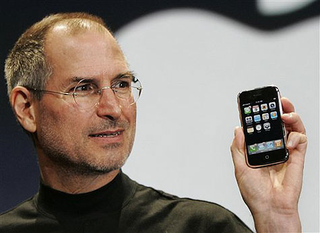
Steve-jobs-appe

First it was Libya, most recently it was Hurricane Irene, but in the middle of the week the single biggest news item, at least measured in terms of newspaper real estate, was that Steve Jobs has stepped down from running Apple. Is it stretching superlatives to say that he may be the one person alive who has most changed the course of history? As Joe Nocera said in the New York Times this week, probably more than anyone else alive, Steve Jobs has known the feeling of what it's like to have changed America, and probably the world. We can debate whether or not the personal computer as it is now has changed the world for the better, but it must be beyond dispute that it has changed it dramatically for most people.

So, let's make the sad assumption that Steve Jobs has stepped down from Apple irreversibly, what now? Where's the next Steve Jobs coming from? Clearly, the industrial world needs more Steve Jobs, but specifically, America needs more. What does it take to turn out, not only the next Steve Jobs, but perhaps a generation more likely to create multiple "Steve Jobs"-like innovators than the generation before? I don't know exactly, but I'm pretty sure that, whatever it is, we're not doing it as a society.

There are many myths about Steve Jobs, many attempts to distil the je ne sais quoi that made this man as impactful as he has been, but one thing I think is certain: we're moving our education system in a direction away from any lessons learned from the bio of someone like Jobs. One of the favourite stories about the Apple founder is that, when he dropped out of college and no longer had any courses that he had to take, he chose to take a calligraphy course. What he learned in that class was reflected years later in the typography for the first Mac. And this in turn changed the personal computer interface forever.


This kind of story is repeated over and over, both in Jobs' story and in the story of other innovators; the story of creative epiphanies springing from the exposure to a wide range of ideas, a wide range of disciplines. Yet we have a public school system that is increasingly deemphasizing art, music, social studies and the like in favour of test prep.

Forbes recently published a piece, Understanding Apple: Five Myths About Steve Jobs. Reading this piece and so many other attempts to dissect the success of the man, what emerges is that Steve Jobs isn't some genius of perfection who has never made a misstep. Rather, he's a master of the art of quickly learning from failures, of which Apple has had many; of seeing the kernel of a brilliant idea in other people's concepts (that those people and organizations had often failed to capitalize upon) and moving those ideas to the next level. He's a master of melding form and function, not sacrificing one to the other. How is it that almost all other technology companies haven't figured this out? I don't know, but they haven't. Apple consistently creates objects that are beautiful and functional. It turns out that aesthetics matter after all. So why are we dropping art classes in our public schools so that there's more time to prep for standardized tests?


Is there any evidence at all that the way that we're educating our children in the US is in any way likely to lead to a Steve Jobs mentality?  Maybe that's a lot to ask; maybe one Steve Jobs comes along every generation, if we're lucky. But are we even getting close? Are we even trying? Are we exposing our children to a wide range of disciplines and ideas and encouraging their creativity?

I know that I've harped on about this over time, but innovation, at any level, requires an appetite for failure. Anyone remember the Newton? An abject failure of Apple's, and there are many others. Yes, it's easy to just remember how fabulous the iPhone and iPad are and how much we all love our Mac Books. But there were plenty of failures. And, under Jobs, Apple learned from these failures and came back even stronger. But we're educating our children to be failure averse.

Does anyone really think that it doesn't matter whether or not we can regularly and reliably turn out Steve Jobs-like, even Steve Jobs-light, individuals? I don't know, but I do know that we are not educating in a way that maximizes the chances of doing so in the future. And that's probably not a good thing.

Posted by Sarah Firisen at 12:05 AM | Permalink

Comments

Thanks for this. A hallmark of good scientists is the recognition that one often learns far more from one's mistakes & failures than from one's successes. ("*Why* did that fail?", among other things.) What we know is always dwarfed by what we do not know, so discovery and innovation require a certain courage as well as humility, since it's inevitable that we will run quickly into the limits of our knowledge in the process of trying to increase it. A fellow musician friend of mine has as his creative motto, "Never satisfied, never discouraged"; perhaps this implicit balance is what characterizes *emotionally* the creative culture which, as the Forbes author points out, Jobs has imbued into Apple (so that any "great man" theories of Apple's post-Jobs demise are off-base), a culture with much in common with the best scientific endeavours.

But while Jobs has, arguably, instilled the best of himself, this fearlessness and willingness to fail in the service of excellence, in the service of giving others the best possible experience with what one makes for them to use, into the institutional DNA of Apple, you are quite correct to point out that there is no comparable phenomenon in education, even and especially in science education. (Part of this is due to the perversion & truncation of science's medium & long-range outlook in favour of the short-term gains that are unregulated capitalism's imperative. The corporatisation of universities, the trade school mentality crowding out the pursuit of knowledge for its own sake, is part of this. But that's a tangent involving more time than is appropriate to spend here. I'll mention only the Forbes writer's comment that for Apple, making money is only a side effect, albeit a highly desirable one, of the main goal of "delighting the customer.") Combined with actively and willfully ignorant anti-science elements on the rise (e.g., Rick Perry), the lack of this crucial aspect of science doesn't bode well for the US's ability to lead, whether in science itself or its application.

Posted by: Kai Matthews | Aug 31, 2011 1:48:47 PM

I highly suggest Mike Daisy's one-man show, "The Ecstasy and the Agony of Steve Jobs." It dives into Job's personality in great detail and the dramatic change in Apple's attitude toward customers over the decades. Paralleling this, it explores electronics manufacturing in China. Compared to those horrors, Jobs offers the humor in the show.

Long story short, Jobs is not a nice person. I find it hard to read these sort of Jobs-as-CEO obituaries without writing a long screed, citing Jobs horrid behavior toward his co-fonder, his employees, and his customers. I would suggest that these personality traits are far more important in understanding Apple's successes and failures than Job's personal "creativity."

Posted by: Cyrus Hall | Sep 1, 2011 3:14:08 AM

There's a reason I used the phrase, "the best of himself"; I've heard the horror stories and have no reason to doubt them, and yes, it's only over time that he's learned to temper the worst of himself, the over-the-top tantrums. But Jobs 2.0 really has been a success at creating a sustained creative culture at Apple. He's often been an asshole, but he's not wrong in his vision of what matters in making a product.

Posted by: Kai Matthews | Sep 2, 2011 1:06:32 PM

Post a comment


Subscribe to this blog's feed  

PayAnywhere with iphone credit card swiper

Android Tablet

Bluetooth Headset

2013 New Style Dresses

Compare Car Rental Prices

DHgate.com Wholesale

3QD on Facebook

3QD on Kindle

3QD by Daily Email

Receive all blogposts at the same time every day.

Enter your Email:


Preview 3QD Email

3QD on Twitter

Miscellany

Lijit Search

AddThis Social Bookmark Button

Add to Google

Recent Comments

Joel Grant on Why Rational People Buy Into Conspiracy Theories

Tomboktu on Why is Europe so Messed Up? An Illuminating History

Joe on Why Rational People Buy Into Conspiracy Theories

Jalees Rehman on The Science Mystique

Dredd on The Moral Status of Rocks

sjg on Why Rational People Buy Into Conspiracy Theories

Dredd on Why Rational People Buy Into Conspiracy Theories

Louise Gordon on Why race as a biological construct matters

Louise Gordon on The stories of two Palestinian villages: From Al-Araqib to Susiya

musafir on a pretty funny book

freddie on The stories of two Palestinian villages: From Al-Araqib to Susiya

freddie on The stories of two Palestinian villages: From Al-Araqib to Susiya

Junaida on Tuesday Poem

rafiq on Tuesday Poem

Raza Husain on the culture animal

Nebor on Tuesday Poem

Eleutheria on I am dust and ashes and full of sin

carlos on I am dust and ashes and full of sin

Joe on the culture animal

Sundar on the culture animal

Eleutheria on Positive Failure - a review of "The Power" by Rhonda Byrne

Eleutheria on Positive Failure - a review of "The Power" by Rhonda Byrne

Matt on The Science Mystique

Eleutheria on Why is Europe so Messed Up? An Illuminating History

Eleutheria on I am dust and ashes and full of sin

Acclaim For 3QD


"I couldn't tear myself away from 3 Quarks Daily, to the point of neglecting my work. Congratulations on this superb site."—Steven Pinker, Johnstone Professor of Psychology, Harvard University.

"I have placed 3 Quarks Daily at the head of my list of web bookmarks."—Richard Dawkins, Charles Simonyi Professor of the Public Understanding of Science at Oxford University.

"Just wanted you to know I’m one of many who reads and enjoys 3 Quarks....almost daily."—David Byrne, musician, former lead-singer of the Talking Heads, artist, intellectual.

Read more here.

The 3QD Prizes

Subscribe to this blog's feed