July 07, 2011
Pakistan’s Army: Divided It Stands
Pervez Hoodbhoy in Economic and Political Weekly:
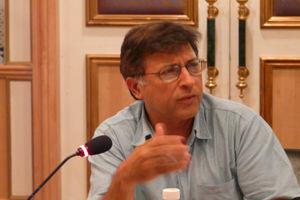
Although the army has been extremely reluctant to admit that radicalisation exists within its ranks, sometimes this fact simply cannot be swept under the rug. Last week, the army was forced to investigate Brigadier Ali Khan for his ties to militants of the Hizb ut-Tahrir, a radical organisation that seeks to establish a global caliphate and thinks its mission should begin from nuclear Pakistan. The highest ranking officer so far arrested, Ali Khan, comes from a family with three generations of military service and is said to have a strong professional record. It is said that General Ashfaq Kayani was reluctant to take this step in spite of incontrovertible proof that Khan had militant connections because he feared the backlash. Four army majors are also currently being investigated, but this could be just the tip of an iceberg.
More here.

Posted by S. Abbas Raza at 08:38 AM | Permalink


Comments
Good article. But I didn't agree with the conclusion that India should do more.
Does anyone honestly feel that Pakistan will stop its rabid hating of India even if India agreed to all of Pakistan's demands?
Posted by: ganji | Jul 7, 2011 12:48:39 PM
No.
Posted by: omar | Jul 7, 2011 4:10:40 PM
Omar, as John Stewart would say, "Go ooooawn..." :-)
Posted by: Abbas Raza | Jul 7, 2011 5:04:09 PM
Does anyone honestly feel that Pakistan will stop its rabid hating of India even if India agreed to all of Pakistan's demands?
Not if religion is involved. A sad, degenerate country, dealing with population overshoot, ecological destruction, depleted aquifers, religious fundamentalism, lack of education, all run by the military.
Probably the first of the big countries over the cliff.
Posted by: Dave | Jul 7, 2011 10:46:41 PM
This is just the wrong way of framing the question and of conceptualizing the problem.
What does one mean by "Pakistan's demands"? Who's demands are these?
India doesn't have to agree to any of "Pakistan's demands." India has to strengthen those in Pakistan who wish to change those demands or get rid of them altogether.
The cynical response would be that there are no such people in Pakistan but that would be an oversimplification. Even Pervez fails to make that point with his stress on the divisions between soft and hard Islamists.
If there were no such trends in Pakistan, the army would not have felt the need to derail them with Kargil.
Posted by: Anjum Altaf | Jul 8, 2011 2:52:11 AM
the 'new mindset' hoodbhoy is trying to articulate makes no sense within the post-partition model we have lived with all our lives -- but his arguments could be the beginnings of a post-post-partition model, which is to say a regionalist, supra-national framework in which different interlocutors have common, albeit perhaps asymmetric, stakeholdership.
Posted by: Aditya Dev Sood | Jul 8, 2011 10:30:54 AM
"If there were no such trends in Pakistan, the army would not have felt the need to derail them with Kargil."
Or perhaps the army was only focused on its "brilliant" strategy to isolate the Siachin glacier's supply chain from India, and couldn't care less what games its civilian figureheads were playing in their sandbox.
It wasn't a matter of derailing those who wished to chart a more sensible course for Pakistan (we are, after all, talking about Nawaz Sharif and his merry men), but allowing them to distract the gullible Banias while the 400% brilliant trap was being sprung.
The cynical response is that there are indeed such people in Pakistan, but they are also inconsequential to the society-at-large and the direction that Pakistan is irreversibly headed.
Posted by: Sam | Jul 8, 2011 1:05:19 PM
The cynical response is that there are indeed such people in Pakistan, but they are also inconsequential to the society-at-large and the direction that Pakistan is irreversibly headed.
Not cynical, observant:
Like This
Posted by: Dave | Jul 8, 2011 1:16:16 PM
Until a popularly elected government that has complete control over the Pakistani army/military as well as all the tribal regions in Pakistan comes to power India should not engage in fruitless and probably self-destructive talks with Pakistan.The ball is clearly in Prof. Hoodbhoy and Pakistani civil society's court.Get your act together first!
Posted by: Sumant | Jul 8, 2011 6:26:44 PM
The first part of Dr. Hoodbhoy's article was strong, although I suspect that his One'ers and Two'ers are no farther apart from each other than Thing One and Thing Two were in The Cat In The Hat. The One'ers, it could be argued, are a little more kleptocratic than fanatic. But this distinction could apply just as equally to the Generals of the Two'ers; the likes of Hafiz Saeed or Fazlur Rahman Khalil, who have made a good living out of their fanaticism.
Dr. Hoodbhoy greatly disappoints in part 2 of his article where he hurriedly slaps on text from a previous article of his, and proceeds to instruct India to reward Pakistan for every instance of atrocious behavior. I fail to see how India has driven Pakistan to a corner when Pakistan's decisions and choices were made on its own accord.
His advice to leave Kashmir as a problem to be solved by Kashmiris, presumably, applies only to Indian Kashmir and not to Pakistani Kashmir. Indian Kashmir has had several open state elections and has far greater autonomy (while keeping its territory intact) than Pakistani Kashmir has ever had. But I suspect that his views remain shaped by the 2-nation theory that he grew up under, and an underlying disquiet over a Muslim majority state existing within the context of a non-Muslim majority country; even if India has nearly as many Muslim citizens as Pakistan does.
Posted by: Sam | Jul 8, 2011 6:48:55 PM
Post a comment