
| ABOUT US | ARCHIVES | LINKS | RSS FEED | MONDAYS | |

3quarksdaily

An Eclectic Digest of Science, Art and Literature

« Let's Talk About It | Main | Monday Poem »

July 11, 2011

Movie Meringues

by Hasan Altaf

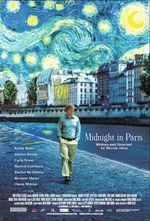
ParisIt seems like everyone I speak to has loved Woody Allen’s Midnight in Paris, and the reviews have also been generally glowing. My search for someone who shared my less rapturous feeling has so far been largely fruitless, and at this point I am beginning to think that there might be something wrong not with the movie, but with me. Midnight in Paris seemed to me kind of like a meringue: Light, harmless, and not entirely satisfying.

There is of course nothing at all wrong with meringues; they are what they are, and the kind of film that one enjoys while watching and then forgets about also serves a purpose. This is the land of summer comedies (Bad Teacher), the new crop of identical, CGI-enhanced superhero movies (take your pick), and even the vast majority of Bollywood. None of these genres, though, is greeted with the kind of rave reviews that Midnight in Paris has garnered.

Beyond the fact of Paris, the film has three things, as far as I can see, working in its favor. The music and the cinematography are undeniably great, but most of us don’t, in the end, watch movies for the cinematography or the music – at the Oscars, these are the categories we tend to glaze over, not recognizing any of the names, although we can appreciate their accomplishments when we see or hear them. On their own, these two feats don’t seem to merit the kind of reaction that the film has received.

The real selling point of Midnight in Paris is the conceit: The idea of the unexpected opportunity for a modern-day man to visit, each night, an era that he has always in some sense longed for, to rub shoulders with his idols, to sit across the table and be bored to tears by geniuses in the flesh. It’s a charming idea, a what-if game brought to life, and it’s hard to resist; it allows the audience to imagine themselves in that scenario, to wonder what it would happen if we could visit the periods of history that have enchanted each of us and meet whoever it was we always wanted to hang out with. 

The conceit, though, seems more naturally to belong in a skit, or a series of brief clips; the closest analogy that came to mind for me was something like a French and Saunders routine (for example, their parody of Mamma Mia!, which can be seen here) – a smaller, more flexible environment, in any case. A frame story – and not a particularly interesting frame story, as such things go – seems to have been hastily constructed around this device in order to justify a full-length feature film. What we wanted, as viewers, was to run around with F. Scott Fitzgerald, be annoyed by Ernest Hemingway, and watch Gertrude Stein give Picasso a dressing-down; I find it difficult to imagine that anyone in the theater particularly cared about what happened to Owen Wilson and his fiancée.

I think many of the other problems of Midnight in Paris could also be blamed on the frame story, including the entirely unnecessary epiphany: The “point” of Owen Wilson’s story was obvious from the moment the movie began, and it was essentially uninteresting. Gill’s time-traveling romance also felt like an unnecessary addition designed to give the film a little bit more plot, to keep it from being just a series of set pieces – which is, I think, what it really wanted to be – and in some cases, there is nothing really wrong with set pieces. Stretching something that wants to be a vignette into a novel never pays off; similarly, building a feature film around a set piece does both a disservice.

The intent of Midnight in Paris made me think of Paris, je t’aime (which for some reason I always remember as París, te quiero), which presented short films by several different directors, each set in a different part of the city. Midnight in Paris could easily have been part of that project, or a similar one, building a whole out of parts. Paris, je t’aime could have included visits to different times in the city’s history, or another movie could have done with history what Paris, je t’aime did with geography. Allen's movie is at heart a love letter to the city; Paris, je t'aime was too, but it was a love letter that made a little more sense.

So what is it that sets Midnight in Paris apart from the other meringues? Maybe it speaks to something different than most movies, and I think also allows for something more personal than harmless entertainment or escapism or vicarious thrills; everyone, after all, has some form of Gill Pender’s nostalgia. Personally, though, I found myself wishing Woody Allen would just set up a YouTube channel, so he could have cut away the excess of the movie and focused on its strengths. Because sometimes what you want is indeed a meringue. If you have that meringue with a bowl of cereal, though, neither one is as good.

Posted by Hasan Altaf at 08:10 AM | Permalink

Comments

For a more powerful yet contemporary Parisian and Allenesque experience this summer, may I suggest The Names Of Love, out all over the East and West Side of Manhattan, and wherever Woody Allen movies used to be shown.

Look forward to that review too!

Posted by: aditya dev sood | Jul 11, 2011 9:44:14 AM

I wish people had taken Woody Allen's last film, "You Will Meeet a Tall Dark Stranger" as seriously as they're taking "Midnight in Paris". I found "Stranger" to be a funny, unnerving, and serious meditation on belief, right and wrong and the fates of some peculiar individuals. Not heavy, not fluffy, but just the right mix of comedy and drama and the unexpected.

Posted by: Faze | Jul 11, 2011 12:05:32 PM

So what you're saying is that it's no Citizen Kane or some other very deep film. I think a lot of critics agreed with you, actually; it didn't get unanimous raves.

I actually enjoyed it, as entertainment, which is what it was. Is there anything wrong with entertainment? In any case, my view of Mr. Allen is that he's always been an entertainer since his stand-up career phase; he managed to convince a lot of people that he's a very deep thinker because he was able to tell jokes about Kierkegaard and Nietzsche, but that didn't make him a philosopher.

Posted by: JonJ | Jul 11, 2011 9:43:16 PM

I suspect that Pauline Kael would have commiserated with you - I remember the buzz around Hannah and Her Sisters when it came out, and she was almost alone in proclaiming it "a minor film" when other critics (and everyone I knew) were exclaiming over it. I saw it again recently and I have to concur with her judgment. Allen may or may not intend to project himself as a deep thinker, but there are plenty of people willing to consider him one. Perhaps he's been playing along for a very long time.

Posted by: Kai Matthews | Jul 12, 2011 12:22:27 AM

What's not to like? The story is charming and Paris looks beautiful.

The message is also timeless, applies to both sides of the political spectrum, and has been much reiterated by religionus teachers and other philosophers: live in the present.

Well and good, but along the way wouldn't you like to rub shoulders with your heroes of yesteryear?

Posted by: steve | Jul 12, 2011 8:37:08 AM

@Faze, I feel the same way about You Will Meet a Tall Dark Stranger. I loved that movie and yet it slipped totally under the radar, while Midnight in Paris got a million rave reviews (and left me cold.) You Will Meet a Tall Dark Stranger actively engages with real, if ridiculous, moral and emotional dilemmas. Midnight in Paris, on the other hand is so light and fluffy it borders on meaninglessness. We get to sit there smugly, taking in the long parade of literary and artistic celebrities. Sort of a self-congratulatory exercise, I thought. (No offense if you liked the movie.) I'll admit, I was delighted to notice Isabelle Adjani, in the role of art docent, tangling with her charges over details from the life of Camille Claudel, whom Adjani played in the 1989 movie about her relationship with Rodin, who gets his turn in the film, as well. Midnight in Paris is full of little precious moments like this where you can nudge your partner and say, "Oh I know who that is!" It's just, once you get past that, there isn't much there.

Posted by: k.walker | Jul 12, 2011 1:28:38 PM

The post's dismissal of the frame story rejects the moral of the film, which is that there is no "golden age" and that we should look for satisfaction in the present, not in nostalgia.

I admit the Hemingway parody was more entertaining than the moral, but that's what the film was saying, and it couldn't be said just by focusing on the 1920s characters. If that's what Allen had wanted to do, he could've set the film in that time for real, adapted A Moveable Feast, whatever.

Posted by: Anderson | Jul 13, 2011 5:59:45 AM

Post a comment


Subscribe to this blog's feed  

PayAnywhere with iphone credit card swiper

Android Tablet

Bluetooth Headset

2013 New Style Dresses

Compare Car Rental Prices

DHgate.com Wholesale

3QD on Facebook

3QD on Kindle

3QD by Daily Email

Receive all blogposts at the same time every day.

Enter your Email:


Preview 3QD Email

3QD on Twitter

Miscellany

Lijit Search

AddThis Social Bookmark Button

Add to Google

Recent Comments

omar on Race Is Not Biology

Raza Husain on Race Is Not Biology

Raza Husain on Race Is Not Biology

Josef Stern on REFLECTIONS ON WOOLWICH

Colette on POETRY IN TRANSLATION: CORDOBA

Dana on A young Houston couple is planning to give away $4 billion—but only to projects that prove they are worth it. Can they redefine the world of philanthropy?

omar on REFLECTIONS ON WOOLWICH

Dredd on REFLECTIONS ON WOOLWICH

omar on Race Is Not Biology

prasad on Race Is Not Biology

JF on REFLECTIONS ON WOOLWICH

Sundar on REFLECTIONS ON WOOLWICH

omar on REFLECTIONS ON WOOLWICH

musafir on Loneliness, isolation and desperate yearning

carlos on The Gut-Wrenching Science Behind the World’s Hottest Peppers

Dredd on A young Houston couple is planning to give away $4 billion—but only to projects that prove they are worth it. Can they redefine the world of philanthropy?

Dredd on Why Rational People Buy Into Conspiracy Theories

JonJ on Daniel Dennett's seven tools for thinking

JonJ on Race Is Not Biology

omar on Race Is Not Biology

omar on Race Is Not Biology

Dredd on Race Is Not Biology

Dredd on Race Is Not Biology

allsmiles on A Mother, a Son and a Wife

sverson on Race Is Not Biology

Acclaim For 3QD


"I couldn't tear myself away from 3 Quarks Daily, to the point of neglecting my work. Congratulations on this superb site."—Steven Pinker, Johnstone Professor of Psychology, Harvard University.

"I have placed 3 Quarks Daily at the head of my list of web bookmarks."—Richard Dawkins, Charles Simonyi Professor of the Public Understanding of Science at Oxford University.

"Just wanted you to know I’m one of many who reads and enjoys 3 Quarks....almost daily."—David Byrne, musician, former lead-singer of the Talking Heads, artist, intellectual.

Read more here.

The 3QD Prizes

Subscribe to this blog's feed