
by Jeff Strabone
When Cy Twombly died last week on July 5, my first thought was that the greatest living painter had left us. That's because I am a simple fellow amused by such games as anointing The Greatest Living Painter and The Most Delicious Dinner Entrée in New York. (It's the duck at The Grocery on Smith Street.) Less foolishly, I hope, my second thought was that Twombly may have been the last great classicist in a world where classicism may no longer be an available position.
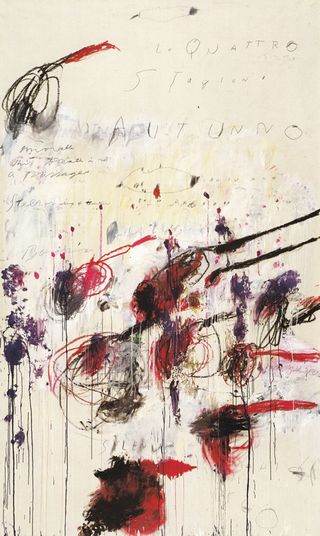
The obituary in the New York Times declared that Twombly was 'stubbornly out of step with the movements of postwar American art even as he became one of the era's most important painters'. Despite painting in a style that would not have been conceivable before the late twentieth century, Twombly stood outside his time chiefly because his deepest commitments were to an ideal of timeless classicism. Although he may have sidestepped the many competing art movements of his day, Twombly's classicism revealed a definite partisan affiliation: he was a Dionysian of the highest order.
All the recent notices remind us that Twombly was the painter who left New York. A more fitting epitaph would be that he was the classicist who went back to the source. Though he admired the beauty of his native Virginia, a place he said had more columns than all of Rome and Greece, he moved to Italy in his late twenties. His explanation tells us a lot: 'I've always lived in the south of Italy, because it's more excitable. It's volcanic.'
In literature and visual art, classicism is work that draws on ancient Greece and Rome, usually with reverent imitation. The poetry of Alexander Pope, for instance, is neoclassical because of its devotion to propriety, balance, and decorum in a way that was thought to mimic the values of the Augustan era in Rome. But classicism is not simply imitative. Any classicist worth our attention converts, in some distinct way, his traditional sources of inspiration into new methods, techniques, and styles.
Twombly was unquestionably modern, but to recognise the depth of his classicism we must be mindful of competing ideas of just who the ancients were. Were the Greeks and Romans the decorous stoics suggested by Pope's 'Essay on Criticism'? Or were they—like Steely Dan's 'Josie', who 'prayed like a Roman with her eyes on fire'—wild bacchantes driven mad by their volcanic lusts and desires? Twombly belonged in the latter camp, as we can see from the way he painted: not just with his eyes but with his entire body, from brain to cock, on fire.
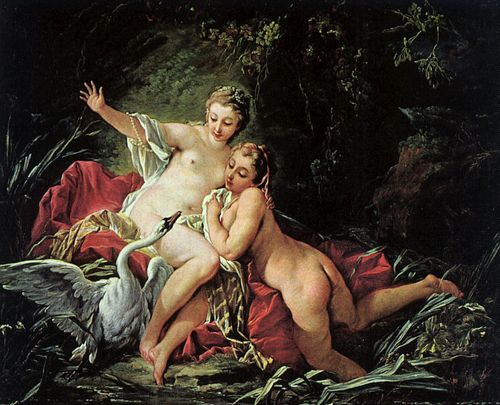
Although Twombly made paintings with titles like Coronation of Sesostris, Fifty Days at Ilium, and Say Goodbye, Catullus, to the Shores of Asia Minor, he did not paint like the Academic painters we might expect to have produced such works, as in, for example, François Boucher's Leda and the Swan.
Twombly's canvases are instead full of crayon slashes, dashed blobs, mad scrawls, howling reds, erotically bruised purples, words written as if some pre-literal frenzy were reclaiming them, and non-words of linguistic illegibility that are nevertheless passionately articulate. Here is his take on Leda and the Swan from 1962.
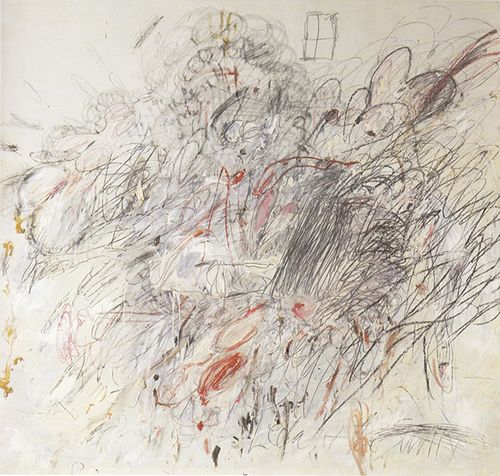
Most paintings of the story show us a moment before the act. Perhaps building on the lead of William Butler Yeats, whose poem on the subject, leads us to envision the seduction of a girl by the 'feathered glory' of a giant swan, Twombly shows us the frenzied carnality of a swan-embodied Zeus and the soon-to-be mother of Helen of Troy in the moment. That is not a simply a big ball of confusion on the canvas: that is a feathered, godly beast and the daughter of King Thestius of Aetolia going at it.
Twombly was also, literally, a painter of poetry. He not only adapted poems into paintings but would sometimes paint passages from the poems on the canvas. In at least one documented case, and surely countless undocumented, he inspired a viewer to go back and read more poetry, as Jonathan Jones recently confessed in the Guardian:
Here is an artist who can teach you to read. Few of us nowadays read as Twombly did, steeping himself in Greek, Latin and English verse and teasing the beholder to follow up enigmatic quotations scrawled in a languid stain on his sighs of paintings. At Dulwich hangs a painting called Hero and Leandro (for Christopher Marlowe). It is a white misty spume of oceanic spray assailed by a bloody smear of red. Blood in water, it seemed to me. Only later did I read the Marlowe poem Hero and Leander that begins: 'On Hellespont, guilty of true love's blood…'
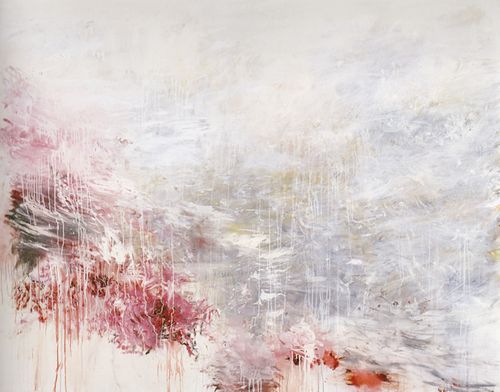
The writing in his the paintings is sometimes illegible and sometimes not even writing, if by 'writing' we mean communication by language. If it makes sense to call such writing-like mark-making illegible but not unintelligible, then we might do so when looking at Cold Spring (1970) below.
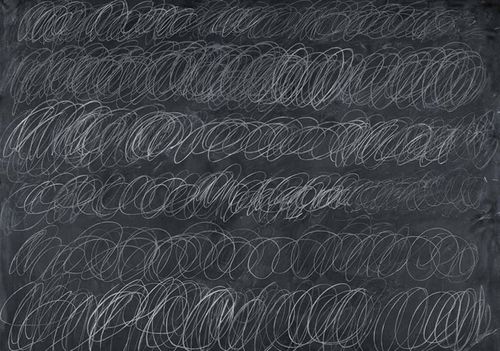
The chalk-like lines appear to have been made by a primitive, compulsive energy beyond—or before?—both language and representation. I want to say that someone might have made these marks on the wall of a cave, but our cave-artist ancestors were actually less primitive and more gesturally circumscribed than this. Although I've never been comfortable with comparisons between Twombly and the Abstract Expressionists, these swirls are where they find some common ground. It is hard not to imagine the arm that swept over the plane in circles. Amusingly, Twombly had been a cryptographer in the U.S. military during World War Two. In cryptography, the practice of creating and breaking codes, there is always a key, but not here. Were Twombly's chalk-scribble paintings the next step beyond cryptography, or its opposite?
It is fair to link Twombly with Robert Rauschenberg and Jasper Johns to the extent that all three found a way past Abstract Expressionism when it was the dominant movement, but there the similarities end. Where then might we look for followers who might carry on aspects of Twombly's highly distinctive work? Only the omnivorous, promiscuous Jean-Michel Basquiat comes to mind, and he, sadly, pre-deceased Twombly. Basquiat, too, blurred divisions between painting and drawing; put words, both legible and illegible, on the canvas; and, like Twombly, was as learned a painter as the twentieth century could produce. And if you don't think there's any classicism in Basquiat, may I suggest you take a fresh look at his Jawbone of an Ass?
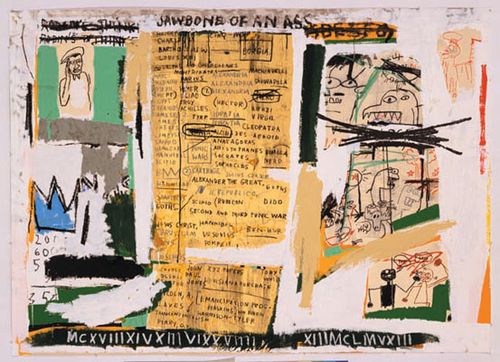
Was Twombly, then, the last classicist we can expect to meet? A true classicist is not a pedant but, rather, someone who feels a deep, personal continuity with the distant past and can make others feel it, too. Twombly's death may mark the end of something that is not coming back anytime soon: genuine sympathy for the distant past. Who reads the Iliad and feels it in their loins anymore? Twombly did. We, on the other hand, may be losing both our feeling for history and our feeling for feeling.
One of my favourite Twomblys is at the Philadelphia Museum of Art, in the gallery dedicated to Twombly's ten-painting Trojan war series , Fifty Days at Ilium (1978). It's this one below called Heroes of the Achaeans.
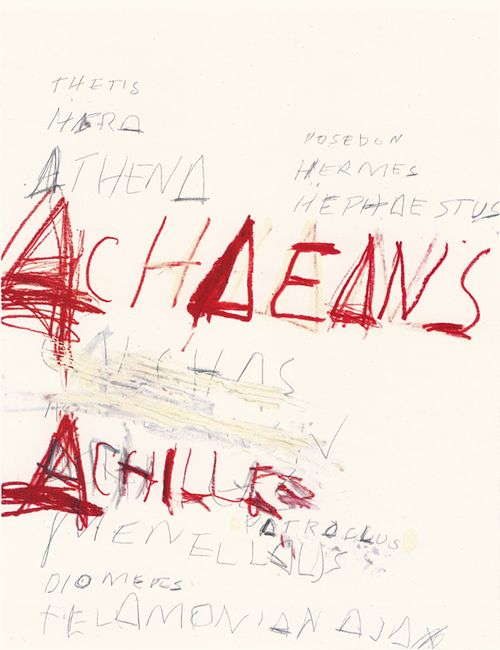
This painting is simple, elemental. It makes one feel more than think. The howling pain of war in Troy has never been communicated to me as potently as when I stood in the museum and saw the screaming red scrawl of the ACHAEANS and ACHILLES. Is this written in blood? in fury? in fear? or perhaps on what's left of the walls of Troy after the fact? Twombly's paintings certainly reward knowledge, but they do not demand it. One can feel his colours, scrawls, and scribbles with an immediacy that no painter alive can convey.
And that may be why this feels like an ending: because we live in a world that is so deeply mistrustful of feeling. And we have developed art practices that are, at their worst, so conceptual that they require long wall-texts to tell us what to think because, by design, there is nothing in them to make us feel. We will go on feeling the loss of Twombly for as long as we remain feeling people. What worries me in the early twenty-first century is that I honestly don't know how much longer that may be.