| ABOUT US | ARCHIVES | LINKS | RSS FEED | MONDAYS | |

3quarksdaily

An Eclectic Digest of Science, Art and Literature

« Perceptions | Main | Men of Straw »

June 27, 2011

Unwieldy Property

by Misha Lepetic

“Whoever lays his hand on me to govern me is a usurper and tyrant, and I declare him my enemy.”
- Proudhon

100813_22_20100723_fp_chongqing_online_selects005 Back in undergraduate days, when, if it is to be believed, my prose was even more incomprehensible than it is now, I wrote a paper on the economic history of the concept of private property ownership. After 37 pages, and having only reached JS Mill, I bowed out as gracefully as I could, and spent the next week wondering how anyone could be said to own anything at all. And yet, society’s legal and social construction of property ownership continues to be of the utmost importance in setting the course for economic development in general, and urbanization in particular.

In this sense, past commentators have looked at housing as an especially crucial area, since the larger issue of urban migration had already reached a boiling point in Europe by the mid-19th century. The work of Pierre-Joseph Proudhon is worth singling out in this regard. Originally an unapologetic Anarchist best known for the pithy aphorism “property is theft”, by the end of his life Proudhon had moderated his views considerably. Writing in the posthumously published Théorie de la Propriété,

“…property is the greatest revolutionary force which exists, with an unequaled capacity for setting itself against authority … [The] principal function of private property within the political system will be to act as a counterweight to the power of the State, and by so doing to insure the liberty of the individual.” Proudhon, quoted in Gray, p135

For the later Proudhon, the validity of property is resurrected only “if it is purged and infused with justice” (Gray, p243). Specifically, this right to property would encourage workers to defend themselves against the depredations of the State and its capitalist abettors. In contrast, the propagation of rent-based housing only exacerbated the uncertainty of their situation. It would also go a ways towards preventing slum clearance, which was as ineffective then as it is now. In fact, two decades after Proudhon’s death in 1865, Great Britain’s Royal Commission on the Housing of the Working Classes published a report where the acknowledged that

Rookeries are destroyed, greatly to the sanitary and social benefit of the neighborhood, but no kind of habitation for the poor has been substituted… The consequence of such a proceeding is that the unhoused population crowd into the neighboring streets and courts…and when the new dwellings are complete…the tenants are not the…persons displaced [so that] those whose need is greatest suffer most acutely. (p19-20)

Thus Proudhon’s hope was that, in aggregate, the landowning proletarian class would throw up a legal-materialistic barricade against those who would otherwise bulldoze their neighborhoods and subsequently engage in the kind of property speculations that only further exacerbate income inequality and displacement of urban populations.

We shall return to this thesis, but Proudhon’s views were starkly contradicted, if not ridiculed outright, by Friedrich Engels, who responds in The Housing Question:

The whole conception that the worker should buy his dwelling rests … on the reactionary basic outlook of Proudhonism, … according to which the conditions created by modern large-scale industry are diseased excrescences, and that society must be led violently, i.e., against the trend which it has been following for a hundred years, to a condition in which the old stable handicraft of the individual is the rule, which as a whole is nothing but the idealized restoration of small-scale enterprise, which has been ruined and is still being ruined…Proudhon only forgets that in order to accomplish all this he must first of all put back the clock of world history by a hundred years, and that thereby he would make the present-day workers into just such narrow-minded, crawling, sneaking slaves as their great-grandfathers were.

267px-Kraak-logo.svg Since the rise of capital (and the city, as a manifestation of capital) was an irreversible phenomenon (that could only lead to socialism), anything else must be considered an intolerable delay. In Andrew Merrifield’s words, “with a “stake” in the system and mortgaged up to the hilt, some workers become paragons of consenting citizens, stifling revolutionary spirit…the Proudhonist plan, far from bringing the working class any relief, was used directly against it” (p45).

However, Engels graciously refuses to design or suggest any future state. As with so much else of Marxism, he discusses the future redistribution of property with the following breezy statement: “As soon as the proletariat has won political power, such a measure prompted by concern for the common good will be just as easy to carry out as are other expropriations and billetings by the present-day state.” This is not helpful. On the other hand, it has led to at least one wonderfully satirical memoir attempting to describe the lunacy of navigating socialist housing in the worker’s paradise that was the Soviet Union.

It may be surprising, then, to realize that while the debate has sharpened, it has not lost its basic contours. For example, it is instructive to consider Engels’s critique in light of the current financial crisis, where homeowners with mortgages almost permanently under water simultaneously function as the taxpayers backstopping the consequences of banks’ irresponsible lending practices.

On a larger stage of global urbanization, two contemporary commentators have taken over from their 19th-century counterparts. In the Proudhonian corner, Peruvian economist Hernando de Soto argues that “the distinction between property-as-possession and property title [is] the basis for the entrepreneurial generation of wealth. The world’s poor have the former; they need the latter.” That is, the lack of a record-keeping system for titling land to squatters obviates the possibility for much further economic development; to de Soto, this is the principle difference between the success of capitalism in the west, and its failure in many other places. To this effect, his Institute for Liberty and Democracy has been consulting to governments interested in developing these kinds of databases.

But is this enough? That is, given significant enough barriers to formal property, is the formation of capital really impossible? De Soto ends The Mystery of Capital with “but for the moment, to achieve those goals [of development and social justice], capitalism is the only game in town. It is the only system we know that provides us with the tools required to create massive surplus value.” (p228)

It should now be clear where de Soto departs from Proudhon: whereas Proudhon’s workers owned their property as a bulwark against the state, de Soto explicitly relies on the state to provide protection and enforcement of property rights (admittedly, Proudhon’s enforcing entity is unclear to me). It should not be surprising that not only governments, but also companies, have been eager to create these information systems, since this is another step into bringing a large segment of the urban population into contact with opportunities for consumption and debt.

Robert Neuwirth, a journalist whose experience of living in slums around the world led to the publication of Shadow Cities, disagrees that formal titling is necessary to provide the baseline for development. Rather, people need two things: a guarantee, however tacit, that they will not be evicted; and access to politics, where residents can organize themselves into entities that are recognized by governmental institutions (see his Long Now talk, starting at 55:15). As an example, Sultanbeyli is an official sub-municipality of Istanbul, with a popularly elected mayor and services provided by taxes collected within the slum. Remarkably, no one owns title to any of the buildings in the community.

Other projects are similarly engaged: the Favela-Bairro project in Rio de Janeiro seeks to “regularize” slums by mapping them, providing better water and construction options, and, while residents are not issued property titles per se, they have tacit assurance that they will not be evicted. In these cases recognition and enforcement of claims may still be precarious, but the uncertainty seems to have been reduced to a point where dwellers are willing to invest in their communities, and in turn, the government is less keen to clear the slum wholesale.

And yet, both de Soto and Neuwirth are firmly entrenched in the belief that the global slum-city is a warren of entrepreneurship just waiting to erupt. For both, the formation of capital, and therefore prosperity, is as inevitable as socialism was to Marx and Engels. This is in itself a peculiar perspective, attacked recently and with relish by journalist Mike Davis in Planet of Slums. Punching away in Engels’s corner at the efficacy of titling, Davis’s newly empowered property owners simply evolve from slum dwellers to slumlords. In fact, this is capital formation by any other name.

An Lagosexample of another objection to de Soto’s project concerns “'Informal employment,' [which] by its very definition…is the absence of formal contracts, rights, regulations, and bargaining power” (p181). This brings us to the crux of the matter. What are the economic and social relations of the people living in any of these places? As noble as it may be, what is most striking about an attempt like de Soto’s is that, once again, urban planners and theorists are tacitly concerned primarily with the built environment. This is almost as if to say that, once the built environment has been reinvented, formalized or brought into some kind of bureaucratic receivership, all social relationships will uncomplainingly evolve in a complementary fashion. (And yet, like Engels, Davis is short on recommendations. In fact, it is even worse, as Davis cannot avail himself of Marxism’s “As soon as the proletariat wins everything is gravy” attitude. Unlike Neuwirth’s Shadow Cities, which makes a gritty but optimistic case, Planet of Slums is relentless, a sort of Bleak House for our urban future.)
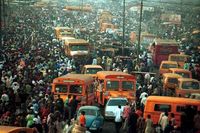
  So, what might informal employment look like in “real life”? In a seminal 2006 article, the New Yorker’s George Packer describes economic relations in Lagos’s informal sector:

What looks like anarchic activity in Lagos is actually governed by a set of informal but ironclad rules. Although the vast majority of people in the city are small-time entrepreneurs, almost no one works for himself. Everyone occupies a place in an economic hierarchy and owes fealty, as well as cash, to the person above him—known as an oga, or master—who, in turn, provides help or protection. Every group of workers—even at the stolen-goods market in the Ijora district—has a union that amounts to an extortion racket. The teen-ager hawking sunglasses in traffic receives the merchandise from a wholesaler, to whom he turns over ninety per cent of his earnings; if he tries to cheat or cut out, his guarantor—an authority figure such as a relative or a man from his home town, known to the vender and the wholesaler alike—has to make up the loss, then hunt down his wayward charge. The patronage system helps the megacity absorb the continual influx of newcomers for whom the formal economy has no use. Wealth accrues not to the most imaginative or industrious but to those who rise up through the chain of patronage. It amounts to a predatory system of obligation, set down in no laws, enforced by implied threat.

It is difficult to square this set of socio-economic relations with de Soto’s embrace of capitalism as “the only system we know that provides us with the tools required to create massive surplus value.” In fact, what Packer describes is a proto-capitalistic system; its currency is fear and debt, not trust and credit. This is emergent economic behavior in its most elemental form, and not some fairy-tale story of a microfinance-funded nail salon. It takes an extraordinary leap of faith to think that titled property rights will displace such a brutish, protean system, or even to assume that somehow these two phenomena are mutually exclusive. In fact, it is much easier to imagine that informal systems of such wicked adaptability could survive alongside, or indeed be nestled in, a formalized system of property rights. It is easy to then further extrapolate that the corrupting influence of money and power generated by the informal system will constantly threaten the formal system. On this topic, de Soto himself recently published a trenchant article entitled “The Destruction of Economic Facts.” Its subject? The undermining of the US property title regime by the banks and the federal government.

Posted by Misha Lepetic at 12:50 AM | Permalink

Comments

An excellent critique of de Soto's solutions.

But where does this leave us?

Posted by: Louise Gordon | Jun 27, 2011 8:56:43 PM

An observation. Quoting Engels in the critique,( “As soon as the proletariat has won political power, such a measure prompted by concern for the common good will be just as easy to carry out as are other expropriations and billetings by the present-day state.” Misha Lepetic is mentioning only a satirical Soviet fiction about the lunacy of (so called) "socialist system". In fact in many socialist countries(as Romania and Serbia) the expropriated Real Estate was SOLD to the renters as the "socialist" state wanted new incomes. However the ownership was partial and in some cases the owners had to re-sale their flats again to the state. In Serbia, due to the economic war problems, the govern wanted to take back the houses and flats that were sold;the public and the party officials (that bought 3-5 properties each ) protested violently and they remained owners of the RE. In the capitalist countries where a (real)socialist party was in power, poor people were living in very small (up to 65m)apartments in very elementary and cheap buildings on a very small monthly payment. This was the case of Israel for many years; however in tendency in privatization those flats were sold to reduced prices to the very happy renters that bought them in view to leave them to their children as an inheritance. And here the remark of Robert Neuwirth that the tenants don't need a formal titling, but "a guarantee, however tacit, that they will not be evicted; and access to politics, where residents can organize themselves into entities that are recognized by governmental institutions " maybe is true for slums and lumpen proletariat, but not for regular citizens of the (ex)socialist and capitalist world.
And from here to Louise Gordon's question: "But where does this leave us?" In the same spot; we, humans, are property owners animals; our books, our collections,our house, our country are ours only and we want to share very little...Practical? we have to ask ourselves if we have enough income to pay the mortgage; if we have, the RE ownership is still a good investment.In the last 10 years, the value of RE is going up all over the world. And till this roulette will still spin, we will bet because the ownership is a part of our nature as our craving for sex, sugar and fats.
“The instinct of ownership is fundamental in man's nature”
William James

Posted by: Mirel | Jun 28, 2011 1:49:40 PM

Might i suggest you also have a look at David Harvey's work? See http://davidharvey.org/2011/05/%E2%80%AAvideo-emancipation-from-what-and-from-whom%E2%80%AC/ for a talk that engages sideways with this topic. I wouldn't really know which of his more recent books to recommend on this topic, but maybe there's something to be found in recent journal articles.

Posted by: Foppe | Jun 28, 2011 2:57:53 PM

Thanks, Misha, for writing such an illuminating article on the antinomy of "Proudhonism" and "Marxism." In your post, you treat the reader to a drama that unfolds in true Hegelian fashion: here are two competing goods, two claims to right, and no reconciliation to speak of.

Especially lucid was your objection to thinking of the problem of urban slums exclusively in terms of the built environment. Surely as you suggest, the development of social mores, of habits, of a certain ethos is just as important as the creation of the right kind of built space.

On this last point, I can provide some anecdotal evidence. In my practice, I seek to cultivate friendships based on trust; payment expressed as gratitude; obligations that double as passions; in short, ways of loving what we ought. My sense is that, in this historical moment, there is a genuine hunger for alternative economic models that more closely resemble those of family, kin, and town. The lesson could be that nostalgia needn't always be a bad thing, especially if it can be recast in a new, more beautiful form.

Posted by: Andrew Taggart | Jun 28, 2011 3:15:03 PM

This is a superb article.

I want to say fifty different things in response, and each one of those fifty contradicts the other forty-nine. That is because shit is complicated, as the modern intellectual drama above reveals.

We associate George W. Bush with the idea of the 'ownership society', but my memory flashes back to Jack Kemp, Bush I's secretary of HUD from 1989 to 1993. Kemp's idea, which he was not able to achieve, was to turn some public housing over to its tenants and turn them into owners. In the Bush II years, the race was on nationwide to give everyone a mortgage who wanted one, even people with No Income, No Job, and no Assets, hence the so-called 'NINJA' mortgage. (When someone invents a mortgage available only to ninjas, I will be the first in line.)

One of the lessons learned in the last decade—but destined to be repeated—is that some people are not, shall we say, sufficiently high-functioning to hold a mortgage.

I am glad you cited Packer's description of the formal rules of Lagos's informal economy. I agree with you that 'its currency is fear and debt, not trust and credit' but not that that makes it proto-capitalist. It is more an urban analogue of feudalism, one that no-one should idealise. Even Marx and Engels saw capitalism as historical progress past that kind of feudal patronage.

The things about de Soto's title-mania is that he is both right and wrong. Giving slum-dwellers title to what they already own gives them an asset to borrow against. (Hold on. It's coming.)

From one legitimate perspective, that is an excellent thing. Lack of access to credit and debt will keep the poor poor. In my mind, this is the main reason that African-Americans stayed poor throughout the century of segregation and since: banks would not lend them money. African-Americans, no matter how industrious or ingenious, had to live a purely cash existence for over a hundred years, and that is no way to get ahead in the modern world.

But, of course, having an asset to borrow against means going into debt in the formal economy, and that's where the banks prey on the weak and the unlucky. Having title is, after all, the first step on the path to losing title. As you and Davis suggest, the smart slum-dwellers may soon become slumlords. Is that progress?

What is the answer then? The only thing we can count on is, 'Man's inhumanity to man', as Robert Burns called it. No matter the system, no matter the rules, we will abuse each other and ourselves. Can I borrow against that? That's one bet that's sure to pay dearly.

Posted by: Jeff Strabone | Jun 28, 2011 7:04:45 PM

Very interesting contribution of Jeff Strabone: indeed Lagos is an example of feudalistic economy.
I would point only the "Ninja" mortgage became possible due to Real Estate Bubble but also to the LOGICAL increase of the property due to the development of the cities ( a large number of people migrating to cities as in China), the transport (mostly public as a railway line attracting people to remote and forgotten villages and to cheap land...that the price is going up in short time)and to fashion(as in the funny example of Saint-Tropez town and region on French Riviera, that from a very low RE priced region become famous due to B Bardot and the comedy movies of Funes to one of the most expensive places in the world.)And with this fashionable trend we may see the slums dwellers or the poor farmers and property owners of remote places (as the fishermen of Saint-Tropez or those of Barbados) as very wealthy people. The property title gives not only security, but also hope for a better life; also the property title gives to the owner Dignity, and is not so remote in time the period that gave the right to vote and to be elected.
Because we spoke of Marx, let's not forget that the XX c was a century of expropriation: all Soviet Union , all Eastern Europe by Communists;in all the Europe by the Fascist governs;the Osten Germans,Poles, Turks and Greeks RE due to frontier changes after WWII, Jewish properties in all the Arab states due to creation of Israel and Jewish and other minorities in Europe due to the Holocaust and immigration(forced "sale" to the state); Palestinian private RE due to Israel's Independence War, Cypriots land and houses, Chinese mass evictions due to the China government's planning of cities and ... Olympic games...and many other examples of expropriation with NO compensations whatever...and never will be...The Eastern states of Europe, members of EU, expressed their firm decision not to compensate and not to return land and RE to the owners or their family.
...So even a property title is only a piece of paper even in the most developed and cultural parts of the world.
Of course even to BUY property has to be allowed by the state. The Jews was not allowed to buy agricultural land till the XIX c and even today a foreign citizen is not allowed to buy RE in some of the states of Eastern Europe. So even to have to acquire RE is political right even before having the money to buy this!
"The moment the idea is admitted into society that property is not as sacred as the laws of God, and there is not a force of law and public justice to protect it, anarchy and tyranny commence”
John Adams

Posted by: Mirel | Jun 29, 2011 2:37:12 AM

>> Wealth accrues not to the
>> most imaginative or
>> industrious but to those who
>> rise up through the chain of
>> patronage. It amounts to a
>> predatory system of
>> obligation, set down in no
>> laws, enforced by implied
>> threat.

Which also describes the internal organization of every major corporation I have worked for in the developed world. I haven't worked at a Wall Street financial firm, but family members who have describe it exactly as this as well right down to the "passing upward" of cash brought in by the lower-level trader.

Cranky

Posted by: Cranky Observer | Jun 29, 2011 12:10:25 PM

@Cranky Observer
It's good that you bring here the concept of "wealth" in this discussion about property, as property of land and house is not wealth; in many parts of the world the land is very cheap and anything built on it. There are hungry people with houses and land that nobody will ever buy and with RE titles that are worth nothing. All is location even in wealth and property; a small two rooms flat in a chic part of Paris is worth a large villa with a pool and 1 acre land in the center of France or 10 (ten)large flats of 4rooms each in a remote part of France or a large farm with a wood and a beach in Canada...and so on..However the owner of the Paris flat may be a very poor and hungry man...

Posted by: Mirel | Jun 30, 2011 2:52:44 AM

Post a comment


Subscribe to this blog's feed  

PayAnywhere with iphone credit card swiper

Android Tablet

Bluetooth Headset

2013 New Style Dresses

Compare Car Rental Prices

DHgate.com Wholesale

3QD on Facebook

3QD on Kindle

3QD by Daily Email

Receive all blogposts at the same time every day.

Enter your Email:


Preview 3QD Email

3QD on Twitter

Miscellany

Lijit Search

AddThis Social Bookmark Button

Add to Google

Recent Comments

Rashid on Aftermath: Pakistan Elections 2013

Yoann on The Bystander Effect in Medical Care. Why Do I Have So Many Doctors Not Taking Care of Me?

Dave Ranning on Aftermath: Pakistan Elections 2013

sadhana on Aftermath: Pakistan Elections 2013

Carol Westbrook on The Bystander Effect in Medical Care. Why Do I Have So Many Doctors Not Taking Care of Me?

Ken Bryant on Aftermath: Pakistan Elections 2013

Umer Vakil on POETRY IN TRANSLATION: CORDOBA

Kabir on Aftermath: Pakistan Elections 2013

Nina on White Indians

Nina on White Indians

Dave Ranning on If Only We Had A Leader Like Chavez, Who Solved Real Problems -- Instead Of Debating Fake Ones Like The Deficit

Mohammed Hassanali on Aftermath: Pakistan Elections 2013

musafir on Aftermath: Pakistan Elections 2013

Maniza on Aftermath: Pakistan Elections 2013

Ellen Perry on The Bystander Effect in Medical Care. Why Do I Have So Many Doctors Not Taking Care of Me?

waqnis on The Bystander Effect in Medical Care. Why Do I Have So Many Doctors Not Taking Care of Me?

Norman Costa on The Bystander Effect in Medical Care. Why Do I Have So Many Doctors Not Taking Care of Me?

Hannah Carlton on POETRY IN TRANSLATION: CORDOBA

Joe on Digging Up Bones or, The Labyrinths beneath Our Feet

JonJ on The Beautiful German Language

cpfaff on Passionate About The Actor's Art: an interview with Michael Howard

Sumiran on Sunday Poem

Ethan on Getting Smarter

Pacificklaus on NORTH KOREA’S NERVE WAR

Félix E. F. Larocca, MD on POETRY IN TRANSLATION: CORDOBA

Acclaim For 3QD


"I couldn't tear myself away from 3 Quarks Daily, to the point of neglecting my work. Congratulations on this superb site."—Steven Pinker, Johnstone Professor of Psychology, Harvard University.

"I have placed 3 Quarks Daily at the head of my list of web bookmarks."—Richard Dawkins, Charles Simonyi Professor of the Public Understanding of Science at Oxford University.

"Just wanted you to know I’m one of many who reads and enjoys 3 Quarks....almost daily."—David Byrne, musician, former lead-singer of the Talking Heads, artist, intellectual.

Read more here.

The 3QD Prizes

Subscribe to this blog's feed