
June 21, 2011
The Illusions of Psychiatry
Marcia Angell in the New York Review of Books:
One of the leaders of modern psychiatry, Leon Eisenberg, a professor at Johns Hopkins and then Harvard Medical School, who was among the first to study the effects of stimulants on attention deficit disorder in children, wrote that American psychiatry in the late twentieth century moved from a state of “brainlessness” to one of “mindlessness.”2 By that he meant that before psychoactive drugs (drugs that affect the mental state) were introduced, the profession had little interest in neurotransmitters or any other aspect of the physical brain. Instead, it subscribed to the Freudian view that mental illness had its roots in unconscious conflicts, usually originating in childhood, that affected the mind as though it were separate from the brain.
But with the introduction of psychoactive drugs in the 1950s, and sharply accelerating in the 1980s, the focus shifted to the brain. Psychiatrists began to refer to themselves as psychopharmacologists, and they had less and less interest in exploring the life stories of their patients. Their main concern was to eliminate or reduce symptoms by treating sufferers with drugs that would alter brain function. An early advocate of this biological model of mental illness, Eisenberg in his later years became an outspoken critic of what he saw as the indiscriminate use of psychoactive drugs, driven largely by the machinations of the pharmaceutical industry.
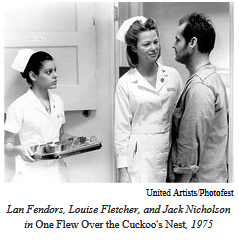
When psychoactive drugs were first introduced, there was a brief period of optimism in the psychiatric profession, but by the 1970s, optimism gave way to a sense of threat. Serious side effects of the drugs were becoming apparent, and an antipsychiatry movement had taken root, as exemplified by the writings of Thomas Szasz and the movie One Flew Over the Cuckoo’s Nest. There was also growing competition for patients from psychologists and social workers. In addition, psychiatrists were plagued by internal divisions: some embraced the new biological model, some still clung to the Freudian model, and a few saw mental illness as an essentially sane response to an insane world. Moreover, within the larger medical profession, psychiatrists were regarded as something like poor relations; even with their new drugs, they were seen as less scientific than other specialists, and their income was generally lower.
More here.
Posted by S. Abbas Raza at 05:42 PM | Permalink


Comments
This is a very sobering and timely post.
It’s about time to insist that DSM-ETC must cease pretending to be the arm of the understanding of mental diseases, instead of what it actually is: an instrument of Big Pharma.
Many of my colleagues have made millions supplying pharmaceutical corporations with the false endorsements they needed for the merchandising of their useless and harmful drugs.
No conflict of interests here?
While this was happening, and at the same time, DSM would remain thirsty for the incorporation of new categories to include in their so-called DSM-V, their new ‘Bible’, so they can suck it to third party payers.
Szasz (the maverick) was always prescient and right: Mental illness, as we know it today, it’s not only a myth, but a profitable and shameless market, I’m sorry to admit.
Posted by: Felix E F Larocca MD | Jun 21, 2011 8:44:39 PM
My son was in a bad mental state at about age 12. He was diagnosed with ADD and treated pharmacologically. He clearly seemed to his parents to have had a considerable attention deficit and went through some rough times in the ensuing years but now, as a young adult, seems to have gotten onto the right track and is doing well.
Did the treatment at least take some of the peaks of his disorder down and enable him to survive the worst years, or would he have simply matured pretty much the same way without treatment? We'll never know, of course, but my impression is that the treatment was necessary. Thus, I don't think that pharmacological psychiatry is completely fake, like, say, Christian Science or Scientology.
Posted by: JonJ | Jun 21, 2011 9:53:41 PM
For greater understanding of the enormity of the problems biopsychiatry has introduced, especially for children, see:
Robert Whitaker
Psychology Today - Robert Whitaker
Posted by: Louise Gordon | Jun 21, 2011 10:28:45 PM
Of course, you might have caught schizophrenia from the cat:
Schizovirus
Posted by: Louise Gordon | Jun 21, 2011 10:50:19 PM
Szasz on Torrey:
http://psychrights.org/articles/szaszontorrey.pdf
Posted by: Louise Gordon | Jun 21, 2011 11:22:52 PM
The difference between harmless (if hideous to behold) eccentricity and mental illness will always be culturally determined, unless science starts to stand outside culture and to contain it -- and even in a technological culture dystopia, that's not going to happen. If you believe, as Szasz wrote, that people described by physicians as mentally ill are "not so much sick as sickening," then you probably believe that psychiatric meds are evil or just unnecessary. While I believe that Big Pharma has a profound influence on physicians, I do not believe that fact makes a watertight case against mental illness being a phenomenological thing, or against psychiatric medicine being useful in saving lives.
But, there's nothing newsy in suggesting physicians be more circumspect in prescribing psychiatric medications, and quicker to advise their mildly depressed patients to get more exercise than to take Prozac. Indeed, how do you get a bestseller out of that?
Posted by: Elatia Harris | Jun 22, 2011 12:45:12 AM
"While I believe that Big Pharma has a profound influence on physicians, I do not believe that fact makes a watertight case against mental illness being a phenomenological thing, or against psychiatric medicine being useful in saving lives."
Elatia,
The medicine is not useful in saving lives when it gives people tardive dyskinesia, diabetes, pancreatitis or brings on psychotic symptoms people never experienced before. It doesn't save the lives of toddlers who may be given neuroleptic drug cocktails for their "irritability."
Further, there is no scientific evidence or foundation for believing that the drugs correct chemical imbalances in the brain, which is a marketing storyline. Whitaker, for one, does not deny that the drugs may have a place in reducing severe symptoms on a short-term basis. What the topic is about is the vast increase in so-called mental illness since the "atypical antipsychotics" were introduced, the increase in routinely dosing school children with drugs such as Ritalin and Adderall (with harmful effects) and the damage that occurs when neuroleptic drugs are taken on a long-term basis.
On Whitaker's blog, he does in fact give information on different treatment modalities, including dialogue and exercise. But maybe it's Carlat's book you are referring to as a bestseller? He reveals that he continues to treat his patients with drugs because he can make $180 an hour that way, whereas talk therapy would bring the cash flow down to a mere $100 an hour.
Posted by: Louise Gordon | Jun 22, 2011 2:32:44 AM
Louise, our points of view differ. I don't believe the hellish tales of over-treatment imply that treatable mental illness is a creation of Big Pharma, or that psychiatric medications are first and foremost tools to make greedy physicians richer. Those are very broad-brushed opinions, applied to an area that cries out for a very fine eye.
Like you, I am disturbed by the routine over-medication of disorderly children, and by the medicalization of their difficulties. Some children, however, are truly ill -- I know some, whom I have observed over 20 years. If you saw something like this, you might think medical interventions were sometimes appropriate. If, however, what you are talking about is fitting a diagnosis to a medication the doctor is under pressure to prescribe, then I agree with you that's disastrous.
Western medicine is a double-edged sword, replete with howlingly awful outcomes. There is more money in treating some diseases than others -- Big Pharma will make out better creating treatments for schizophrenia than for bipolar disorder. There are immense injustices here. But, if you are a legal adult, you have a right to refuse medical treatment that you find wrong for your mind or your body, whether you have a stomach ulcer or a major mental illness.
I think it's important not to judge Medicine itself by the worst outcomes brought about by the least skillful and least ethical physicians. Or to judge all parents in light of those who are so overwhelmed they seek drugs for their children because that streamlines their parenting labor.
Posted by: Elatia Harris | Jun 22, 2011 11:40:07 AM
"I don't believe the hellish tales of over-treatment imply that treatable mental illness is a creation of Big Pharma, or that psychiatric medications are first and foremost tools to make greedy physicians richer."
Then you must believe that it is the brain, not the social/cultural/environmental situation, that can be treated. If this is so, it would at least be reassuring to know that Pharma remedies do in fact balance imbalanced brain chemistry, but there is no evidence of that. They alter normal functioning of the brain, which may modify what are seen as "symptoms" of illness, but at the same time, they cause very severe side effects.
"But, if you are a legal adult, you have a right to refuse medical treatment that you find wrong for your mind or your body, whether you have a stomach ulcer or a major mental illness."
This is not true, Elatia, or there would not be civil commitment hearings, with judges usually going along with anything the psychiatrists tell them. It is illegal in this society to be considered (by psychiatrists) a danger to oneself or others.
What you seem to be ignoring in your defense of medicine is the trend toward more and more and more "disorders" that make their way into the DSM, and more and more and more people diagnosed and treated for such disorders. Yes, with potions from Pharma that often leave people worse off than when their "treatment" began.
The "least skillful and least ethical physicians" seem to be leading the pack as key opinion leaders (in academia, running clinical trials, on the physician education lecture circuit paid by Pharma) in over-diagnosis of behaviors that were once considered normal. Childhood, along with what are now called disorders such as shyness, have been pathologized, along with any behavior the DSM committee believes might be "treatable."
Further, it is not always parents who seek drugs because it streamlines their parenting labor. In many cases, it is teachers in public schools who start to pressure parents to drug kids, sometimes threatening them with placement of the child in special education if the parents refuse to comply. After all, fidgeting and failure to hang on the teacher's every word is so disruptive, making classroom management an insurmountable challenge for teachers.
I am astonished that you could read Marcia Angell's two articles and continue to maintain that Pharma and medicine are the answer to people's psychological distress. So, I guess we shall have to agree to disagree.
Posted by: Louise Gordon | Jun 22, 2011 12:37:25 PM
Louise, without meaning anything unfriendly, I do disagree with you about this -- we know that from previous interchanges. I believe there is a place for psychiatric medication, you don't. I don't believe it's up to culture to define down mental illness so that very ill people are merely "different," any more than diabetics should be seen as just that little bit "metabolically challenged," rather than as ill with something you treat through diet, lifestyle management and drugs.
I base my thinking on observation, not on polemics I have read, so more polemics are not likely to make me change my observations. I would change my mind if I observed situations, and the individuals in them, for long enough to gather new data that forced me to question and even overturn my thinking. As I am already an X-treme Moderate in my view of the usefulness of psychiatry and psychiatric meds, I'm not holding onto much -- just a few saved lives.
If "letting mental illness be" worked for the person who, in other circs, might be the patient, we would all know it by now. With luck and skill, therapy and medication work better than nothing. But doing nothing IS an option -- the death of the person who might have been a patient is of course the final cure.
Now, none of this makes your reading or your observations of life wrong, Louise. I would, personally, need much more research, and much more familiarity with methods, and much more ability to interpret statistics, to be convinced, in a big way, that I should be angry enough at the bad stuff for the good stuff to be swept aside.
Posted by: Elatia Harris | Jun 22, 2011 1:23:52 PM
"Now, none of this makes your reading or your observations of life wrong, Louise."
How reassuring!
I did not say that there is no place for psychiatric medications. I said they might be useful on a short-term basis, before their effects result in physiological damage, much of which cannot be reversed. Diabetes, for example.
Further, I did not say that doing NOTHING is an answer to psychological distress.
"But doing nothing IS an option -- the death of the person who might have been a patient is of course the final cure."
Just that with all those drugs and hospitalizations and electroshock treatments, David Foster Wallace, Anne Sexton and Sylvia Plath are not among the saved.
Posted by: Louise Gordon | Jun 22, 2011 5:13:49 PM
This is a hot topic deserving of much debate in view of its important repercussions to medicine and psychiatry throughout the entire world.
About the importance of DSM
It’s of interest that its serendipitous development --- as we know it --- was the unintended brain child of a group of investigators dedicated to psychiatric research. This group, at the time, was working at one of the few departments of psychiatry with an ‘organic’ (read ‘medical’) orientation in the US.
(The department was at Washington University in St Louis MO.)
During those days the great majority of the chairs of psychiatry were occupied by psychoanalysts. So, that owing to that fact, DSM I and II were oriented in the psychodynamic bent (the power of the majority).
With the passage of time and the preponderance of the analytic influence gone, DSM III & IV --- and the ensuing revisions and new editions of the manual --- reflected a movement towards the so-called ‘medicalization’ of psychiatry.
Psychotherapy became an incidental, if not undesireable, tool of the trade.
No one would question that psychotropic medications have their place in the treatment of mental illness --- whatever that is.
It can be said categorically that, of course Ritalin works for ADHD and narcolepsy, and that equally, SSRI are effective in ameliorating symptoms of depression, but that’s not my point.
My point is my perception of the reality that psychiatry has lost its initial diagnostic precision, based on a combination of clinical (phenomenological) and research confirmation of data, and it’s drifting away propelled (some say) by the winds of Big Pharma.
What the future holds
DSM-V (due to appear in 2013) is contemplating inclusion of absurd diagnostic categories that, some dread, obey the mandates from the drug companies: ‘A new drug to fit a new diagnosis’.
That’s what some of us most fear.
For those interested in other books worth reading on the subject:
• The Medicalization of Society by Peter Conrad
• The Loss of Sadness by Allan Horwitz et al
• Creating Mental Illness by A. Horwitz
• Shyness: How Normal Behavior Became a Sickness by Christopher Lane
Reference
(Feighner, JP et al: Diagnostic Criteria for Use in Psychiatric Research. Arch Gen Psych 26 [1972] 57-63)
Nice posting and great discussion
Posted by: Felix E F Larocca MD | Jun 22, 2011 6:04:58 PM
Harper's magazine:
An Encyclopedia of Insanity
Posted by: Louise Gordon | Jun 22, 2011 6:34:51 PM
Thank you, Felix, for mentioning these books:
Shyness: How Normal Behavior Became a Sickness
Posted by: Louise Gordon | Jun 23, 2011 12:06:28 AM
Post a comment