
June 29, 2011
The Art of the Deal
Liz Mermin, also in Caravan:
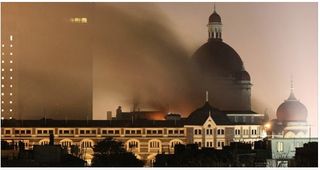
In October 2009, two agents from the Federal Bureau of Investigation (FBI) arrested David Headley at Chicago’s O’Hare International Airport as he was about to board a flight to Philadelphia. His intention, he later told interrogators, was to go from there to Pakistan and then on to Copenhagen to attack the Jyllands-Posten newspaper. At the time, investigators had no idea Headley had been involved in the Mumbai attacks (a detail he offered up after he was in custody), but he had been fixated on the Denmark plan following the “success” of 26/11, and intended to carry it out on his own, if necessary.
Although he had been trained to use AK-47s and grenades, Headley had never killed anyone with his own hand. His contribution to the 26/11 attack was intelligence from Mumbai: he provided his LeT handlers with hours and hours of video footage and offered strategic suggestions based on his time living in and scouting out the city. He was impatient for more action, and now wanted to attack the West. But LeT was under intense scrutiny after the Mumbai attacks, and his handler—though initially enthusiastic—had told him to back off. So he turned to al Qaeda. And when the men in Europe whom al Qaeda said would carry out the Copenhagen job were unwilling to do so, he offered to do it himself.
The plan was to enter the newspaper’s heavily secured office building with guns and knives, take hostages, shoot them, and then cut off their heads and throw them out the window into King’s New Square. As in Mumbai, the attackers were not supposed to survive. So it seems that the FBI might have saved David Headley’s life by arresting him—a courtesy they would extend again when he agreed to plead guilty and cooperate with the US government in exchange for a promise that he would avoid the death penalty and extradition to Denmark, Pakistan or India. The latter was something Headley wanted to avoid at all costs.
I had been following the Headley saga since November 2009, when I happened to see a MiD DAY gossip column headlined “Did Headley Date Starlet?” The piece began: “Lashkar-e-Taiba mastermind David Coleman Headley (49), whose reputation as a strikingly handsome charmer almost matches that of his terror history, may have dated starlet Aarti Chhabria.” My first thought—reading the paper online from London—was “who the hell is David Headley?”
Posted by Robin Varghese at 02:27 PM | Permalink


Comments
Can a horrific event that took place half way around the globe, and involving (mostly) non-white victims be properly understood by an American jury? The verdict in Chicago would indicate otherwise. The jury appeared to weigh the planned, but not consummated, beheading of Danish civilians far more heavily than the actual mass slaying of Indian civilians that had taken place.
The belated wiretaps on Rana confirmed that he was at least aware of his friend's involvement in the massacre in Mumbai. Assuming that he learned of the involvement of his friend only a year and a half after the attack took place, unlikely as it seems, did he immediately apprise the authorities of the information he had just received on a major terrorist attack? No. Did he demur or express distaste at what had happened in a city that he and his wife had visited relatives only months before the attack? No. Instead he agreed that the Indians had it coming.
He may have angrily stared during the trial at his former friend for betraying him, but I think that the sense of betrayal was more to do with his complicity in the crime being exposed by his close friend, than to do with his innocence.
Posted by: Sam | Jun 29, 2011 5:49:42 PM
We can only guess what the jury (selected for their ignorance) was thinking, but my guess would be that they were not convinced by the evidence of Dr Rana's involvement "beyond a shadow of doubt", but they had seen enough to think that he was in some ways sympathetic to Islamic terrorism even if not directly involved in planning and execution. That tends to lead to "splitting the difference".
In another view, they were being remarkably fair minded in that the evidence about his involvement pre-mumbai (his failure to report a crime was not among the charges) WAS weaker.
The other issue is the problem the US state faces if it gets too uppity about Mumbai...should it risk "success" or even an orderly face-saving withdrawal from Afghanistan by pushing too hard on what it (and most of its citizens) regard as an "India-specific" case of terrorism? I know some US citizens also died, but the US govt has ignored the deaths of its citizens before, when "state interests" are at issue, as in latin American right wing terrorism.
I am not saying its a morally sound position, but how many liberals (forget hardcore crooks like Cheney) would sacrifice ten American soldiers for some faraway imbroglio in South Asia about which they know little and understand less? I think very few indeed.. You must always keep that in mind.
Posted by: omar | Jun 29, 2011 8:09:07 PM
Post a comment