
| ABOUT US | ARCHIVES | LINKS | RSS FEED | MONDAYS | |

3quarksdaily

An Eclectic Digest of Science, Art and Literature

« Late Retort | Main | Golden dust in the afternoon »

June 20, 2011

Summer Reading

by Meghan Rosen

Cover 15 years ago, General Motors debuted the first fully electric vehicle for lease in the United States.  The EV1 was silent, fast, and as aerodynamic as an F-16 fighter jet; but most importantly, it could run between 70 and 150 miles on a single charge. (Toyota’s Prius Plug-in Hybrid, for comparison, has an all-electric range of 13 miles.)  Between 1996 and 1999, more than 1000 EV1s were manufactured.  800 were leased out in Arizona and California, and, according to the brand manager at GM, inspired “maniacal loyalty” in their drivers. 

Four years later, despite pleas from drivers, and a waiting list of interested customers, GM declared the electric-car program a money loser, and ordered the car’s destruction.  Existing EV1s were taken from their drivers, transported to the desert (in some cases, under police protection), and crushed. (Today, a few can be found in museums, but they’ve been disabled so as to never drive again.)

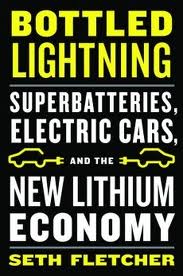
The plight of the EV1 was chronicled in the 2006 documentary, Who Killed the Electric Car?, but Seth Fletcher’s new book, Bottled Lightning, is not just about the the EV1. It’s about the batteries that make electric vehicles a reality, the lithium that powers them, and the players who forge global energy policies.  But the long, rocky history of electric cars is where Fletcher is most compelling.

In Bottled Lightning, Fletcher begins his story at the dawn of human knowledge of electricity (in 600 B.C with a Greek philosopher and static electricity), takes it past the invention of the first battery in 1800, through the lithium boom of the 21st century, and ends with a look at the technologies that might make a post-oil society feasible (like batteries made out of printer paper coated with carbon nanotubes, or of molten metals separated by density into Oreo-like layers). 

Along the way, he gives us a glimpse into the chemistry of batteries, the history of political unrest in lithium-rich countries, and the policy decisions that incentivized (or hindered) battery research in the US.  The details are often intricate, and always meticulously researched, but frequently technologically heavy. 

There’s no question that Fletcher, a senior editor at Popular Science, has a deep understanding of the chemistry-driven technologies at the heart of battery research, and he’s not afraid to dive into scientific esoterica other authors may have avoided. At most points throughout the book, Fletcher’s ambitious thoroughness is a strength (for example, rather than simply describing a dispute between lithium battery researchers, he braves the primary literature to translate the ‘scientific smack-talk’ for his readers), at others, it’s a weakness (for those with more interest in electric cars than electrochemistry, Fletcher’s detailed descriptions of the materials science behind potential battery components may feel exhaustive).

At the end of Bottled Lightning, Fletcher acknowledges countless scientists, engineers, industrialists, entrepreneurs, analysts, and experts.  Their quotes, Fletcher’s colorful character descriptions, and his accounts of fascinating trips spent researching the book (from the ‘endless’ salt flats of Bolivia to Chilean lithium plants to industry auto shows in the US) bring energy and levity to a story loaded with technical information.

So what’s the bottom line? If you’re looking for a thought-provoking, scientifically accurate chronicle of the evolution of the battery, its components, and its part in the story of electric vehicles, Bottled Lightning is an excellent resource. It might not be a book I’d take to the beach, but it’s definitely something I’ll keep as a reference.

Posted by Meghan Rosen at 12:15 AM | Permalink

Comments

I attended a talk in Melbourne recently about the roll-out of an electric car infrastructure. This Israeli/Australian initiative rolls out in Israel and Denmark this year and Australia next year.

http://australia.betterplace.com/

Posted by: Troy | Jun 20, 2011 5:19:57 AM

Post a comment


Subscribe to this blog's feed  

PayAnywhere with iphone credit card swiper

Android Tablet

Bluetooth Headset

2013 New Style Dresses

Compare Car Rental Prices

DHgate.com Wholesale

3QD on Facebook

3QD on Kindle

3QD by Daily Email

Receive all blogposts at the same time every day.

Enter your Email:


Preview 3QD Email

3QD on Twitter

Miscellany

Lijit Search

AddThis Social Bookmark Button

Add to Google

Recent Comments

LWR on POETRY IN TRANSLATION: CORDOBA

Rashid on Aftermath: Pakistan Elections 2013

Yoann on The Bystander Effect in Medical Care. Why Do I Have So Many Doctors Not Taking Care of Me?

Dave Ranning on Aftermath: Pakistan Elections 2013

sadhana on Aftermath: Pakistan Elections 2013

Carol Westbrook on The Bystander Effect in Medical Care. Why Do I Have So Many Doctors Not Taking Care of Me?

Ken Bryant on Aftermath: Pakistan Elections 2013

Umer Vakil on POETRY IN TRANSLATION: CORDOBA

Kabir on Aftermath: Pakistan Elections 2013

Nina on White Indians

Nina on White Indians

Dave Ranning on If Only We Had A Leader Like Chavez, Who Solved Real Problems -- Instead Of Debating Fake Ones Like The Deficit

Mohammed Hassanali on Aftermath: Pakistan Elections 2013

musafir on Aftermath: Pakistan Elections 2013

Maniza on Aftermath: Pakistan Elections 2013

Ellen Perry on The Bystander Effect in Medical Care. Why Do I Have So Many Doctors Not Taking Care of Me?

waqnis on The Bystander Effect in Medical Care. Why Do I Have So Many Doctors Not Taking Care of Me?

Norman Costa on The Bystander Effect in Medical Care. Why Do I Have So Many Doctors Not Taking Care of Me?

Hannah Carlton on POETRY IN TRANSLATION: CORDOBA

Joe on Digging Up Bones or, The Labyrinths beneath Our Feet

JonJ on The Beautiful German Language

cpfaff on Passionate About The Actor's Art: an interview with Michael Howard

Sumiran on Sunday Poem

Ethan on Getting Smarter

Pacificklaus on NORTH KOREA’S NERVE WAR

Acclaim For 3QD


"I couldn't tear myself away from 3 Quarks Daily, to the point of neglecting my work. Congratulations on this superb site."—Steven Pinker, Johnstone Professor of Psychology, Harvard University.

"I have placed 3 Quarks Daily at the head of my list of web bookmarks."—Richard Dawkins, Charles Simonyi Professor of the Public Understanding of Science at Oxford University.

"Just wanted you to know I’m one of many who reads and enjoys 3 Quarks....almost daily."—David Byrne, musician, former lead-singer of the Talking Heads, artist, intellectual.

Read more here.

The 3QD Prizes

Subscribe to this blog's feed