
by Tom Jacobs
Why should we not enjoy an original relation to the universe?
~ Emerson, “Nature”
One of the most important and enjoyable responsibilities given to a young altar boy is to ring a set of bells at the moment the priest holds the communion host above his head and proclaims somethin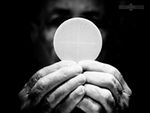
The lord took bread, and when he had given thanks, he broke it, and said, “This is my body which is for you. Do this in remembrance of me.”
The reason we rang these bells, my parish priest told me years ago when he first trained me to become an altar boy, is to draw the parishoners’ attention so that they are reminded of what is going on up on stage, as it were. And what is going on up there is meant to be breathtaking and awesome. The little, tasteless piece of circular, unleavened “bread” becomes, at that precise moment in the ceremony of the Eucharist, the actual body of Christ, which we are all then invited to eat. When I was first told this, I was surprised and astounded. What we were doing every Sunday was eating the flesh of a deity (and just after, having a little tug of his blood).
Of course, I had my doubts about the genuineness of this transformation, but still I found the whole concept rather amazing. This is not the sort of thing one sees everyday (unless you go to daily mass, I suppose). To think that these little unremarkable wafers that I had taken out of their little chinese-take out-looking boxes and placed in the tabernacle not one hour earlier, had now become the literal body of a god was an extraordinary idea, and a nice piece of theater, too, it must be said.[i]
And it was my job to ring the bells to get everyone to pay attention, if only for a moment, at what was going on before them. No less astonishing was the parishoners’ typical response: boredom, wristwatch-looking, ongoing attempts to stop one’s children from squirming and playing with their siblings in the pews. Nobody seemed to really grasp what was occurring before them, and even those who did, didn’t seem much to care.
*****
One of the reasons that magical realism is so incredibly compelling is that it inserts the mystical, the magical, the strange and peculiar into the narrative of everyday life. Young lovers are engulfed by swarms of yellow butterflies. A person inhabits the same place but at two different time periods simultaneously. Angels descend to earth and are then exploited, put into a freak show, and then depart, and the townsfolk return to their lives as if nothing had changed. Life leaps out of its grooves, something miraculous happens, and when the dust settles normalcy returns. Coffee is made and sandwiches are eaten and windows are stared out of and friends are met and one tries to figure out what to do with the rest of the afternoon. But even a good sandwich can’t exorcise the sense of haunting mystery behind things.
Spalding Gray, the great monologist, pursued these moments of heightened attention to the sacred and mysterious in everyday life. He had a very fine sense of how what he called “perfect moments” intrude upon and reorganize mundanity. For Gray, a perfect moment was one of those times when everything came into a strange kind of numinous intensity, when the oceanic sense of attachment to something bigger than yourself is momentarily felt, and then you are dropped back into your life and can move onto the next stage, the next thing, the next day. Gray notes that “they’re a good way of bringing things to 
I was so far out—I could tell that I had never been in this situation before because of the view of the shoreline. I had never seen the shore from that point of view before. It was so far away that I felt this enormous disconnection from Mother Earth.
Suddenly, there was no time and there was no fear and there was no body to bite [by the sharks (and bears) that he so fears]. There was no longer any outlines. It was just one big ocean. My body had blended with the ocean. And there was just this round, smiling-ear-to-ear pumpkin-head perceiver on top, bobbing up and down. And up the perceiver would go with the waves, then down it would go, and the waves would come up around the perceiver, and it could have been the middle of the Indian Ocean, because it could see no land.
And then it’s over and he knows it’s time to go back home to Krumville. But of course he doesn’t want to, he wants more, but he also knows the danger of staying in a perfect moment, in paradise; he has a “flash,” an “inkling” and he thinks he knows “what it was that killed Marilyn Monroe.” Maybe it is what killed him, too. Perfect moments are best restricted and limited to the momentary and ephemeral. They’re only to be visited. You can’t live there.
*****
I'm thinking back to when I was a child
Way back to when I was a tot.
When I was an embryo – A tiny speck. Jus t a dot.
When I was a Hershey bar
In my father's back pocket.
Hey look! Over there! It's Frank Sinatra Sitting in a chair.
And he's blowing Perfect smoke rings
Up into the air.
And he's singing: Smoke makes a staircase for you to descend.
So rare.
Ah desire! Ah desire! Ah desire!
So random, So rare
And everytime I see those smoke rings I think you're there.~ Laurie Anderson, “Smoke Rings”

These eruptions of the fantastic and miraculous into the dullish fabric of life’s routine are the province of a good ritual. Like Auggie Wren’s daily photograph of the street corner in Brooklyn that lay outside the front door of his cigar store, or the person who allots themselves one ruminative cigarette a day, or possibly even one’s daily exercise regimen, all of these actions take on an almost ceremonial quality, and they come to mean something. The meaning of these rites, however, is not resolved but rather extended or deferred beyond the moment of the ritual and into the larger world. A good ritual offers a kind of participatory experience of collectivity that is less discursive than sensuous and emotional, an experience that connects the individual to history or the cosmos or the larger social body and implies, however inchoately, a sprawling skein of normally unobserved relationships amongst things. Durkheim claims that ritual functions to “strengthen the bonds attaching the individual to the society of which he is a member” and that it does so not by means of a conscious act of affiliation but the experience of the collective representation as a simultaneously transcendent and immanent commonality. The spaces of ritual are spaces of freedom and liminality, of abyssal in-betweenness, and evoke a mode of consciousness that is, as Catherine Bell contends, “betwixt-and-between the normal, day-to-day cultural and social states and processes of getting and spending.”
I am speaking of profoundly secular rituals here—not the transformation of bread into the body of Christ—but even secular rituals have their own transformative and miraculous elements. In a profane world the sacred suddenly and magnificently shoulders itself into view and then recedes again, until the next time.
I was once in the habit of having a cigarette on my front stoop when I came home from work. I was usually back before my roommates, and I had a twenty minute or so window of solitude. Although it only very gradually assumed the dimensions of a ritual, this solitary cigarette on my front porch had a kind of telescoping effect on my perception of my surroundings. Patterns began to emerge in the cars parked on the streets, the people walking past, the life cycles of the trees lining the street. For the time of the cigarette, I felt integrated into a vitalizing circuit that was quite intense while it lasted.
Rituals like these actually acquire some of their significance from the structure of everyday life, instituting a kind of counter-structure that marks off from the spaces of necessity (and labor, in particular) a space of reflective freedom. These little counter-structures of ritual are like doors, or maybe even like non-silly versions of Reich’s orgone boxes—spaces that we can enter, stand on the threshold for a moment, and then reemerge into the world, somehow slightly changed.
I don’t think rituals can be willed into existence; perhaps they can be coaxed into being, but in general they seem to present themselves to us very slowly, over time and after many repetitions, eventually the energies and echoes of previous iterations converge and it is clear that you are commingling with something large and mysterious. Perhaps you have rituals of your own (and if so, I’d love to hear about them and the nature of their power and effect). They seem important aspects of our everyday experience, and I guess I’m still ringing the bell, wondering if anyone else feels this interweave of mystery and banality.
[i] William Gaddis, in his The Recognitions, has a nice take on how this ceremony has become one of the primary conceptual distinctions that has distinguished orthodox Catholicism from less orthodox sects, and eventually, of course, from Protestantism: “Homoiousian, or Homoousian, that was the question. It had been settled one thousand years before when, at Nicaea, the fate of the Christian church hung on a diphthong: Homoousian, meaning of one substance. The brothers in faraway Estremadura had missed the Nicaean Creed, busy out of doors as they were, or up to their eyes in cold water, and they had never heard of Arius. They chose Homoiousian, of like substance, as a happier word than its tubular alternative (no one gave them a chance at Heteroousian), and were forthwith put into quiet dungeons ….”