by Azadeh Amirsadri
As a child, I was lucky to have grown up with two grandmothers: one living with our family and the other visiting from her house in the same city, and staying with us for a few days at a time. Both grandmothers were very kind, and my sisters and I spent a lot of time with them, each of us having a special relationship with them. Mamabozorg was my paternal grandmother, who raised me from the age of one to five, and who, along with my grandfather, became my primary attachment figures. Her name was Zahra, and she lived to be 104, or so we think, since I don’t believe we have an official birth certificate for her, just the usual traditional writing of birth and death dates on the first page of the family koran. A devout religious person, she prayed five times every day of her life as required by Islam. When she was too old to stand, she would sit in bed and pray, ending with her prayer beads. One of my favorite things as a child was to put my head on her knees, as she was sitting cross-legged on her prayer rug, after her last prayers, saying the name of the Prophet and his first successor as a form of meditation. I felt warm and safe with her, and the world was predictable as it should be for every child. As a traditional Muslim woman, she wore the chador and always kept her headscarf on, even at home.
Mamajoon, Mariam, was my maternal grandmother, the modern grandma. She didn’t wear the chador, unless she was going to some religious event, which she rarely did, but she also wore the head scarf at all times. She was born and raised in Rasht, a city by the Caspian Sea, and, with her grayish-blue eyes, her round hips, and her long silver hair, she remained a beauty in her old age. She had become a widow at a young age and later lost her oldest son to heart disease. She endured having had land and a fortune, then losing it all, but stayed the life-loving person she was. She lived in the United States for some years while raising her young grandson and caring for her college-age son. She loved America and regaled us with stories of banana-split ice cream, cheeseburgers, huge supermarkets with laundromats, and people who followed rules, compared to our unruly ways. She would take us to a new place in Tehran that had donuts, and as my sisters and I were cutting them with our knives and forks, she told us that Americans eat them with their hands. When I visited her in California, we would go to Fashion Island in Newport Beach, where she’d claim a table at an outdoor cafe, order coffee for herself and whatever we wanted for us, smoke her cigarettes, and watch the world go by. Read more »








 Not so long ago, the conventional wisdom in most liberal/left circles was that people concerned about population growth tended to be racists, nativists, and eugenicists. And mostly old white guys, according to a leading UK environmental writer.
 Sughra Raza. Who’s Jealous?!. Celestun, Mexico, March 2025.
 When people hear that we should empathize with our adversaries, the reaction is often uneasy. Empathy sounds like softness. It sounds like moral compromise, even capitulation. Why should we try to understand those who compete with us, oppose us, or even threaten us?




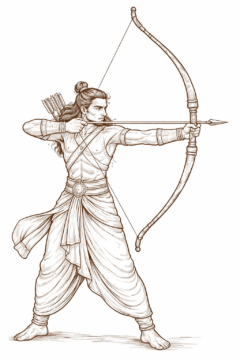 My friend Arjuna is an archer in the army. He has been on several campaigns, always victorious. His bow is as tall as he is. It is made of wood but strengthened with sinews. The combination makes it firm, supple and elastic. I say that, and marvel at the expert ease with which he handles it, and I know I – man of letters and numbers as I am – would never be able to pull the string back as he does.