
I
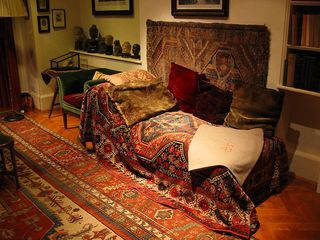
My first psychoanalyst was an old German woman, who lived in a faded flat overlooking a small lake in Calcutta and who spent our time making me lie on a couch and free-associate. Later, she’d point out things that I seemed to be avoiding – the putative hidden centers around which my thought moved. I was fifteen and alternately charmed and troubled by the inscrutability of this all. Of course I censored myself and said what I thought she wanted to hear. And, of course, it didn’t really do anything to help me, at least not in the short term.
For many years later I’d intermittently free-associate on paper, scrutinizing the traces of the workings of my mind for clues to its substrate. Of course I censored myself and created what I thought I wanted to hear, and of course I was aware of this. I puzzled over how to cut this knot. I think Freud says that psychoanalysis doesn’t begin with free-association; it ends when one is able to free-associate. I’m not sure whether this was supposed to mean a Zen-like state where the productions of the unconscious can flow out unhindered by conscious monitoring, or one where the unconscious has no more conflicts to reveal and so can be purely random.
But to free-associate with yourself is to simultaneously experience the thrill of the detective and that of the criminal, creating the signs of a crime and then trying to decipher them. It is a replay of cops and robbers, even if the roles are often muddled, and, since the act of interpreting the unconscious events often serves to create them, the criminal is sometimes framed.
II
To the ironic and sentimental modern mind, there is much about the Jungians that must seem dated. The self teeters not on the edge of an abyss of semi-conscious sludge and is not the fragmented and contingent intersection of desire and power relations; and we have no reason to be suspicious of the very notion of an “interior”. Instead, the self contains the universe if we would just look deep enough.
The entire cosmos signifies again, but this is not from an external world pregnant with a chain of meaning leading up to God, but from a transcendent self that spills onto objective interiority, from archetypes and psychic constellations that orbit lazily through the infinite depths of the self and reflect on the world outside of us.
And cultural symbols, instead of being radically historical and local productions, represent essential ahistorical and trans-verbal truths about the human condition, being mediated in various ways through the stories people tell each other. And the individual participates in these stories not just socially but also through fantasy and dreams.
There are many charges that can be leveled against this view of the world, but a lack of charm isn't one of them. And so, at one point in my life, I spent many hours talking to interior symbols and paintings and tarot cards, having long conversations with archetypes in the hope of unlocking or encountering various part of the psyche, tossing coins and dice not to randomize my life but to consult various texts, the randomness perhaps giving room for my unconscious beings to express themselves. I look back on my journals and see a world of giants and fools, of elemental forces and wise old women, of dragons and terrible gods, and I wish I could someday be that self again.
III
“Gestalt Therapy: Excitement and Growth in the Human Personality” is an unusual book, with three very different authors and two very different halves. The first half contains practical exercises whose relationship to Gestalt therapy is often disputed; the second contains a theoretical exposition written by Paul Goodman and derived from Fritz Perls’ notes. The following exercise is typical:
“Let your attention shift from one object to another, noticing figure and background in the object – and in your emotions. Verbalize the emotions each time, as, ‘I like this’ or ‘I dislike this.’ Also, differentiate the object into its parts: ‘It is this in it I like, but that I dislike.’ And, finally, when this much comes naturally to you, differentiate your emotions, thus: ‘For this I feel disgust’ or ‘For this I feel hatred,’ etc.
The resistances you are likely to encounter in yourself during this experiment are embarrassment, self-consciousness, the feeling of being too hard, presumptuous, nasty, or perhaps the wish to be paid attention rather than give attention. If, with respect to the persons you are in contact with, these resistances should become too strong to tolerate and tempt you to abandon the experiment, restrict yourself for a time to animals and inanimate objects.”
Doing this exercise at about sixteen or so, I suddenly realized how vivid my likes and dislikes were and that I had definite aesthetic and emotional preferences about things and people that I had thought I felt neutrally about. It was a sudden stumbling onto a large dimension of the self; the sudden activation of a storm of emotional charge that still persists. Or, perhaps I created another inner life that day.
Some of the other exercises in the book are more unusual. At various points I’ve followed them into everything from hanging all my pictures upside down to throwing up repeatedly in order to examine my resistances to throwing up. The latter is a surprisingly interesting exercise.
IV
Paying attention to bodily sensation is a very common meditative practice, often used to train awareness. Distraction is particularly obvious when the object of focus is so tangible, and it is also immediately obvious to most people that when they attempt to pay attention to and feel, say, their leg, they start by picturing it in their mind rather than actually feeling it.
The body is full of muscular tensions, twinges and other odd phenomena that lurk below the surface of regular consciousness, and rather than using them as the ground on which to train a more general awareness, Reichian psychoanalysis directly interprets the patterns of bodily tension as crystallized character attitudes, suppressed impulses and even repressed memories. In working with these, Reichian psychotherapy oscillates between the twin impulses of the psychoanalyst: that of detective, attempting to interpret and scrutinize every single sign, and that of the naturalist, attempting merely to observe and catalogue phenomena.
Often these interpretative leaps can make of the body nothing more than a sea of symbols, so that for a while I was convinced that muscular tightness in my legs was a manifestation of not knowing where to go and that that in my arms was a manifestation of not knowing how to act. It had a certain compelling simplicity to it. More modestly, I became noticeably less anxious after I began to free up rigid stomach muscles, allowing me to exhale more completely.
Later, following some of Reich’s disciples, I’d stand with my body arched or with my pelvis rolled forward and wait for my intricate intrinsic muscular tension to make my body vibrate until I fell over in an exuberant heap, psychoanalytically entwined with my body and compromised by it.