
June 14, 2011
From Hitler to Mother Teresa: 6 Degrees of Empathy
From The New York Times:
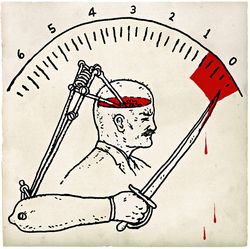
Dr. Baron-Cohen, a professor of developmental psychology at the University of Cambridge and director of the university’s Autism Research Center, proposes that evil is more scientifically defined as an absence of empathy, exacerbated by negative environmental factors (usually parental, sometimes societal) and a genetic component. When these three exist in tandem they result in what he calls a Zero-Negative personality. Zero-Negative takes at least three forms (and possibly more), borrowing from terms used in psychiatry: Zero Type P (psychopathology), Zero Type B (borderline disorder) and Zero Type N (narcissism).
Whereas psychiatry groups these three loosely under the term “personality disorders,” Dr. Baron-Cohen proposes that they all share the characteristic of zero degrees of empathy. (His “empathy quotient” scale is available in the book or online, with an instant numerical score that is translated into degrees of empathy from zero to six, or super empathy.) Viewing these disorders in terms of empathy “has very different treatment implications,” he maintains. Psychopaths aside, people with low degrees of empathy can be taught empathy, as is done in schools concerned about bullying, and treated with standard psychiatric approaches.
More here.
Posted by Azra Raza at 06:35 AM | Permalink


Comments
In 1943 Leo Kanner wrote a groundbreaking paper whose importance has remained unquestioned since the words: ‘Early Infantile Autism’ entered into the psychiatric lexicon.
This happened in the days when psychoanalysis held sway and the etiology of this disorder was blamed on ‘Frigidaire’ mothers --- why not? During those same days a psychoanalytic joke was, when in a professional meeting, attended by analysts, the word mother was mentioned, the audience booed.
Then came DSM
DSM-ETC (‘ETC’ due to its protean tendency to metamorphose as the situation demands) has incorporated Asperger Syndrome into a broader diagnostic category that goes by the name of ASD (Autism Spectrum Disorder), a catchall basket that includes other categories that most clinicians would find difficult to accept. Rett syndrome, for example.
The most important feature of Autism (to Kanner and Leon Einsenberg) was the lack of affective contact pervasive in the autistic. Now this has been changed, and with new emperors people don their pet theories with new clothes.
Empathy, TOM (Theory of Mind) and other new terms adapted from neuroscience have become fashionable without valid justification.
On appraising this excellent review I find Dr Baron-Cohen book disturbing because by using the bio-socio-psychological model, the Professor muddies more, already turbid waters, adding hints at having therapeutic applications.
As to the explanation offered for the behavior of volunteers in the experiments of Stanley Milgram and Philip Zimbardo, other valid hypotheses are applicable.
I disagree with the message offered in this book.
Kanner L (1943). "Autistic disturbances of affective contact". Nerv Child 2: 217–50. Kanner, L (1968). "Reprint". Acta Paedopsychiatr 35(4): 100–36. PMID 4880460.
Posted by: Felix E F Larocca MD | Jun 14, 2011 9:30:53 AM
I scored 12 on empathy. Is that bad?
Posted by: J. Hawkins | Jun 14, 2011 10:40:45 AM
A lifetime of exposure to popular (American) entertainment has taught me that minor characters are completely disposable, that only the main character is of any importance, and that main character is always, at bottom, me.
Posted by: black dog barking | Jun 14, 2011 3:04:08 PM
Post a comment