
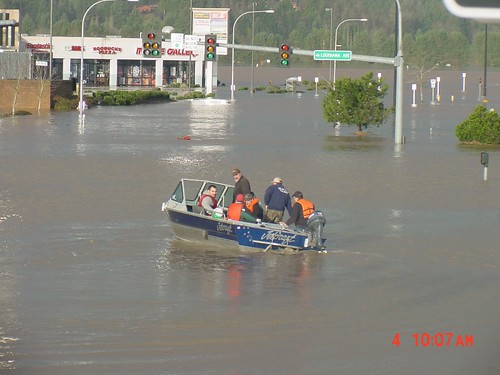
 by Dave Munger
One thing you can't see on a TV news report is the sound of a flood. It's a sort of muffled silence, like a windless forest the morning after a snowstorm. When you hear a dog barking in the distance, it's muted, like some hidden force is slowing its voice before it reaches you. Listen a little closer and you might hear the floodwaters lapping up on your back porch.
Finally, look at the still-darkened curtains of your window and you'll see the rippling reflections of streetlights emanating from the lake that was once your front yard.
It's 5:30 am. Last night when you went to bed, everything seemed fine. Sure, it was raining, but Centralia, Washington gets tons of rain. Sure, there was some flooding in the area, but when you bought this house a two years ago, you were assured it wasn't on a flood plain. This land has never flooded; it's high ground nearly a mile from the river.
You struggle to your feet, limp to the front door, and open it, hoping that your car will start. One look at the water lapping over its hood tells you it won't. It's only then that you notice the smell, a combination of gasoline, raw sewage, and toxic chemicals. The foundation of your house is perhaps three feet above ground level, and the water is inching towards your doorstep.
There is stifling dampness everywhere, like being in a boathouse with water where the floor should be. In effect, you are in such a place: The water is now just inches below your feet, rising steadily in your crawlspace. Helicopters rattle by every minute or two, searching for stranded inhabitants or covering the flood for local news stations.
The next hour or two passes by in a haze: You call 911. You call your mother to let her know that you're okay but she probably won't be hearing from you for a few days. You remember to put some important papers and other valuables up on your bed. You unplug your stepbrother's hand-me-down computer and whatever else you can think of, saving the phone for last, after it finally stops working.
The water begins to seep through the floorboards in the corner of the back room, confirming your long-held suspicion that the house's foundation had settled there. This house wasn't ideal, but it was all you could afford in 2005. Two tiny bedrooms and a small living room and kitchen. The siding was mismatched, the gutters were falling off, and the back porch had never been finished. But it was infinitely better than that dank basement apartment with a $660 rent bill you could hardly afford in the best of times. There was light, finally, there was light coming through the windows. There was a yard, with chirping birds, and a few trees, and eventually you got used to the trains rumbling by a few blocks away, sounding their horns incessantly through the night.
Even then you couldn't really afford this house. The mortgage was in your mom's name, and so was the title to the house. But you had made the $450 payments month after month, all the while trying to turn it into a tolerable space to live. Someday, your mom assured you, you would own this property free and clear. It would be your own space, and no one could take it away from you.
As the water creeps higher above the floorboards, you put on a coat and make your way through the rising waters to the back door. There's a ladder next to the house, and you get ready to climb up on the roof as the rain resumes. Then you hear a boat coming down the middle of your street, and you splash across the kitchen floor to the front door to let them know you're here and you need to be rescued. It's 8:00 am. It's still dark outside.
If you were my stepbrother Mark, this is how you would have experienced the morning of December 4, 2007, the morning the tiny life you were starting to build for yourself got taken away. Even today, this flood would be in your dreams every time it rains. It would be what you think about every time you pick up a hammer and try to rebuild your home once again. You wouldn't be able to stop thinking about the day your home was so gravely damaged, or stop worrying that it might happen again.
Mark didn't have flood insurance because the official county maps didn't place his home in a flood plain. But Lewis County, where Centralia is located, was declared a federal disaster area, and FEMA officials came into town offering $25,000 grants to help affected homeowners rebuild.
In a few days, the waters began to recede. In the end, the flood only reached a few inches up the walls of Mark's home, but it soaked the wallboards to the ceilings, destroyed his floors, and damaged some cabinets he had bought before the flood to replace the already-dilapidated ones in his kitchen. A contractor came by to estimate how much it would cost to repair the damage; it was strikingly close to the $25,000 grants FEMA was getting ready to hand out.
You can't repair a flooded-out home right away; first you have to dry it out. In the best of circumstances, this takes weeks; in a wet Western Washington winter, it takes months. The house dries out faster if you open the windows, but then it costs a fortune to heat. If you have degenerative disk disease, as Mark does, you need heat to avoid excruciating pain. Some months your heating bill is bigger than your mortgage payment. When your mortgage payment is two-thirds of your federal disability check, those numbers don't add up.
A group of volunteers from a church two hours away in Snohomish, Washington, drives down and crawls under your house to remove the flood-sopped insulation, which will help your house dry faster, but also makes it colder. A few months later you're the poster child for their newsletter, and you're grateful for their help, but your house still hasn't been fully restored.
Mark went through all the proper channels to apply for FEMA aid, filling out all their forms and attending their information sessions. But in the end, he didn't qualify for any aid at all. Since his mother's name was on the title to the home, he didn't count as the homeowner. He could get renter's assistance—a month or two in back-rent—but only if he gave up on the house and moved out, leaving his mother to struggle with mortgage payments on a useless second home.
His mother couldn't get assistance either—a second home only qualifies for aid in the form of a “small business loan,” but her credit wasn't good enough to merit even that.
Over the next three and a half years, slowly, steadily, you begin to rebuild your home yourself. Eventually you manage to secure some money from the gas company to install insulation. You rip up your flooring and nail down new plywood, a sheet at a time, until the pain in your back finally prevents you from continuing. You move your furniture from room to room while you repair the walls and repaint them. For three years, you wash dishes in the bathroom.
Today, your home is almost livable. Two rooms—a bedroom and kitchen—are complete. But the floor in your living room is still bare. The workroom where you hope to make jewelry to supplement your disability checks is not ready to use. Most days you are too tired to work on the house, and so you turn on the radio and listen to news about flooding in Tennessee and Louisiana, about tornados in Alabama and Missouri.
And you wonder: Do those people have any idea how these disasters will reshape their very existence?