
| ABOUT US | ARCHIVES | LINKS | RSS FEED | MONDAYS | |

3quarksdaily

An Eclectic Digest of Science, Art and Literature

« Rahima’s War | Main | How to spend billions and not make friends »

June 06, 2011

A crab canon for Douglas Hofstadter

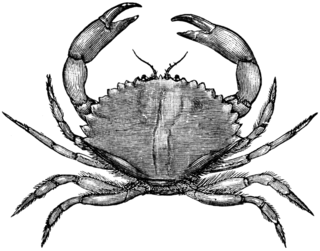
Crab
Since it first came out in 1979, Douglas Hofstadter’s Pulitzer Prize-winning book “Gödel, Escher, Bach: An Eternal Golden Braid” has widened the eyes of multiple generations of nerdy kids, and I was certainly no exception. The book draws all sorts of parallels between music, art, math, and computer science, ultimately shaping them into a bold thesis about how consciousness arises from self-reference and recursion. It’s also a very playful book, full of puzzles, puns, and imagined dialogues between Achilles and a tortoise which weave in and out of the main chapters, illustrating the concepts therein.

One of those dialogues, titled “Crab Canon,” seems puzzling when you begin reading it – sprinkled with seeming non-sequitors, the word choice a bit awkward and off-kilter. Then shortly after the halfway point, when you start to see recent lines repeated, in reverse order, you realize: the whole dialogue is a line-level palindrome. The first line is the same as the last, the second line is the same as the second-to-last, and so on. But because Hofstadter chooses his sentences carefully, they often have different meanings when they reoccur in the reverse order. So, for example, the following bit of dialogue in the first half…

Tortoise: Tell me, what's it like to be your age? Is it true that one has no worries at all?
Achilles: To be precise, one has no frets.
Tortoise: Oh, well, it's all the same to me.
Achilles: Fiddle. It makes a big difference, you know.
Tortoise: Say, don't you play the guitar?

… becomes this bit of dialogue in the second half:

Achilles: Say, don't you play the guitar?
Tortoise: Fiddle. It makes a big difference, you know.
Achilles: Oh, well, it's all the same to me.
Tortoise: To be precise, one has no frets.
Achilles: Tell me, what's it like to be your age? Is it true that one has no worries at all?

Hofstadter does “cheat” a bit, by allowing himself to vary punctuation (for example, “He often plays, the fool” reoccurs later in a new context as “He often plays the fool"). Nevertheless, it’s an impressive execution of a clever conceit.

Thumbing through Gödel, Escher, Bach again recently, I came across the Crab Canon and was struck with the desire to attempt a similar feat myself: a line-level palindrome that tells a linear story, that is, a story in which a series of non-repeating events occur.

It’s maddeningly difficult trying to come up with lines that make sense, that in fact make a different sense, in both directions. And because all of the lines interlock -- each relying simultaneously on the line preceding it, the line following it, and its mirror-image line -- changing any one line in the poem tends to set off a ripple effect of necessary changes to all the other lines as well.

I eventually figured out a few crucial tricks, like relying on ambiguous pronouns ("they," "their") and using images that carry a different meaning depending on what’s already happened. Below is the final result – my own canon, in homage to the book that dazzled my teenaged self years ago:


SEASIDE CANON, for Douglas Hofstadter

by Julia Galef

~
The ocean was still.
In an empty sky, two gulls turned lazy arcs, and
their keening cries echoed
off the cliff and disappeared into the sea.
When the child, scrambling up the rocks, slipped
out of her parents' reach,
they called to her. She was already
so high, but those distant peaks beyond --
they called to her.  She was already
out of her parents' reach
when the child, scrambling up the rocks, slipped
off the cliff and disappeared into the sea.
Their keening cries echoed
in an empty sky. Two gulls turned lazy arcs, and
the ocean was still.

~

Posted by Julia Galef at 09:34 AM | Permalink

Comments

great mirror poem!

Posted by: Carol Peters | Jun 6, 2011 1:03:11 PM

Fantastic!

Posted by: The Science Pundit | Jun 6, 2011 2:46:47 PM

". . . Douglas Hofstadter’s Pulitzer Prize-winning book “Gödel, Escher, Bach: An Eternal Golden Braid” has widened the eyes of multiple generations of nerdy kids, . . ."

Can I still play if I don't consider myself (or my kid self) nerdy?

Or am I just in denial?

Posted by: Sam Ogden | Jun 6, 2011 3:48:58 PM

Very nice indeed.

The good news is that if the child is falling in an Escherian universe, the ocean at the bottom of the cliff is also a pool at the top where her parents will find her swimming joyfully when they reach the summit.

Posted by: DAS | Jun 6, 2011 4:17:24 PM

You might have already seen these, but there's an excellent palindrome poem by James A. Lindon, titled Doppleganger: http://thevirtualworld.blogspot.com/2005/03/palindrome-poems.html

Posted by: Justin Li | Jun 6, 2011 4:33:15 PM

Brilliant - and not because it is palidromic, but because it is so poignant and evocative as a poem!

Posted by: arun | Jun 6, 2011 5:36:53 PM

Wonderful background story and excellent poem...!

Posted by: Liam | Jun 6, 2011 9:47:15 PM

Better than the original!

Posted by: Andrew B. | Jun 7, 2011 12:46:09 AM

Gorgeous!

Posted by: Mike Cope | Jun 7, 2011 3:08:34 AM

That's great :) I'm a fan, both of hofstadter's and your cannons!

This masterpiece takes much greater liberties, but creates an incredibly strong poem. Please watch it: http://www.youtube.com/watch?v=Az2MAXuSZiA&feature=youtube_gdata_player

Posted by: Marcus | Jun 7, 2011 3:44:50 AM

Post a comment


Subscribe to this blog's feed  

PayAnywhere with iphone credit card swiper

Android Tablet

Bluetooth Headset

2013 New Style Dresses

Compare Car Rental Prices

DHgate.com Wholesale

3QD on Facebook

3QD on Kindle

3QD by Daily Email

Receive all blogposts at the same time every day.

Enter your Email:


Preview 3QD Email

3QD on Twitter

Miscellany

Lijit Search

AddThis Social Bookmark Button

Add to Google

Recent Comments

Doogle on Why Steven Pinker Is Wrong

Kyle on Syria: Inventing a Religious War

Peter John on Gezi Park

dthoko on The History of Typography - Animated Short

Richard on John Gray’s Godless Mysticism

Abbas Raza on Why Steven Pinker Is Wrong

nogodrod on Syria: Inventing a Religious War

Lusine on Quest for 'Genius Babies'?

Bill on Syria: Inventing a Religious War

j_93 on Gezi Park

j_93 on Syria: Inventing a Religious War

Norman Costa on The Insanity Virus

Dave Ranning on Political Ideology and the Avoidance of Dissonance-Arousing Situations

Sundar on Quest for 'Genius Babies'?

Sundar on Syria: Inventing a Religious War

gaddeswarup on What is ‘smart’ and how does it fit our consciousness?

gaddeswarup on What is ‘smart’ and how does it fit our consciousness?

musafir on Syria: Inventing a Religious War

Lusine on Syria: Inventing a Religious War

Brad Wilson on Gezi Park

Raza Husain on Syria: Inventing a Religious War

Brad Wilson on The Insanity Virus

billy on Syria: Inventing a Religious War

rafiq on The Insanity Virus

Ben Schwartz on Here He Goes Again: Sam Harris’s Falsehoods

Acclaim For 3QD


"I couldn't tear myself away from 3 Quarks Daily, to the point of neglecting my work. Congratulations on this superb site."—Steven Pinker, Johnstone Professor of Psychology, Harvard University.

"I have placed 3 Quarks Daily at the head of my list of web bookmarks."—Richard Dawkins, Charles Simonyi Professor of the Public Understanding of Science at Oxford University.

"Just wanted you to know I’m one of many who reads and enjoys 3 Quarks....almost daily."—David Byrne, musician, former lead-singer of the Talking Heads, artist, intellectual.

Read more here.

The 3QD Prizes

Subscribe to this blog's feed