
| ABOUT US | ARCHIVES | LINKS | RSS FEED | MONDAYS | |

3quarksdaily

An Eclectic Digest of Science, Art and Literature

« An Unexpected Surprise | Main | A Good Scene »

May 16, 2011

There’s Something about the Teeth of Tyrants

by Ryan Sayre


00976r I’d really like to have a peek at Osama Bin Laden's dental records. Not because I need proof of his death. It's simply that I am obsessed with the teeth of world historical figures. I'm fascinated with Hitler’s halitosis, Mao’s festering gumboils, Napoleon’s rotten maw. I like to think of this all in terms of a kind of orthodonto-politics, a historical approach by which the subject of dentition brings the loose chiclet teeth of historical processes into a smooth arch. The under bite of Saddam’s double allegedly who was allegedly hanged in his stead, the gap between Churchill's dentures made to preserve his signature lisp: these things are grist for the molars of a political history of teeth. So when I say I am interested in seeing Bin Laden's dental records for purposes of closure, you can rest assured that I am referring to the kind of closure that dentistry professionals call 'occlusion,' that is, how the teeth make contact with and lock against one another. I am interested not in questions of validation, but in whether there are trace-marks in the enamel of the words that left from this figure's mouth.

The question I’d like to play around with below involves stories told about teeth and the ways in which truth and truth telling is inscribed into and tugged out from mouths. Washington’s dentures contained no wood, but you could fill a medieval bestiary with all the animals used in his dentures. His mouth was a veritable zoo, stabling at different times donkey, mule, humans, horse, elephants and hippopotami. I think there is something regal in the fact that whenever Washington passed words from his throat, he spoke not only for himself but also out from the animal republic in his mouth.

What does it mean to speak out over the far side of one's teeth? Who is one speaking for when one speaks through one’s teeth? What is it to put words into one’s mouth?

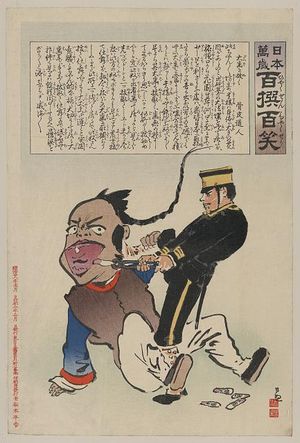
If Hitler's toothbrush mustache is to symbolize Nazism, then Hideki Tojo's teeth hold highest rank in the history of the dentition of dictators. Tojo's received caricature is that also of the Japanese people during WWII more generally; malnourished primates wearing coke-bottle glasses with buckteeth reaching to the floor; a race less evil than mutant. And despite all the emphasis given to Tojo's incisors, what the US was to find upon his capture was not tusks in his mouth, but little rotten pebbles hanging loosely from his gums. Even the small fistful of teeth he retained was in an advanced state of decay. His upper incisors were missing altogether. The prison dentists set right to work on his crockery, fashioning the former leader a set of false teeth for the war crimes trials in which he was forced to appear. The young dentist tasked to engrave the prison ID number on the backside of the teeth carefully drilled out a series of dots and dashes .-. . -- . -- -... . .-.   .--. . .- .-. .-..   .... .- .-. -... --- .-.  Now, if you can read dots and dashes, i.e. Morse code, then you're in on this little prank. What Mallory had scratched into Tojo's teeth was the three words "remember pearl harbor."

I imagine Tojo sitting in his cell passing his tongue over and over, from left to right, right to left, across this series of chicken scratch and think of Kafka's "In the Penal Colony," a story about legibility and torture in which the ‘apparatus,' a lumbering torture contraption, passes a large needle first leisurely and then violently across the criminal’s restrained body, stitching into it a crisscross, arabesque script identifying the crime committed by the tortured man. "You have seen how difficult it is to decipher the script with one's eyes," says the Officer to the traveler to whom he is introducing the ‘apparatus’, "but our man deciphers it with his wounds." I think back to Tojo, alone in his cell in Sugamo Prison, whiling away the day sliding his tongue back and forth over the scored porcelain. 

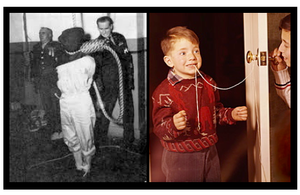
A sick personal providence would serve to entangle poison gas into Hitler's mustache as its truth (his mustache owed its unique shape to an order to shave his Kaiser mustache during WWI so his gas mask should fit snuggly to his face). Tojo's pearly whites were symbolically moored fast to pearl harbor in that dentist office in Sugamo Prison. Was Tojo literate in Morse code? Was literacy a prerequisite for understanding the message carved into his teeth? I can't help but wonder if for Tojo the constant running of his tongue back and forth across his teeth provided for some 'apparatus’ moment in which the dots and the dashes turned into letters, letters into words and words into the truth inscribed in his body. I wonder if it was the tongue on the back of the teeth or if perhaps some realization came, dropping from the gallows, when the rope suddenly became taught and he was jerked from the gums of this world like a bicuspid.   
Screen shot 2011-05-16 at 4.50.52 PM

The truth of torture in Kafka's story arrives in the subject's body, in the total internalization of the publicity of criminality into the self. The tortured body is the body forced to participate in the truth of publicity. In the case of Tojo's teeth, an inverse reading must also be made; not from publicity to the private, but from the secret memorializing of the two dentists in the midst of an unknowing public.

'Remember Pearl Harbor' was intended to be a private rib-tickling joke among the dentists at Sugamo prison. Mallory was well aware he was practicing a kind of silent ventriloquism on his patient: "It's just that not many people had the chance to get those words into his mouth," but as he told a reporter of his local newspaper in 1995, “It wasn't anything done in anger.”  It was done with a smile rather than a snarl.

Tojo's defenses, protestations, and capitulations rode over his dental pavement, each of his words bouncing against the inscription. Every claim he made carried along with it the silent refutation 'remember Pearl Harbor.’ These memorial tablets placed in Tojo's mouth are reminiscent of the work of Jochen Gerz who, with the help of his students, over the span of three years between 1990 and 1993, borrowed from the grounds of the Saarbrücken public square a total of 2146 stones, replacing them carefully after inscribing on each of the rock's hidden underbellies the name of a different Jewish cemetery desecrated in Nazi Germany. This work soon became a so-called 'invisible monument' indicated by a plaque. But let's stay in the moment before it was made 'public' for a moment. Before it was known and celebrated it operated as a hidden memorial, the closely guarded secret of few who addressed the public at large from underfoot. For the family walking down the street, the lone man, the lovers, there was nothing to see, nothing to experience, nothing to 'know.' The monument existed, but not in dialogue. It existed only in quiet adjacency to all that passing over it. Private memory is nothing but breadcrumbs laid along the path not yet devoured by hungry woodland creatures. But public memory here and in the case of Tojo's teeth, doesn’t exist in dialogue and thus is not threatened in the same way. Gerz's memorial and the memorial in Tojo's mouth used the most public of spaces to bypass the public, announcing themselves not to judging, feeling publics, but directly to Mnemosyne, the goddess of memory, herself.

What I am after with an orthodonto-politics is to gain a vantage into the perversities at work in rendering the human mouth into a memorial and a repository for private spectacles and public secrets. While I have an interest in getting a look-see at Bin Laden's dental records, the passing days are making me increasingly ok with the idea that I may not have access to the precise shape of the teethmarks he's left on history's skin, but may have to just live in adjacency to the curvature of the world historical figure's dental occulusion.

Posted by ryan sayre at 12:40 AM | Permalink

Comments

I can assure the author of this great post that when rulers sink their teeth into the populace, it is all the same, it is toxic.

It then becomes a matter of having sufficient antitoxins.

Posted by: Dredd | May 16, 2011 11:06:58 AM

Awesome Monday Column! Sharing it.

Obama has fantastic teeth. Means anything?

Posted by: Ruchira | May 16, 2011 1:52:56 PM

As a man who came to his life's crossroads bc of a dental procedure gone bad this article has bite. Did you know that Neandertals who made it into old age almost always died bc their teeth were so ground down they couldnt chew meat!? What a way to go - sucking on some food while starving to death.

Posted by: Matt | May 16, 2011 8:00:53 PM

Thanks all! Ruchira, an entertaining piece in the thespoof.com has Donald Trump satisfied with Obama's Hawaiian birth but now demanding dental records to prove the president's perfect teeth are natural born. When writing this piece I did a bit of thinking about the proxy conversations about race and genetics being had through his teeth, but this all proved too much for me to bite off at present. Certainly food for later thought. Another theme I was considering but didn't have time to delve into in regard to Obama concerns how teeth do or don't function as a pivot point between celebrity and civil service - have a look at Woodrow Wilson's teeth at his inauguration in 1913 http://www.doctorzebra.com/imprez/28teeth.jpg. Can you imagine those things in the oval office today?!!! Thanks for the comments!

Posted by: ryan sayre | May 16, 2011 10:43:53 PM

Ryan, what a wonderful article. Thank you!

Posted by: Elatia Harris | May 17, 2011 1:51:29 PM

Not quite on the same level, but Joe Strummer,the Clash's band leader and arguably speaker of his generation, had absolutely rotten teeth.

Posted by: Jerry | May 17, 2011 2:42:21 PM

Ryan, you are absolutely right that in the age of cosmetic dentistry and close-ups on TV, someone with teeth like Woodrow Wilson will probably not get elected.

Pearls are evoked in almost every language to denote an attractive set of teeth. One of the more interesting comparisons I came across was in an Indian folk song where the beloved's perfect teeth were likened to pomegranate seeds. The poet was obviously not referring to the color but most certainly to the glistening texture and small, even size.

Aside from teeth, the tangential thread about the carvings inside Tojo's mouth and "memorials as repositories for private spectacles and public secrets" was fascinating. One has to wonder how many such secrets are hiding in plain sight just as bin Laden himself did for many years. Surely there is much to chew upon in that beguiling possibility.


Posted by: Ruchira | May 17, 2011 11:31:10 PM

Ruchira, I always thought that teeth like pomegranate seeds meant they were stained from chewing betel.

Posted by: Zara | May 18, 2011 1:58:31 AM

Zara, that is what one would automatically think - teeth stained red with betel juice. But I confirmed and the lyrics referred to the shine and the evenness.

Ancient Indian literature and folk poetry tradition employ numerous allusions to "fruit" in describing female beauty. Some similes are obvious others not so much.

Posted by: Ruchira | May 18, 2011 10:26:43 AM

Ruchira, love the reference. I think there's something exceedingly lovely in the eye of the lover that looks indifferently past the pearl, coral, the raindrop and everything else white, because, as a lover he has it as his prerogative to carefully steal details from the world (i.e. the succulence, roundness, sweetness of the pomegranate) to present to his lover. It is equally within his rights to leave behind without a care all those pedestrian little details, however seemingly prominent (i.e the red of the pomegranate seed) that terrorize the expression of his love. At first I was thinking that as all cats are grey in the dark so too are all pomegranate seeds white in the light of the lover's eye, but I think I prefer the lover that meticulously and willfully plucks details from the world to the one whose love hides the differences in things from his perception.

Posted by: ryan sayre | May 19, 2011 12:42:10 AM

perhaps you would enjoy Zadie Smith's White Teeth--a literary exploration of orthodonto-politics on a globalized and metaphorical scale.

Posted by: Katie Brigger Kruger | May 28, 2011 1:53:08 PM

Post a comment


Subscribe to this blog's feed  

PayAnywhere with iphone credit card swiper

Android Tablet

Bluetooth Headset

2013 New Style Dresses

Compare Car Rental Prices

DHgate.com Wholesale

3QD on Facebook

3QD on Kindle

3QD by Daily Email

Receive all blogposts at the same time every day.

Enter your Email:


Preview 3QD Email

3QD on Twitter

Miscellany

Lijit Search

AddThis Social Bookmark Button

Add to Google

Recent Comments

prasad on the culture animal

Mitt Romney's Dog on Why race as a biological construct matters

Elatia Harris on The Moral Status of Rocks

prasad on The Moral Status of Rocks

Raza Husain on The Moral Status of Rocks

Fred on Unknown Mathematician Proves Elusive Property of Prime Numbers

Joel Grant on Why Rational People Buy Into Conspiracy Theories

Tomboktu on Why is Europe so Messed Up? An Illuminating History

Joe on Why Rational People Buy Into Conspiracy Theories

Jalees Rehman on The Science Mystique

Dredd on The Moral Status of Rocks

sjg on Why Rational People Buy Into Conspiracy Theories

Dredd on Why Rational People Buy Into Conspiracy Theories

Ken Pidcock on The need for critical science journalism

Louise Gordon on Why race as a biological construct matters

Louise Gordon on The stories of two Palestinian villages: From Al-Araqib to Susiya

musafir on a pretty funny book

freddie on The stories of two Palestinian villages: From Al-Araqib to Susiya

freddie on The stories of two Palestinian villages: From Al-Araqib to Susiya

Junaida on Tuesday Poem

rafiq on Tuesday Poem

Raza Husain on the culture animal

Nebor on Tuesday Poem

Eleutheria on I am dust and ashes and full of sin

carlos on I am dust and ashes and full of sin

Acclaim For 3QD


"I couldn't tear myself away from 3 Quarks Daily, to the point of neglecting my work. Congratulations on this superb site."—Steven Pinker, Johnstone Professor of Psychology, Harvard University.

"I have placed 3 Quarks Daily at the head of my list of web bookmarks."—Richard Dawkins, Charles Simonyi Professor of the Public Understanding of Science at Oxford University.

"Just wanted you to know I’m one of many who reads and enjoys 3 Quarks....almost daily."—David Byrne, musician, former lead-singer of the Talking Heads, artist, intellectual.

Read more here.

The 3QD Prizes

Subscribe to this blog's feed