
| ABOUT US | ARCHIVES | LINKS | RSS FEED | MONDAYS | |

3quarksdaily

An Eclectic Digest of Science, Art and Literature

« The Work of The Motley Crew | Main | Letter From Be’er Sheva »

May 23, 2011

The Leatherbacks of Trinidad

By Namit Arora

Grande Riviere, a tiny village on the northeastern coast of Trinidad, is one of the few beaches in the world where the leatherback turtle comes to nest. It lies near the end of a serpentine road that hugs the palm-fringed Atlantic coast for miles, then cuts through the lush rainforest of the Northern Range. A river, for which the village is named, and the rainforest—abuzz with the sound of crickets and birds—tumble onto its Caribbean sands, giving the place a remote and sensual air.

Cacao plantations once flourished here but the few hundred people of Grande Riviere now rely on fishing and ecotourism. All three or four of its pricey tourist lodges are near the beach; a village bar, a couple of provision stores and eateries, and a post office are on the main road further behind. The star attraction, and the primary reason for our visit last month, is clearly the leatherback.

My partner, Usha, and I arrived in the early evening with Ulric, our gentlemanly guide of Afro-Carib ancestry, whom we had hired in Port of Spain to drive us to a few places on the island. After we decided to stay at the Le Grande Almandier (the LP guidebook called it "the best value"), he left to spend the night at a friend's place in a nearby town. Being the kind who love their work, he had gone out of his way to bring alive the island and its people to us, not the least through his own personal history. All day his Trini English had grown on me. Dinner consisted of vegetarian pickings from a Creole-French menu, a legacy of the plantation era culture in these parts. At the Visitor Center, we secured our permits to see the turtles, saw a documentary film on them, and waited.

[Article continues below this HD video.]

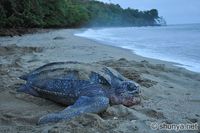
Is there another animal that appears more often in human mythology, folklore, and literature than the turtle and its land dwelling cousin, the tortoise? They have variously stood for wisdom, tenacity, longevity, fertility, or stability in cultures around the world. The leatherback is the largest of all living turtles, the male up to 900 kgs and 3 m. It feeds mostly on jellyfish and lives up to 45 years (a disputed number). Unlike other turtles, it lacks a bony shell but has a hard leathery skin. That plus its powerful flippers and hydrodynamic body allow it to dive down to 1400 m and swim as fast as 35 kmph. Given its large size, its natural predators include only sharks, killer whales, and now humans.
LeatherbackTurtle22Surviving as a species for an astounding 150 million years (modern humans arrived 0.2 million years ago), through big extinction events like the one that killed the dinosaurs, it is now endangered by human activity: entrapment in commercial fishing gear; poaching for meat on nesting beaches; consumption of turtle eggs as a delicacy or for their (non-existent) aphrodisiacal properties; coastal development near nesting sites (lights, noise, and worse); and the turtles mistaking marine plastic waste for jellyfish. Today the estimated worldwide population of nesting females is 35,000, down from an estimated 100,000 a mere thirty years ago; the Eastern Pacific has seen a drop of over 90% in twenty years. At this rate, the leatherback may go extinct in a generation or two, although both heroic and desperate conservation efforts are underway and turtles have come to symbolize marine environmentalism itself.

About thirty tourists, mostly Europeans but also many Trinis, congregated near the entrance to the beach at 9:30 PM. A guide reviewed the turtle-watching etiquette—no white lights, flash photos, loud noises, feeding, or touching. Did everyone in their beach-facing rooms turn off the lights? He then led us onto the sands, awash in the light of a nearly full moon. Within minutes, we saw over a dozen leatherbacks. Since turtles do not see red, some people used red flashlights to illuminate them. Two more were wading out from the sea but we were told not to go near them lest they turn back.
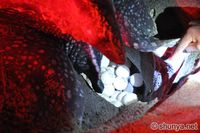
LeatherbackTurtle55 We saw a mother drop her eggs in a sand pit about two feet deep, freshly dug using her hind flippers; the eggs bounced like hard rubber balls as they fell on top of other eggs. About eighty eggs later, she began covering up the hole. She will do this every nine days or so for about two months during the nesting season, once every 2-3 years. Then she will disappear and play no part in the hatchlings' lives. After sixty days or so, the hatchlings will dig out of the sand and make a wild dash to the sea. In the ocean, only about one in a thousand will survive into adulthood. Most mothers arrive on the beach and leave in the dark—their superb night vision also serves them well in the deep sea—but a few latecomers can stay well into the light of dawn. We decided to take a chance and return at daybreak.

LeatherbackTurtle12 The leatherbacks often travel thousands of miles each year to feeding sites. They mate at sea and while the male never returns to land, the female, quite amazingly, returns to spawn on the very beach where she was born. Most scientific studies are therefore based on the female. How she returns to her birthplace without a GPS device is not conclusive, though the best theories posit at least a sensory apparatus for the earth's magnetic field, not unlike many migratory birds. Quite possibly, the geomagnetic coordinates of their natal beach are encoded into the hatchlings long before they reach the sea, and the adult female navigates to it the rest of her life. Indeed, the leatherbacks we saw were all returning to their ancestral home. So the loss of turtle nesting habitat has led directly to a decline in their numbers. This has led to more jellyfish, which eat large quantities of fish larvae, contributing to a drop in fish populations.

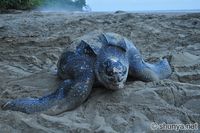
Back on the beach at 5:30 AM, we were delighted to find four turtles—our chance to observe this creature of the sea on terra firma in the light of day. And what primeval looking beings they are! Quiet, solitary, and non-aggressive, laboriously trudging along the sand with their flippers. A sticky gel oozed out of their eyes; sand clung to their eyes, mouth, and body. "So ugly, they're cute!" I said to Usha. I couldn't tell a young turtle from a middle-aged one; they looked so ageless. Every so often one would freeze and soulfully stick her neck up. I wondered what the world looked like to them, with their strange bodies, instincts, and cognitive capacities. How different our own "real world" would have been with night vision or a geomagnetic sensorium? How would human culture have turned out, say, without our fear of the dark?
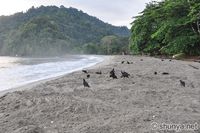
Vultures5 The morning also brought vultures looking for chance exposures of turtle eggs. Broken shells lay strewn about on the sand. I must have stepped on a freshly cracked one, for I noticed egg yolk on my big toe. We saw a turtle get disoriented and move away from the sea towards the lodge. Usha attributed it to a rowdy family of tourists who had stood obstructing the turtle's path to the sea and even used flash photography, confusing the animal. She intervened with a polite little lecture for the family, a scene that both amused me and brought a surge of affection for her. After an hour or so, the turtle fortunately turned around. The leatherbacks can stay only a few hours on a tropical beach before overheating and dying. Each time one of them made it back to the sea, I felt the world was set right in a small way—a world that many ancients and moderns have thought, metaphorically or not, to be resting on the backs of turtles upon turtles—reaching all the way down. 
______________________________________________________________________

Click here for more pictures from Grande Riviere. More writing by Namit Arora?
______________________________________________________________________

Posted by Namit Arora at 12:30 AM | Permalink

Comments

What a treat!
Forty years ago I had the chance to see an Atlantic turtle come ashore and lay her eggs on a Florida beach.
Words are not enough to say what the experience is like.
In life terms it ranks very near the top, close to being present for the birth of my own children.

Posted by: John Ballard | May 23, 2011 6:21:09 PM

Post a comment


Subscribe to this blog's feed  

PayAnywhere with iphone credit card swiper

Android Tablet

Bluetooth Headset

2013 New Style Dresses

Compare Car Rental Prices

DHgate.com Wholesale

3QD on Facebook

3QD on Kindle

3QD by Daily Email

Receive all blogposts at the same time every day.

Enter your Email:


Preview 3QD Email

3QD on Twitter

Miscellany

Lijit Search

AddThis Social Bookmark Button

Add to Google

Recent Comments

Rashid on Aftermath: Pakistan Elections 2013

Yoann on The Bystander Effect in Medical Care. Why Do I Have So Many Doctors Not Taking Care of Me?

Dave Ranning on Aftermath: Pakistan Elections 2013

sadhana on Aftermath: Pakistan Elections 2013

Carol Westbrook on The Bystander Effect in Medical Care. Why Do I Have So Many Doctors Not Taking Care of Me?

Ken Bryant on Aftermath: Pakistan Elections 2013

Umer Vakil on POETRY IN TRANSLATION: CORDOBA

Kabir on Aftermath: Pakistan Elections 2013

Nina on White Indians

Nina on White Indians

Dave Ranning on If Only We Had A Leader Like Chavez, Who Solved Real Problems -- Instead Of Debating Fake Ones Like The Deficit

Mohammed Hassanali on Aftermath: Pakistan Elections 2013

musafir on Aftermath: Pakistan Elections 2013

Maniza on Aftermath: Pakistan Elections 2013

Ellen Perry on The Bystander Effect in Medical Care. Why Do I Have So Many Doctors Not Taking Care of Me?

waqnis on The Bystander Effect in Medical Care. Why Do I Have So Many Doctors Not Taking Care of Me?

Norman Costa on The Bystander Effect in Medical Care. Why Do I Have So Many Doctors Not Taking Care of Me?

Hannah Carlton on POETRY IN TRANSLATION: CORDOBA

Joe on Digging Up Bones or, The Labyrinths beneath Our Feet

JonJ on The Beautiful German Language

cpfaff on Passionate About The Actor's Art: an interview with Michael Howard

Sumiran on Sunday Poem

Ethan on Getting Smarter

Pacificklaus on NORTH KOREA’S NERVE WAR

Félix E. F. Larocca, MD on POETRY IN TRANSLATION: CORDOBA

Acclaim For 3QD


"I couldn't tear myself away from 3 Quarks Daily, to the point of neglecting my work. Congratulations on this superb site."—Steven Pinker, Johnstone Professor of Psychology, Harvard University.

"I have placed 3 Quarks Daily at the head of my list of web bookmarks."—Richard Dawkins, Charles Simonyi Professor of the Public Understanding of Science at Oxford University.

"Just wanted you to know I’m one of many who reads and enjoys 3 Quarks....almost daily."—David Byrne, musician, former lead-singer of the Talking Heads, artist, intellectual.

Read more here.

The 3QD Prizes

Subscribe to this blog's feed