
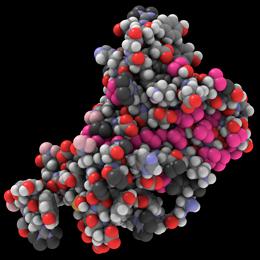
Why are we so complicated? You might imagine that we've evolved that way because it conveys adaptive benefits. But a study published by Nature today suggests that the complexity in the molecular 'wiring' of our genome — the way our proteins talk to each other — may simply be a side effect of a desperate attempt to stave off problematic random mutations in proteins' structures.
Ariel Fernández, previously at the University of Chicago, Illinois, and now at the Mathematics Institute of Argentina in Buenos Aires, and Michael Lynch of Indiana University in Bloomington argue that complexity in the network of our protein interactions arises because our relatively small population size — compared with that of single-celled organisms — makes us especially vulnerable to 'genetic drift': changes in the gene pool due to the reproductive success of certain individuals by chance rather than by superior fitness.
Whereas natural selection tends to weed out harmful mutations in genes and their related proteins, genetic drift does not. Fernández and Lynch argue that the large number of physical interactions between our proteins — a crucial component of how information is transmitted in our cells — compensates for the reduction in protein stability wrought by drift.