
By Jenny White
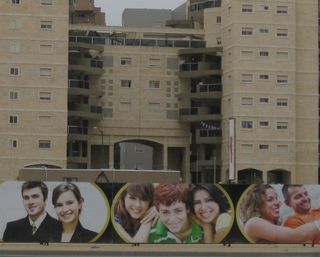
I am now in Be’er Sheva in the Negev desert, teaching a three-week course at Ben Gurion University. A driver brought me from Tel Aviv airport to my residence in a ten-story building that towers over the neighborhood. The streets near the residence are little more than rows of cement rooms with walled-in tile forecourts. Behind them loom three- and four-story apartment buildings of unfinished cement without ornamentation or color. There is little attention to detail and the buildings are crumbling, festooned with wires and rusting grates. They remind me of bunkers with blank walls and slits for windows. That is the only pattern I see beyond the ubiquitous lack of ornament. But it is a pattern.
On the Sabbath I set off toward the high rises I could see in the distance. I had heard about a mall – the only one – that was open on Saturdays because the owner was Russian. I trudged for an hour and a half along wide utilitarian roads unrelieved by vegetation and then through a deserted industrial area until I reached the mall—a strip of boxy shops arrayed in a horseshoe around a parking lot and the Hillel Café, which to my great relief was open. After an invigorating pasta salad, I returned home by another route. Nothing I saw diminished my first impression. The buildings were higher and better built, but pale, bunker-like, with wide, narrow windows, and without detail.
There is little color in Be’er Sheva, even in people’s clothing. I am told that many eastern Jews live here who are observant. Some of the women wear long skirts or tunics and little caps over their hair. Others dress in shorts and t-shirts. Observant or not, it's a low-key, cheap-jersey world. Sidewalks are cracked, littered. Things are jury-rigged. In some ways the city reminds me of Turkey in the 1970s, but without the colors. In those days, even the poorest Turkish house was whitewashed or painted blue against the Evil Eye and flowers planted in recycled oil cans brightened balconies and doorways. In Israel it seems as if color might tempt the Evil Eye rather than ward it off.
The university is an oasis to which I gratefully return after each expedition. Its buildings are attractively modern, set like sculptures within artfully designed greenery through which snakes a gurgling stream. It is full of cafes, like a little Tel Aviv. The students on campus look like the students on any US campus. But the buildings also have something of the bunker about them, thick cement expanses, narrow windows, no color. I was told that if anything threatening happens, there were bunkers in the basement, but that simply stepping into an inner room would likely be safe enough. The common room in my residence also doubles as a bunker. There is a reason, of course, for bunkers. Not long ago, Grad rockets fired from Gaza reached Be’er Sheva and one landed on a university dormitory.
Jerusalem gave me the impression of monumental fortifications, by which I mean less the Ottoman city walls, but the vast settlements, enormous cliffs of structures rising from hilltops and extending into the distance like impregnable walled forts. I also visited Sderot last year, one of the towns that bears the brunt of Hamas-inflicted rockets. Sderot is nothing but a bunker. Even the bus stops are bunkers where the riders wind themselves into cement walls to wait. The city representatives met us in their underground command bunker and told us about their traumatized populace.
Tel Aviv boasts celebrated modernist structures in the cubic Bauhaus style. But when I visited Tel Aviv for the first time last year, I saw a city of square, unadorned cement buildings with balconies, their cladding peeling like bad sunburn, shots of color provided by the occasional orange trumpet vine. The boardwalk along the sea was bleak cement. Friends who live there see an entirely different city; they see cafes, the sociable homes of friends and family, intellectual and economic exchange, a vivid life projected onto these otherwise unremarkable surfaces like hot-pink bougainvillea. I didn’t think “bunker” in Tel Aviv, but I did think “impermanence.” This is a clue, I think: structures built not from a tradition or for posterity (except in a defensive sense), but also not built as a tradition in the making. The statement seems to be a practical “get on with it”, set in a no-nonsense present that eschews investment in an uncertain future.
Yesterday I asked one of my university colleagues here why there was so little color or ornamentation. He explained that early Israeli architects brought with them the Bauhaus style and that modernism remained the building norm. In the 1950s and ‘60s Israel’s population increased so rapidly that buildings were thrown up as quickly as possible with “no time for nonsense.” The modernist style and the lack of ornament and color, he added, were also a rejection of the East. It was a way for Israelis to say, “We are Western.” Indeed, houses in Bedouin towns on the outskirts of Be’er Sheva and in Palestinian Ramallah, which I visited last year, were notably more ornate with large arched windows and rooftop crenellations that looked less like battlements than crowns.
In Ritual and its Consequences, Adam Seligman et al. suggest that repetition of pattern in the world we construct around us is closely related to ritual, that is, stylized repetitive interactions that relate the self to the world. These exist in both religious and secular domains. Ritual isn’t an external expression of the world as it actually is, nor is it simply the expression of an internal state. Instead, it supersedes the individual by providing an “as if” world that makes it possible for very different groups of people to share a social world. Rituals, I would add, are acts by which we calm ourselves, rehearse who we are and who we would like to be as a society, despite our differences. Israel’s national pattern might be called the blast wall, a defensive structural skin that protects the family within. It shows little concern for structural details or exposed public space, but places all its emphasis on what is inside. My otherwise bleak walk to the mall, for instance, was relieved by a colorful head-high billboard as long as a city block that showed a series of ordinary faces of men, women, children, couples. People are displayed in bright hues, whereas structures and actual people on the street are wrapped in protective coloring.
There are, of course, instructive exceptions. In suburbs inhabited by professionals, houses are shaded by lush gardens. Tel Aviv is said to be a city of cafes – individuals practicing public simultaneity and open display. Contradicting the Israeli pattern with such alternate rituals cracks open the “as if” world of Israeli public identity and reveals the different groups within. Last year, the Zionist head of an illegal West Bank settlement told my visiting group with some disgust that “those people in Tel Aviv who sit around in cafes and drink cappuccinos” had forgotten their Zionist heritage. They had become soft, he complained, and would no longer be able to defend the nation.
The lens through which Israelis see the world is that they are a people under existential threat (it is common to hear people say, “they hate us because we’re Jews”). Patterns of material culture evince that fear with a repetition of defensive walls and an unwillingness to draw attention through ornament, color or public display. Instead, Israel as a nation emphasizes Jewishness and the physical presence of Jews and their families, the fertile yolk within a hard, white shell. There is little “Israeli” material culture. You won’t find tourist artifacts that represent Jewish Israel (rather than the many other cultures that reside here). Other than religious artifacts and Dead Sea bath salts, there is nothing “Israeli” to buy in the areas tourists frequent or the airport shops. Jewishness and Jews are the portable treasures.
There are signs of change, the confidence to tempt the Evil Eye. The newest building on campus has a vulnerable glass skin under a cement awning. A new housing complex has Moorish arches over its windows. Delicate nods to the future from a haunted present.