
| ABOUT US | ARCHIVES | LINKS | RSS FEED | MONDAYS | |

3quarksdaily

An Eclectic Digest of Science, Art and Literature

« Hell on Wheels | Main | Removing the Blades from Hume’s Guillotine »

May 09, 2011

Are marathons worth it?

by Dave Munger

It's 10:00 on a beautiful Sunday morning in California. To my left is some of the most spectacular coastline America has to offer. I'm walking along a road on Point Lobos that is ordinarily packed with cars on days like this, but today, thanks in part to my $135 entry fee, the road has been closed to traffic.

There's only one problem: I should be running, not walking. Over the past year, I've spent hundreds of dollars on running gear and race entry fees. I've logged more than 1,600 miles training for this event, including nearly 1,000 miles in the past four months alone. I've lost over 35 pounds and steadily improved my speed and stamina. Why can't I make my body do what I've trained it to do?

Dozens of runners pass me on either side, each of them experiencing varying degrees of misery similar to my own. Most of them, like me, have traveled hundreds or thousands of miles to get here, spending $500, $1,000 or more to participate in this event, the Big Sur International Marathon. Like Boston, New York, Paris, and Berlin, Big Sur is a "destination marathon," a once-in-a-lifetime experience that is so beloved, many runners return year after year.
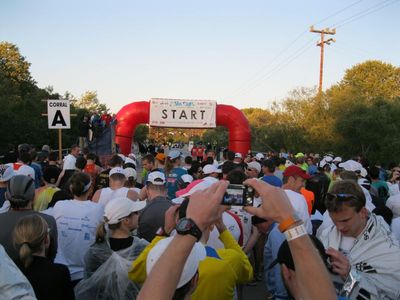
IMG_0068 The race was run on May 1 this year, but Big Sur's 4,500 spots for marathoners had already sold out last October. Other races sell out even faster. This year's Boston Marathon, despite strict qualification standards, sold out in 8 hours. The 2011 Marine Corps Marathon, which tours the monuments of Washington, DC, sold out its 30,000 spots in 28 hours.

While I'm a better-than-average runner, I'm by no means a competitive athlete. My best finish ever was fourth place, in a 5-kilometer race that only had 74 participants, many of whom were walking the entire course. I'm certain that there are several hundred runners faster than me who live within 50 miles: When I do well in a race, it's either because those guys aren't racing, or they're racing elsewhere.

Last year, over 500,000 runners completed a marathon in the U.S. alone. Nearly all of these runners had absolutely no chance of victory: The 625 marathons held in 2010 yielded only 1,250 slots for victors (male and female). To encourage more runners to participate, many races offer a variety of other awards: Age-group winners, a master's division for runners over 40, awards for runners above a certain weight, for runners who live in snowy climates and so have limited opportunities to train, for relay teams, even for best costume. But even when you account for all these awards, only a tiny fraction of competitors actually wins anything.

No, the runners in all these races are rarely actually competing against the other runners. Most runners have only one opponent: Themselves. Once you've run one marathon, you need to run another one, to see if you can do better. The PR — personal record — has become everyman's definition of a "good race," whether he finishes in first or three thousand and first.

The quest for a new PR can lead runners to spend hundreds of hours training, and thousands of dollars on gear and services designed to help them trim a few minutes off their previous records. Running shoes now routinely cost over $100 a pair, and Mizuno this weekend cracked the $200 barrier with its latest offering. Supposing these new shoes actually make you faster — a dubious proposition — does it really make sense for an average runner to buy them? This runner isn't going to win any races regardless of what shoes they wear. Even if they set a new PR, what's the value in that if it doesn't actually reflect improved conditioning?

It's now 10:14 a.m. The race course has left the coast and heads up one final hill before the finish. I've been running (with the exception of a few walk breaks) for nearly three and a half hours. My $170 GPS watch tells me that my pace, which earlier in the race had been faster than 8 minutes per mile, has now slowed to worse than 10 minutes per mile. After 25 miles of running, I'm in uncharted territory: The most I had run previously was 22 miles. I stop at an aid station to get a cup of water, allowing myself to walk for 60 seconds while I gulp it down. I start running again, telling myself that I won't slow down until I reach the finish, just over a mile away.

If all most runners hope to gain from a race is a new PR, isn't the whole business of road racing a rather narcissistic enterprise? Perhaps, but on any given Saturday, there are five or more road races within an hour's drive of my home, just north of Charlotte, North Carolina. Most of these races are 5-kilometer runs, usually put on for the benefit of a charitable organization. This past weekend, races in my area benefited Batten disease research, women's cancer research, a food bank, a community college, and a day-care center. If a small race has 200 entrants and charges a $20 fee, that could mean thousands of dollars for a local charity. If organizers can leverage runners' selfish goals to raise money and awareness for their cause, then perhaps it all balances out.

My GPS watch tells me I've run 26 miles, but I've yet to see the official 26-mile marker on the course. I've noticed that my watch is often off by as much as two tenths of a mile in races, so this doesn't surprise me, but it has led me in less stressful times to consider buying a new watch that not only tracks my location by GPS, but also by counting steps. This can be more accurate in certain situations when GPS satellites are out of line-of-sight contact. It can also be much more expensive. Finally I arrive at Mile 26. Just 0.2 miles to go, and I will have finished my first marathon. I try to pick up the pace for a sprint to the finish line, which looks suspiciously like the starting line I left over three and a half hours ago. I know that the official race photographers will be snapping photos as I cross the line, so I raise my arms in "victory" as I finish, in a time of 3:37:55, good for 354th place. Later I recreate the pose for my dad so he can take a cheaper version of the same picture.
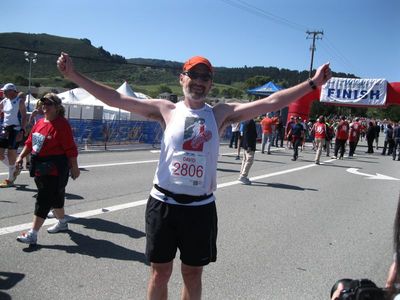
IMG_0087A few days after the race, the race organizers email me a link to a site where I can preview my official photos — and download them, for a fee, of course. There I am, crossing the finish line. There I am, looking strong in the early part of the race, with the waves of Big Sur crashing to the shore in the background. But I'm most intrigued by a photo taken around 10 a.m., on Point Lobos. I'm walking, not running, and the look on my face is somewhere between exhaustion and despair. That photo, more than any of the other professional photos or the ones I took myself, captures what it's like to run a marathon. I had never pushed myself as hard in my life, even during those hundreds of miles in training. It's a feeling I've never experienced before, and one I don't want to experience again in a race, but it left me with an almost overwhelming desire to be stronger than that, better than that, and damn the cost.

I wish I could say the feeling was unique; it's probably not. Indeed, it's probably a feeling most runners get in most marathons. There's almost certainly something better that marathoners could be doing with all that time and money. Running a lot of marathons, in fact, may not even be good for your health—while the research on the effects of long-distance running is mixed, it stands to reason that a more moderate workout regime puts much less stress on the heart. While many races benefit charities, they also feed for-profit companies like The Competitor Group, which manages the wildly popular Rock-N-Roll series of marathons. Surely there's a more efficient way of getting resources to people who need them.

In America, marathoning is a rich person's sport. There's certainly no way my stepbrother Mark, who I've discussed here before, could afford it, even if his health permitted it. My brother's situation, for me, is the strongest argument I've yet encountered for ending this whole business. So far I haven't succumbed, though. I'm registered for another one in Colorado next month. Maybe I'll get a PR.

Posted by Dave Munger at 12:10 AM | Permalink

Comments

I ran only one marathon, in the 80s in NYC, and went to Central Park to register in person, thereby getting a leg-up on all the folks who applied by mail. The best part of that marathon was that there was an audience every step of the way, who clapped hands and cheered us on. I'd never have finished if it weren't for them. Do they have such an audience at Big Sur?

Posted by: Evert Cilliers | May 9, 2011 8:25:25 AM

Great read, Dave (and great time at Big Sur). The business of marathoning is both fascinating and disgusting to me. During the recession, marathoning was one of the few businesses that was able to gain even more customers, while at the same time sharply increase prices (and in the case of The Competitor Group, decrease their quality of service). I can't afford to pay for as many marathons as I'd like to run, and my body can't afford to run them as fast as I'd like to. So, I prefer to run my 26.2 where I live, at a leisurely pace. There have been some groups that put on free marathons to help marathon addicts get their fix, and I'm hoping it really catches on. I think the for-profit groups like the Rock n Roll series will always be in business though, for the reason you allude to in your article; people who intend to only run one marathon in their life often say, "damn the cost" and more than willingly, they'll drop $1,000 for all of the hoopla that, for many, adds to that feeling of accomplishment of finishing one's first marathon.

Posted by: Matt Jenkins | May 9, 2011 8:50:25 AM

If you think marathoning is a rich person's sport, I'd love to see what you think about triathlons. The cost of one of those singlets alone is enough to make one reconsider the idea that $100 for a pair of shoes to protect your feet is excessive. (And a GPS, while nice, is hardly mandatory for the sport.)

I think if you enjoy distance running and you enjoy the atmosphere of road racing, you should do it. If you don't enjoy these things, don't do it. If the proliferation of big corporate race organizers bothers you - as it does me - then avoid their races. I really don't think it's more complicated than that. (I say this as someone who is known for analyzing things to death.)

P.S. Congratulations on the fabulous time, and on such a challenging course, too!

Posted by: Caitlin | May 9, 2011 9:08:01 AM

Evert: Big Sur doesn't have a lot of opportunities for fan support. The highway you run on is the only access point to most parts of the course, and it is closed to traffic! But it's easy to draw inspiration from the unbelievable scenery along the way. I wrote a longer post on my running blog that should give you some sense of what it's like.

Matt: I hope the free marathon movement catches on; my sense is that most people don't think a casual event like that "counts" the same way a race that you have to shell out the big bucks for does. But maybe that will change.

Posted by: Dave Munger | May 9, 2011 9:16:00 AM

Caitlin: I agree, there are some ways to reduce the expense of running marathons. But other than one-time and unnecessary expenditures on high-tech gizmos and travel, shoes are the most expensive item, and it's hard to get around the fact that they wear out quickly and need to be replaced.

More than that, the time commitment marathons require and the physical toll they take is extraordinary. In my experience, most marathoners have desk jobs; it's simply too much effort to be doing physical labor all day and then train for marathons.

Posted by: Dave Munger | May 9, 2011 9:27:22 AM

Competitive marathons may be a rich person's sport, but long distance running for pure pleasure is one of the two most exquisite free experiences humans have available to them.

Posted by: Sister Y | May 9, 2011 11:00:31 AM

Also, more expensive (cushioned) shoes are bad for you.

Posted by: Sister Y | May 9, 2011 11:32:42 AM

The Big Sur Marathon raises around 50,000 every year for Court Appointed Special Advocates of Santa Cruz County, serving youth in the child protective system. So if you want to feel less self-indulgent running Big Sur, run with Team CASA!

Posted by: Vicki Baker | May 9, 2011 1:08:13 PM

Fantastic time Dave! Much better than my ONLY marathon on my 50th birthday when I trained for 3 months and finished in nearly 6 hours. I ran for much longer than the vast majority of participants and for over twice as long as the winner - next time I'm going for a new PR - maybe 7 hours.

Posted by: Buzz | May 9, 2011 4:39:13 PM

Post a comment


Subscribe to this blog's feed  

PayAnywhere with iphone credit card swiper

Android Tablet

Bluetooth Headset

2013 New Style Dresses

Compare Car Rental Prices

DHgate.com Wholesale

3QD on Facebook

3QD on Kindle

3QD by Daily Email

Receive all blogposts at the same time every day.

Enter your Email:


Preview 3QD Email

3QD on Twitter

Miscellany

Lijit Search

AddThis Social Bookmark Button

Add to Google

Recent Comments

Elatia Harris on Daniel Dennett's seven tools for thinking

Abbas Raza on Daniel Dennett's seven tools for thinking

Jonathan on Daniel Dennett's seven tools for thinking

Bill on Daniel Dennett's seven tools for thinking

Louise Gordon on The need for critical science journalism

omar on Mohsin Hamid: 'Islam is not a monolith'

Jonathan on Daniel Dennett's seven tools for thinking

Bill on Daniel Dennett's seven tools for thinking

jo smith on Mohsin Hamid: 'Islam is not a monolith'

carlos on Daniel Dennett's seven tools for thinking

freddie on Daniel Dennett's seven tools for thinking

Eli on "Everybody Hurts" by Sachal Studios, Lahore, Pakistan

Jalees Rehman on The need for critical science journalism

Dredd on Why Rational People Buy Into Conspiracy Theories

Dredd on Why Rational People Buy Into Conspiracy Theories

Scrutineer on Why race as a biological construct matters

prasad on the culture animal

Mitt Romney's Dog on Why race as a biological construct matters

Elatia Harris on The Moral Status of Rocks

prasad on The Moral Status of Rocks

Raza Husain on The Moral Status of Rocks

Fred on Unknown Mathematician Proves Elusive Property of Prime Numbers

Joel Grant on Why Rational People Buy Into Conspiracy Theories

Tomboktu on Why is Europe so Messed Up? An Illuminating History

Joe on Why Rational People Buy Into Conspiracy Theories

Acclaim For 3QD


"I couldn't tear myself away from 3 Quarks Daily, to the point of neglecting my work. Congratulations on this superb site."—Steven Pinker, Johnstone Professor of Psychology, Harvard University.

"I have placed 3 Quarks Daily at the head of my list of web bookmarks."—Richard Dawkins, Charles Simonyi Professor of the Public Understanding of Science at Oxford University.

"Just wanted you to know I’m one of many who reads and enjoys 3 Quarks....almost daily."—David Byrne, musician, former lead-singer of the Talking Heads, artist, intellectual.

Read more here.

The 3QD Prizes

Subscribe to this blog's feed