
| ABOUT US | ARCHIVES | LINKS | RSS FEED | MONDAYS | |

3quarksdaily

An Eclectic Digest of Science, Art and Literature

« Subjective Consciousness: A Unique Perspective | Main | Density, destiny and other convenient anagrams »

May 02, 2011

Dishonest to Whom?

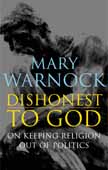
Scott F. Aikin and Robert B. TalisseWarnock Dishonest to God

Mary Warnock’s Dishonest to God: On Keeping Religion Out of Politics (Continuum, 2010) is an  ambitious book.  In it, Warnock distinguishes religion from morality, demonstrates the dependence of religious reasoning on moral reasoning, and argues that religious perspectives are nevertheless crucial for social and political life.  We have a review of the book forthcoming in The Philosopher’s Magazine.  For the most part, we are in agreement with Warnock.  But we do have some disagreements, and we want to focus here on one aspect of Warnock’s view that strikes us as especially troublesome, namely, Warnock’s conception of the value of religion in a secular society.

Warnock’s case in favor of religion is broadly consequentialist.  She holds that religious institutions and practices should be sustained because, on balance, they are socially beneficial.  Warnock contends that -  unlike morality and the rule of law - religion is not necessary for civil society; yet she insists that “there is no possible argument for holding religion is outdated, or that it can be wholly replaced in society by science or by any other imaginative exercise” (159).  Surely this is overstated.  No possible argument for the social dispensability of religion?  Really?  Actual arguments for this conclusion are easy to find.  Consider Hegel’s argument at the end of the Phenomenology that religion must give way to art and philosophy in public life.  Or John Dewey’s argument in A Common Faith that the social and experiential benefits of religious life can be detached from religion and subsumed under a more substantive conception of democratic community, leaving religion to wither away.

It is likely that Warnock means to claim that there is no good argument for the dispensability of religion; that is, Warnock means to deny that there could be an argument for the dispensability of religion which gives religion its due.

Warnock affirms that religion can be morally good, and good for us.  She holds that the stories of the New Testament “can teach morality as nothing else can, in vivid and memorable form” (159).   Additionally, she holds religion is a civilizing force.  Emotionally profound episodes in life call for ritual and ceremony; death, birth, thanksgiving, marriage are made public, sharable, and civil given their intersection with religion.  Finally, Warnock emphasized the aesthetic dimension of religion; she holds that the breadth and depth of our imagination is increased with religious icons and stories.  She claims that “to lose these things, though it would not be the end of society, would be its incomparable spiritual loss” (161).  Hence there are moral, social, and aesthetic reasons to reject the view, common in some atheist circles, that sufficiently enlightened individuals see the elimination of religion as a worthy social goal, that in a properly civilized social order, religion would be at best a historical curiosity. 

Warnock acknowledges that the question of the social value of religion comes to the balance of goods and evils.  Surely Warnock is correct to holds that, from this consequentialist perspective, religion can be a vital social good.  However, there are familiar social consequences of religion that are not so salutary: religious bigotry and intolerance, mistreatment of women, opposition to science, general credulity, authoritarianism, and so on.  But it is important to emphasize that, regardless of how the cost/benefit calculation runs, Warnock has hung her case for the social value of religion on entirely secular considerations.  In proposing that the matter is to be decided on the character of the social consequences of religious belief, Warnock has asserted that the value of religion is wholly detached from the truth or rationality of the central theological claims of the major religions.  On Warnock’s view, the content of religious beliefs, arguments, and commitments is irrelevant. 

In fact, on Warnock’s view, religion can be highly socially valuable – and therefore worth sustaining - even if all distinctively religious claims are demonstrably false.   Her defense of religion, then, has the same form as the defense we adults give of our practice of promoting among our children the belief in Santa Claus: It’s such a useful and comforting fiction that the belief ought to be promoted (or at least not denied), despite the fact that Santa does not exist.  This is what Plato famously called a Noble Lie.

Given this, we must ask: Is Warnock’s defense a defense of religion?  Or is it merely a defense of the idea that some people need the comforting fictions that religion provides in order to be good, responsible citizens?

Arguably a defense of religion along these latter lines evacuates religion of what does the inspiring and instructing, namely, the distinctively theological commitment to God.  Put otherwise, a defense of religion which rests solely upon considerations regarding the social value of religious belief is ultimately no defense at all.  If religious belief is to be defended, it must be understood in terms that religious believers can recognize.  According to religious believers, their beliefs are not merely useful social instruments or efficient means for instilling good moral habits.  They are rather commitments to very particular metaphysical, ontological, and epistemological views.  These views provide the basis for the moral and communal practices among religious believers that Warnock finds socially valuable.  But the social value of the practices provides no defense for the underlying views, all of which are, we contend, false.  No discussion of the merits of religious practices and institutions should be permitted to evade the fundamental question of the truth of distinctively religious claims.

When we first read Warnock’s book, we puzzled over its title.  Why would a book that sets out to defend the social value of religious belief be titled Dishonest to God?  We wondered: Who is being dishonest?  What could dishonesty to God be?  In the light of subsequent reflection, though, we think we’ve come to understand the title perfectly.

Posted by Scott F. Aikin and Robert B. Talisse at 12:10 AM | Permalink
Comments

I'll look forward to the review (and the book, for that matter), but isn't the title reflective of the contention that:

(i) religion is a social good;

(ii) the doctrinal content of any particular religion is immaterial to that social good - and, in fact, societal adoption of doctrinal content would be deleterious;

(iii) one can't, however, have religion without a doctrinal content; and so

(iv) it follows that societal acceptance of religion must not be based on truth claims about doctrine but rather (perhaps as per Gould) on accommodation of doctrine as isolated from such claims.

Or is that missing the point?

Posted by: Max | May 2, 2011 8:06:12 AM

This seems right. There is a deep problem that arises when you attempt to justify sacred values using consequentialist reasoning. Belief in God cannot possibly be contingent on its producing good effects. No believer would stop believing in God if it were empirically established that religion does not produce good effects overall in the world. But this means that, according to Warnock, the vast majority of people should remain totally ignorant of the reasons that justify their central beliefs. They must think they should believe because there is a god: we philosophers know that god's existence doesn't matter. But we won't let them in on the secret. If we do, moral, aesthetic and social collapse!

I would also challenge the idea that religion is socially, morally and aesthetically necessary for good human citizenship. There is an elemental fallacy at work, here: that religion has been the primary means of securing good citizenship throughout human history does not imply that it must be so.

Hammers are good for driving nails, but this does not mean they are they only things that are good for driving nails. The task of the agnostic or atheist is to start using their imagination in order to come up with a new toolbox, perhaps one that we don't need to lie to people about in order for it to function.

Posted by: Nick Smyth | May 2, 2011 2:45:10 PM

Maybe anthropology is a better perspective than social engineering.

What anthropologists see is that ordinary moral life is founded on the sacred - on 'taboos' - and only indirectly on philosophical reasons like harm, freedom or justice. The problem of moral philosophers has always been that however rationally convincing their arguments, they don't join up well with our actual moral feelings. (Actually the real problem is that most moral philosophers are content to write off most of ordinary moral life as not meeting their standards for what counts as morality).

It is religion rather than philosophy that has had most success in creating strong moral sentiments by attaching a sacred awe to its precepts.

Unfortunately for us there are problems about its content (sacred cows, dietary rules, treatment of women....). Unfortunately for religion, it faces the steady erosion of its metaphysics - its particular claims about how the world 'really' works, behind its appearances. Science is just much better at explaining appearances than any religion, and when the metaphysics goes, so does the link with morality and one gets just a boring list of rules with all the sacredness gone.

Posted by: Philosopher's Beard | May 3, 2011 7:36:10 AM

"...the stories of the New Testament “can teach morality as nothing else can, in vivid and memorable form...”

I could just about credit this statement coming from someone who had never read Plato or Confucius: but from Mary Warnock it simply demonstrates a thick, distorting lens of religious conditioning which presumably dates from her childhood.

One of the many gains made by modern atheism is that we seldom have to listen any more to claims about how 'profound' or 'moving' the drab, confused little parables and fantasised histories in the Bible are.

Posted by: Jon Jermey | May 5, 2011 6:32:37 PM

Post a comment


Subscribe to this blog's feed  

PayAnywhere with iphone credit card swiper

Android Tablet

Bluetooth Headset

2013 New Style Dresses

Compare Car Rental Prices

DHgate.com Wholesale

3QD on Facebook

3QD on Kindle

3QD by Daily Email

Receive all blogposts at the same time every day.

Enter your Email:


Preview 3QD Email

3QD on Twitter

Miscellany

Lijit Search

AddThis Social Bookmark Button

Add to Google

Recent Comments

Louise Gordon on The need for critical science journalism

Stuart Mathieson on REFLECTIONS ON WOOLWICH

Kai Matthews on The Moral Status of Rocks

Norman Costa on Dear Guardian: You’ve Been Played

Dave Ranning on REFLECTIONS ON WOOLWICH

Joel Grant on Why Rational People Buy Into Conspiracy Theories

musafir on REFLECTIONS ON WOOLWICH

Norman Costa on Race Is Not Biology

Geoff on REFLECTIONS ON WOOLWICH

Kai Matthews on Why Rational People Buy Into Conspiracy Theories

fallensparks on REFLECTIONS ON WOOLWICH

jon s on Race Is Not Biology

musafir on REFLECTIONS ON WOOLWICH

musafir on Faith Healing

Dave Ranning on REFLECTIONS ON WOOLWICH

Geoff on REFLECTIONS ON WOOLWICH

Luke Lea on Race Is Not Biology

fallensparks on REFLECTIONS ON WOOLWICH

Luke Lea on Race Is Not Biology

jo smith on REFLECTIONS ON WOOLWICH

jo smith on Guy de Maupassant

Geoff on Jeremy Scahill & Noam Chomsky on Secret U.S. Dirty Wars From Yemen to Pakistan to Laos

Jim on Friday Poem

JF on REFLECTIONS ON WOOLWICH

Jesse on REFLECTIONS ON WOOLWICH

Acclaim For 3QD


"I couldn't tear myself away from 3 Quarks Daily, to the point of neglecting my work. Congratulations on this superb site."—Steven Pinker, Johnstone Professor of Psychology, Harvard University.

"I have placed 3 Quarks Daily at the head of my list of web bookmarks."—Richard Dawkins, Charles Simonyi Professor of the Public Understanding of Science at Oxford University.

"Just wanted you to know I’m one of many who reads and enjoys 3 Quarks....almost daily."—David Byrne, musician, former lead-singer of the Talking Heads, artist, intellectual.

Read more here.

The 3QD Prizes

Subscribe to this blog's feed