
by Feisal H. Naqvi
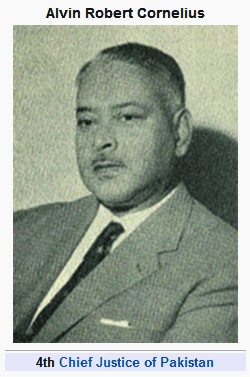
M.R. Kayani, the former Chief Justice of what was then called West Pakistan, is on his terms, just as well known as Cornelius. Like Cornelius, he is remembered as a great jurist. Like Cornelius, he is remembered as a voice of strength and courage, one which refused to be silenced by the might of the state. But unlike Cornelius, his view on religion was that it was a dangerous tool in the hands of fanatics. As one of the co-authors of the famous 1953 report on the causes of the anti-Ahmedi riots, he wrote:
If there is one thing which has been conclusively demonstrated in this inquiry, it is that provided you can persuade the masses to believe that something they are asked to do is religiously right or enjoined by religion, you can set them to any course of action, regardless of all considerations of discipline, loyalty, decency, morality or civic sense.
The Cornelius-Kayani debate is examined at length in a brilliant upcoming article by Professor Clark Lombardi of the University of Washington. In brief, his view is that (a) as argued by Cornelius, human rights norms are strongest when entrenched in public acceptance of those norms, (b) Pakistan’s public discourse is dominated by considerations of what is Islamic, (c) the experience of Egypt’s Constitutional Court shows that a secular institution like the courts can imaginatively and sensitively reinterpret Islamic norms in a modern and progressive manner and therefore (d) countries like the United States which are interested in promoting liberal secularism in Pakistan should also consider promoting if not Islamization, then “at least a certain type of Islamization.”
As much as I respect Professor Lombardi’s acumen and learning, I disagree. In my view, the legal and political system in Pakistan needs to be kept as de-Islamized as possible.
To begin with, I am not sure how much comfort one can draw from the Egyptian experience. Egypt’s Constitutional Court only first got the jurisdiction to strike down laws on the grounds of repugnancy to Islam in 1980. The Constitutional Court subsequently determined in 1985 that the test of repugnancy was only to be applied prospectively and so legislation enacted before 1980 could not be struck down on the grounds of it being unIslamic. Since then the Egyptian court has only delved into the matter on very limited occasions. To jump from these few examples that the judiciary can serve as a bulwark against the worst excesses of Islamic fundamentalism is, at best, premature. Once can, for example, just as easily point to decisions by Egyptian courts in which outspoken thinkers have been condemned for apostasy and then had their marriages declared null and void. Finally, the decisions in question are recent. This means that they were made under the aegis of a dictatorship which justified itself – both to the Egyptian people as well as to the international community – as the last line of defence against the dreaded evil of Islamic fundamentalism. In that context, it takes little strength of character to stand for an ostensibly enlightened or moderate form of Islam.
Second, I don’t accept the argument advanced by Cornelius that popular acceptance of human rights in Pakistan will only come about if the concept of those rights is grounded in Islamic jurisprudence. The recent Lawyer’s Movement in Pakistan represents, by many accounts, the single most sustained popular human rights movement in Pakistan’s history. I concede that there are multiple alternative interpretations of the Lawyer’s Movement available which explain mass participation on grounds other than public support for an independent judiciary (general opposition to Musharraf, popular anger over economic equality etc.). However, while interpretations can be argued ad infinitum, the fact remains that (a) the undoubted ruler of Pakistan first threw out the Chief Justice of Pakistan in March 2007 and then threw out the majority of the superior judiciary in November 2007; (b) the entire lawyer’s community was tremendously outraged by these development; (c) despite violent reprisals by the state, the lawyer’s community refused to back down; (d) the lawyer’s community was backed ultimately by both the media and the larger public; and (e) the deposed judges were brought back despite Musharraf’s gambit being adopted by the newly elected federal government. During all of this time, the Lawyer’s Movement stayed resolutely secular – or at least, non-religious. It is therefore no longer possible to maintain that in Pakistan popular support for human rights can only evolve if those rights are given a religious colour.
Thirdly, there is inherent in Cornelius’ argument a colossal degree of arrogance and political naiveté. Cornelius’ argument was (and is) that if (a) the elite institutions of Pakistan were to try and engage with popular Islamic culture, they could capture its commanding heights; (b) they could then present a sanitised and suitably updated version of popular Islam to the masses, then (b) the masses would be enthralled by this new vision of Islam and (c) the end result would be a liberal Islamic utopia.
As stated above, this argument is both arrogant and naive. It is arrogant because it assumes that a disembodied and disengaged elite is best placed to analyse all of the “good” parts of Islamic discourse (while, of course, filtering out all the “objectionable” parts). And it is naive because it assumes that if only the prevalent liberal/secular orthodoxy is wrapped up in Islamic garb, the end result will be happily adopted by the people of Pakistan. In other words, the Cornelius argument says the following: the people of Pakistan are an ignorant and backwards bunch, unfortunately very attached to religion. Let’s repackage all the good things we know as being Islamic. That way, we should be able to guide the nation into the right direction.
Cornelius’ assumption was understandable during his lifetime because Pakistani politics in the 1960s was certainly not an advertisement for popular engagement. The country then was ruled by a military dictator who believed very openly that representative democracy did not suit “the genius” of the people. More importantly, Pakistan was run by a smugly entrenched bureaucracy whose senior ranks had been inducted by the British era and which, like the bureaucracy of the Raj, believed completely in its ability to divine what the masses were thinking even better than the masses themselves. The jump from “guided democracy” to “guided religion” therefore did not require much effort.
Leaving aside the issue of what was normal back in the 1960s, does this approach have any merit today? In my view, the answer is no. I have no cavil with the concept that the passions of the masses need to be filtered through some sort of deliberative mechanism in order to protect people from what has elsewhere been termed as the “madness of crowds.” Where I disagree with Cornelius and his sympathisers is the contention that the broad moral contours of a nation’s beliefs should be demarcated by an isolated group of decision-makers (i.e. judges) rather than a popularly elected and popularly accountable group of people. My disagreement with the Cornelius view is both ideological and practical.
At the ideological level, I simply do not accept the contention that complex moral questions are best decided by a isolated group of legal thinkers. In such cases, one can normally find persuasive arguments in favour of any number of different but equally legitimate positions. Any attempt to force a consensus can just as easily lead to a backlash as to general approval.
Take, for example, the treatment of abortion in the West. In the United States, abortion is the single most polarising factor between liberals and conservatives. Confirmation hearings to the Supreme Court are often dominated by a potential nominees views on this question. And while potential judges have learnt to avoid answering abortion-related questions, the two ends of the political spectrum both tend to depict the problem in apocalyptic terms.
Feminist scholar Mary Ann Glendon has persuasively argued that the reason why the abortion debate has become so polarised in America is because it has been treated as a legal problem rather than a political problem. Legal problems tend to get analysed (and decided) in terms of right and wrong. In other words, a decision by a court in favour of a particular political argument (the “right” side) tends to delegitimize the counter-argument (the “wrong” side). In normal circumstances, this is not a problem. But in circumstances where the public is both divided and strongly involved, a judicial decision may serve to radicalise the people who find themselves on the losing side. Glendon’s argument is that this is exactly what happened as a consequence of the decision of the U.S. Supreme Court in Roe v. Wade. Her point is that abortion was as divisive an issue in European countries like France and Germany but that in these countries, the debate was settled through a parliamentary debate. And that as a consequence, the compromise position which emerged has not had any problems finding popular support (even though, the ultimate result may not be particularly different from that mandated by Roe v. Wade).
Let me make my point clearer. Islam is a highly emotive issue in Pakistan. Any attempt to cap the geyser of popular belief with a carefully considered, well balanced liberal interpretation of Islam is just as likely to provoke a storm of outrage as it is to preserve human rights.
There is an additional issue involved as well. Judgments based on liberal (or conservative) “interpretations” of the Constitution not only leave open the theoretical possibility that people aggrieved by such judgments can overturn them through the democratic process but also preserve the fiction that judges remain tethered by the popular will (whether expressed in statutory or constitutional form). Deciding cases on the basis of “Islamic” principles negates both of those aspects. A person who is aggrieved by a judgment based on ostensibly Islamic reasons has no remedy, even in theory, because he cannot change that which is Islamic. Furthermore, a judge who decides on the basis of Islamic law is completely independent of any popular concept of what is right or wrong. I, for one, am not prepared to trust any judiciary with such power.
At a practical level, I have a simpler problem. The judiciary in Cornelius’ day was a bastion of Anglicised elitism. Cornelius himself was an ex-ICS officer, somebody who had earned his spurs as a young babu holding court in the mofussil. If Cornelius assumed that trusting the superior judiciary with the broader power to rely upon Islamic jurisprudence would result only in the repackaging of standard western liberalism, he can be forgiven for extrapolating his own beliefs onto others. But, that assumption is self-evidently not valid today.
One of the more comprehensive treatments of Islam and the judiciary is Martin Lau’s 2006 treatise “The Role of Islam in the Legal System of Pakistan.” Lau’s view of the impact of Islamic doctrines on judicial precedent is mostly positive, but he also does acknowledge that there are certainly some decisions which give cause for concern. For example, Lau discusses cases in which Islamic considerations were used to uphold religious restrictions against Ahmedis and to deny women the right to marry individuals of their choice. But while he notes how the law of Qisas and Diyat was forced onto Parliament by the Shariat Court, he does not discuss how the said law (which permits the heirs of a murder victim to forgive the killer) has lead to an increase in honour killings of women. Similarly, while Lau discusses the repeated attempts by various judges to purge the financial system of Pakistan of all interest-based mechanisms, he makes no effort to put these attempts into a larger economic context or to explain how such attempts have lead to a peculiarly hypocritical mess in which “interest” ostensibly does not exist but mark-up certainly does.
Leaving aside the merits of Lau’s book, the further point to note is that Pakistan in 2011 is a different country from the Pakistan of 2006. What was simply a troubling insurgency in the north has now become a life-threatening cancer. Pakistan has for so many years lived on the edge of disaster, sliding ever so imperceptibly towards complete meltdown without ever making it all the way there. But in recent months, the slide has become ever more evident.
Pakistan’s blasphemy laws have for years been used to intimidate and threaten liberals and minorities, but now those threats are becoming more violent. In November 2010, Aasia Bibi, a Christian woman was sentenced to death by hanging. When her cause was taken up by Salman Taseer, the then Governor of Punjab, Pakistan’s largest province, he became a target for extremists. On 4 January 2011, Taseer was shot 26 times at close range by his own bodyguard, Mumtaz Qadri. While that was terrifying enough, what followed was even more scary. Several religious leaders refused to lead the funeral prayers for Taseer before one brave enough was found. More than 500 lawyers signed up to defend Qadri and when he was produced before a court, he was showered with rose petals by a crowd of lawyers. Till date, Qadri has yet to be convicted even though he does not deny shooting Taseer.
Taseer is not the only victim or even the only high-profile victim. On March 12, 2011, Pakistan's Federal Minister for Minorities, Shahbaz Bhatti, was assassinated in Islamabad. According to reports, he had informed the Federal Government that his life was under threat because of his stance on the blasphemy law. For some reason, it appears as if the threat to his life was not taken seriously.
Let me try and pull all these disparate strands together now. There is a serious and well-respected line of argument which believes that the best way to protect human rights in Pakistan is to recast those rights in Islamic terms. I disagree. Constitution-based human right jurisprudence is not only tried and tested but it preserves a dialogue between the judiciary and the electorate and limits the chances of what the law terms, in another context, as “frolics of one’s own.” By comparison, Islamising jurisprudence is a step into the unknown. It may result in the liberalisation of Islamic discourse and the entrenchment of human rights. Or it may result in prejudice and bigotry being shoved down people’s throats on the basis that God says it is good for them. That is a chance I would rather not take.
Feisal H. Naqvi can be followed on Twitter: @laalshah