
by Alyssa Pelish
For Julia Turner, who, on Slate’s Culture Gabfest of 30 March 2011, declared, “I hate epigraphs!”
You see how cream but naked is;
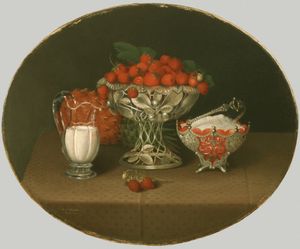
Nor dances in the eye
Without a strawberry;
—Robert Herrick, “The Lily in a Crystal”
There is a scene in Pushkin’s Eugene Onegin that, I must admit, I was pretty crushed out on in my younger years. In it, the novel’s young heroine, Tatiana, pores over the private library of Onegin, dandified object of her unrequited love. Here, she finds not only the books (heavy on the Byronic heroes) from which he has clearly fashioned himself, but his marginalia: “crosses or a jotted note /…the question mark he wrote.” There it is: his soul laid bare, the primary sources of his character. And the truth is, she’s not sure she likes what she sees; he’s so obviously cloaked in the robes of someone else’s genius – “a Muscovite in Harold’s cloak,” she thinks, noting how ostentatiously Onegin has affected the world-weariness of the first Byronic hero.
What makes the scene doubly great is that Pushkin is all the time inviting us to level a similar charge of appropriation at his entire novel. And it’s true: Eugene Onegin emphatically borrows characters and tropes from the body of Western European literature and culture that once cast a long shadow on Russia’s literary aspirations. As if this weren’t enough, Pushkin inscribes his novel with many, many epigraphs plucked from the Western canon, playing with the idea that his sprightly “novel in verse” is just a hodgepodge of re-heated scraps from the real geniuses over in France, Germany, and England. But of course that emphatic playfulness is what makes Pushkin’s novel: the constant Western references (Onegin eating Strasbourg pie and reading Byron next to his bust of Napoleon, Tatiana captivated by the sentimental heroines of Richardson and Rousseau) and, most visibly, the epigraphs that front every canto. Pushkin is wildly, dazzlingly aware of the role his consumption of Western European culture has played in his literary creation, and he now re-animates the lines he’s learned – in the context of his own verse[1]. The difference between Pushkin and Onegin, you could say, is that Pushkin takes those old lines and makes you see them anew; Onegin, alas for Tatiana, merely takes them.
In fact, the difference between Pushkin and Onegin is really the difference between a well-deployed epigraph and an ill-used one.
Those quotations pinned onto the title page of a novel (and etc.) aren’t inherently good or bad; it’s all in how they’re used. Pushkin knew how to make them resonate backwards and forwards, retuning our appreciation of the source text while illuminating his own. Who wouldn’t love a well-deployed epigraph? The way they open up wormholes between one time and text and another?[2] The way they make the universe seem connected and meaningful and filled with some kind of transcendental genius?
But no. Not everyone loves an epigraph. In what could only be an intentionally provocative gambit, Julia Turner, of Slate’s Culture Gabfest, recently denounced the epigraph and challenged the podcast’s listeners to offer a defense. Since that March 30th podcast, a range of responses – from cris de coeur to rational opinings and favorite epigraphs[3] – have appeared on the Gabfest’s Facebook page. Clearly, the epigraph is more than just an academic curiosity. Part of me thought it might be most appropriate to respond to Julia’s gambit with an appropriate quotation that contained the distilled genius every well deployed epigraph has. But an epigraph isn’t truly an epigraph unless it’s preceding a text. Much of its magic is in its juxtaposition – that resonance it has in both the old text and the new text whose precipice it perches upon. So here we go: A Defense of Epigraphs. (And, Julia, watch that quotation above. See it begin to reverberate in the context of this essay.)
Epigraphs didn’t really take off until the eighteenth century, which was when a much more general readership than ever before really began to devour novels. During this time, as we shall see, the epigraph became almost ridiculously de rigueur. Still, you could spot a few epigraphs on the literary texts of the seventeenth century. The earliest one seems to be that accompanying the English poet Robert Herrick’s collected verse, Hesperides. Upon its first, 1648 edition, printed below the blocky type of title and author, is a finer, italicized line from Ovid’s eulogy of a fellow poet: Defugiunt avidos carmina sola rogos.[4] “Our songs will escape the greedy funeral pyre,” Ovid assures both the dead poet and himself, writing from the exile where he would die. Herrick, also in exile for his political beliefs, embraced Ovid’s conception of poetry as a realm outside the limitations of space and time, untouched by distance or death. What we see, then, on the title page of Herrick’s Works Both Human & Divine, is nothing less than his motto – that of his Works and that of himself. And this makes a good deal of sense, once you consider the origins of the epigraph.
On the coats of arms that, by the mid-thirteenth century, pretty much every burgher and his brother had, the motto it boasted might well be a quotation. Though most of these mottos don’t sound all that different from the standard For God and country, it was common enough for an author to select a quotation – particularly from the ancients – to adorn their crests. Rousseau, for instance, selected a line from Juvenal: vitam impendere vero (to risk one’s life for the truth), and the sixteenth-century Spanish writer Mateo Aleméan y Enero swore by his spider-serpent emblem and its accompanying motto, Ab insidiis non est prudentia (Pliny’s insistence that “There is no defense against treachery.) You don’t have to squint to see how these mottoes functioned as epigraphs, really, to the body of these men’s lives. No real explanation is needed for this urge: Why does your senior yearbook photo have a quote beneath it? Why is there a section on your Facebook page designated just for favorite quotes?
But okay. I’m not yet attending to Julia’s challenge, which is a defense of epigraphs. Mottoes, yearbook and Facebook quotes: these are all a means of blazoning our various alliances upon our public face. And while this urge is understandable (“If you really want to understand me, read this.”), what does it actually add to a text that is in itself an illustration of its author’s convictions? When accusations are leveled at the epigraph, it is usually on counts of pretension, obscurity, and/or redundancy. What, these critics ask, does that precious quotation, displayed just between the title and the text, actually add? Well, we are talking about epigraphs, so it depends on the context.
Epigraphs became enormously popular in the late eighteenth century, and it’s worth considering why. Ann Radcliffe, queen of the Gothic novel (authoress, most notably, of The Mysteries of Udolpho and The Italian), punctuated her widely read volumes with an admixture of actual quotation and her own miniature verse. To what effect? Think about the Gothic novel: Virtuous maidens abducted and imprisoned by dark Italian counts? Monks lured into sexual, satanic self-destruction? It’s not hard to see the tension between conscious and unconscious desires that these romances trade in. And the always anachronistic epigraph that appears between the action of two chapters underscores that tension. The typically female and middle-class consumer of Gothic novels, having just followed the imprisonment and attempted rape[5] of virginal Emily in the ruined castle di Udolpho, turning the page to find out what happens next, would first encounter this:
“Of aery tongues, that syllable men’s names
On sands and shores and desert wildernesses.”
MILTON
The epigraph, as it happens, is from Milton’s Comus, his 1634 masque that honors chastity in a young Lady. These lines, like Radcliffe’s romances, suggest the supernatural. But more significant, if you are a reader of neither Comus in particular nor Milton in general, is the effect of this voice out of time – these many voices out of time, in fact: Radcliffe allotted each chapter an epigraph, and they float, in a diction and style different from her narrative prose, above and between the action of her Gothic world. In effect, they momentarily jerk the engrossed reader out of the consuming space of the story – a space that’s pretty transgressive when compared with the social constraints of her middle-class milieu. So Radcliffe’s epigraphs tease apart the already-divided self of her reader; by doing so, they heighten her awareness of those tensions in the novel she can’t put down.
Undoubtedly, the epigraph always acts as a kind of tuning fork, adjusting readers’ expectations, priming their perceptive minds. Detractors (Julia?) sometimes argue that this is a cop-out, that the primary text should do that itself – but when done right, such prefixed notes are all part of the game. And fiction is a game[6]: Regardless of whether you’re Ann Radcliffe or Samuel Beckett, the goal is to mess with your reader’s reality – for at least as long as they’re reading your book. The epigraph, then, is all part of your strategy; it can be a tremendous first move.
Think of Moby Dick. (Because we can’t talk about epigraphs or tremendous first moves without mentioning Moby Dick.) Ishmael doesn’t even introduce himself until we’ve waded through two small collections of epigraphs – “Etymology” and “Extracts” – wherein Melville catalogues for us the various ways man has named and narrated the whale: κῆτος, cetus, whŒL, hvalt, wal. “And God created great whales.” Genesis. “The whale’s liver was two cart-loads.” Stowe’s Annals. “By art is created that great Leviathan, called a Commonwealth or State (in Latin, Civitas) which is but an artificial man.” Opening sentence of Hobbes’s Leviathan. And on and on. What this proliferation of epigraphs amounts to is overwhelm. Before we’ve sighted the numeral of the first chapter, we’re overwhelmed with the multiplicity of things the whale has symbolized to man, and the multiplicity of ways he has tried to symbolize it. Did you know that, whereas the Romans called it cetus, the Erromangoan word is pehee-nuee-nuee? That, while Webster’s Dictionary attributes our whale to the Danish word for “arched or vaulted,” Richardson’s finds the origins in the Dutch and German to roll or wallow? Had you thought about Hamlet’s line to Polonius after considering all the times something like whale appears in the Old Testament? And then there are the lines lifted from travelogues and newspapers and naturalists’ journals and old sea shanties. The excess of epigraphs overwhelms. Save for an inexact chronology and the recurring reference to whale itself, there is no thread that sews these extracts into a coherent whole. You are at sea – and the whale is your only loadstar. I dunno. I don’t think I’d cut that particular instance of the epigraph.
And speaking of this game in which the epigraph is like the opening move, we can’t neglect the cryptic little quotation that Nabokov pins to his ludic Pale Fire. Because it’s a novel founded on the unreliability of not only its narrator but also that narrator’s identity, repeat readers spend their time trying to unravel the highly digressive annotations that comprise the bulk of the novel: Is the narrator an exiled king, a paranoid madman, or the fictional creation of the poet who’s work he’s annotating? It’s clearly a game we’re invited to play, which is why the epigraph seems like such a delicious clue:
This reminds me of the ludicrous account he gave Mr. Langton, of the despicable state of a young gentleman of good family. “Sir, when I heard of him last, he was running about town shooting cats.” And then in a sort of kindly reverie, he bethought himself of his own favorite cat, and said, “But Hodge shan’t be shot: no, no, Hodge shall not be shot.”
—James Boswell, Life of Samuel Johnson
At first, how strangely removed eighteenth-century England seems from the paranoid voice of Nabokov’s émigré narrator in twentieth-century America. But a second look reveals enough parallels between Johnson’s Scottish biographer and the unreliable voice who has entwined his own story with that of the New England poet whose autobiographical verse he’s annotating that… Pages and pages of speculation can ensue. As they have. But Nabokov’s epigraph can’t be definitively interpreted anymore than his novel can. That it, being outside of the novel proper, would seem to offer a more authoritative voice is just its false bottom of a function. As an epigraph, it does what Nabokov does best, which is to defer all authority to himself, the author, and concede nothing.
There are, Julia, so many well-played epigraphs to choose from that it’s difficult to choose only one more! But, with an eye toward symmetry, I would like to glance at the single sterling line from Ovid that precedes Joyce’s A Portrait of the Artist as a Young Man. Just below the black block letters of the author’s name, and right before Chapter One announces itself, is this: “Et ignotas animum dimittit in artes.” OVID, Metamorphoses, VIII., 18. Ah. We are back to that classical dignity we first saw in Herrick’s Hesperides and in those early coats of arms. The line, of course, is from Ovid’s telling of how Daedalus the craftsman “set his mind to unknown arts” in order to escape from the island of Crete. Julia and her ilk might protest that the story of Daedalus is already quite sufficiently alluded to by Stephen’s surname – and thus the epigraph is mere pretension. But maybe, in part, that’s why it works so well! Any reader who knows the story of Daedelus and Icarus will attach the questionable success of the craftsman’s invention (those wax wings that melted when too near the sun) to Stephan Daedalus, the artist as a young man. But Stephan is a bit of a pedant (he lectures his friends interminably on questions of aesthetics and theology). And he’s an insecure pedant, at that; he has to cite the book and line for you. It’s very easy to see young Stephan, educated in the Jesuit tradition of the classics, copying out this line of Ovid in his school tablet. (That it was most likely Joyce who chose the epigraph makes it even better, suitably blurring the line between the author and his autobiographical hero.) What unknown arts Stephen will set his mind to, how they’ll lead to his escape, what incidental tragedy they’ll bring – and what makes Joyce a modern mythologist – is suggested only obliquely by the epigraph. As is the case with any epigraph that really works, you need to read everything after it for the quotation to accrue meaning in its new context. Then it’ll begin to glow like a mood ring on a humid hand.
And that, Julia, is the truth about the epigraph: It’s only as good as its context is apropos of it. You might have the most marvelous line, hand sifted from the greatest of the Great Books, a line in which both sweetness and light shimmer, in which the best that has been thought and said, ever, is crystallized in a multi-faceted phrase. But set it upon the wrong foil, and it’s cheap and dull. By the same token, a lowly artifact of human speech (say, a single syllable uttered by Nixon as the Watergate scandal broke, the “What?” that is Pynchon’s epigraph to his final section of Gravity’s Rainbow), when set in the right place, is doubly luminous. To distinguish a genuine from an ersatz setting is a matter of careful reading – as poor Tatiana finally found.
EPILOGUE
So, Julia, forgive me: But to dismiss all epigraphs out of hand suggests a lack of discernment uncharacteristic of you. It's as if (to turn to my epigraph) you’d simply refused any strawberry, ever, to impinge on your serving of cream – without ever taking time to observe how certain shades of that fruit elicit an entire spectrum of the cream’s coloration that you’d never dreamed of Here's hoping you'll reconsider.
[1] In one of my favorite instances, when Onegin heads from Petersburg to his uncle’s home in the Russian countryside, Pushkin uses as his epigraph the (slightly altered) apostrophe from Horace’s Satires: “O Rus!” In the original context, Horace wonders when he will ever again see his country home. As Pushkin’s chapter epigraph, the Rus exclaimed over is not just the countryside but great wide Russia herself – from most of which Pushkin happened to be exiled while writing Eugene Onegin.
[2] We can’t forget T.S. Eliot’s quite lovely observation: “The existing monuments form an ideal order among themselves, which is modified by the introduction of the new (the really new) work of art among them.” From “Tradition and the Individual Talent.” It seems to me that the impressing of an epigraph onto a new work is a means of underscoring this ongoing modification.
[3] Consistently, people seem to be most impressed with how newer genres, like scifi and the graphic novel make use of the epigraph. And I think this makes sense: If what newer genres and fantastical narratives do best is make us recognize the old and familiar in their novel worlds, punctuating these texts with established voices from our world underscores that connection.
[4] Herrick (or the type-setter) actually misquoted the line; on his title page it appears as Effugient avidos Carmina nostra Rogos.
[5] In the eighteenth-century sense, of course.
[6] “[F]or better or for worse, the reader enters into the spirit of the game.” Typical Nabokov – here, in his essay on “Good Readers and Good Writers.”
* Thanks to William Flesch, who has written quite a bit on quotation in general, and who pointed me toward some reliable sources on the history of epigraphs.