
by Tom Jacobs
…our image of happiness is indissolubly bound up with the image of redemption. The same applies to our view of the past, which is the concern of history. The past carries with it a temporal index by which it is referred to redemption.
–Walter Benjamin, “Theses on the Philosophy of History” (1940)
DIALECTICAL THINGS
The fourth floor of the New-York Historical Society houses the Henry Luce III Center for the Study of American Culture, a collection encompassing over 40,000 objects spanning from prehistorical to 21st century New York. By adopting an “open storage” policy, the NYHS has opened what would otherwise be a warehouse to the public, so that the miles of shelved artifacts that would normally be languishing unseen in a storage area on the fourth-floor can now be observed (albeit, without placards or captions). Unless one consults the computer databases, one is left pretty much on one’s own to make sense of what one is seeing. This can be a productive scene of fascination, recognition, and misrecognition.
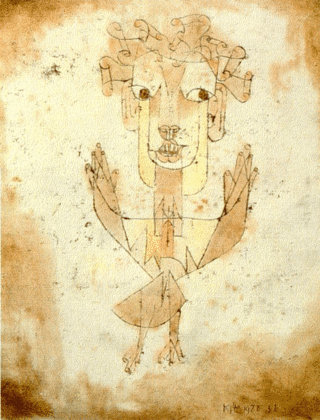
Like all forms of value, aesthetic value derives, as Santayana noted, from the “irrational part of our nature.” Whatever it is we decide to valorize—history, politics, beauty, use, coolness, kitschiness, money—each of these is contingent upon a wide range of “first principles” that are, at root, irrational, based on a desire for a kind of ultimate coherence that can never be fully satisfied. The meaning of these types of engagements with the substance of material culture, however, depends on the historical, cultural, political, and aesthetic forces that converge in the context of the encounter, and on the narratives that shape individual judgment and perception of the event. Concepts, categories, and perhaps even language itself cannot contain or explain the unique somatic power of evocative objects like these. It’s hard not to feel that something else is going on here…something that is either full of wordless meaning or else mystical nonsense.
THE UNCERTAIN TRAJECTORIES OF THINGS
Marx sought to read the outlines of the entire capitalist system through the structure and flow of its commodities—that is, through a careful analysis of the ways they represent different kinds of values, the ways they are exchanged, the ways they are abstracted from the scene of their production. An extraordinary undertaking, Capital illuminates, among other things, the extent to which our modern relationships to objects-as-commodities has changed our understanding of ourselves, others, and the world as a whole. But what of our relationship to things that are not abstract, not commodities, but rather fully material, sensuous, erotic, and aesthetic things of intense fascination? And more specifically, how does our relationship to these types of things shape our understanding of the past? In all of these works, the encounter with objects and images becomes a site of negotiation and revelation, a “contact zone” where forces of history, aesthetics, and the commodity converge. These encounters assume ritualistic dimensions in the ways they offer modes of negotiation between the logic of individual experience and the broader currents and flows of history. These are moments when the physical body comes into a private but felt contact with the social body.
There are, by the way, many instances of this encounter recorded in literature. I will point to only one (and very briefly): about half way into Invisible Man, the unnamed protagonist, who has recently emigrated from the rural South to Harlem, inadvertently walks into the scene of an eviction in progress and is confronted with a vast assemblage of objects splayed out on the sidewalk before him. These objects, he soon comes to realize, are the personal possessions of the evicted elderly couple collected over the course of their lives. All of their prized possessions, private souvenirs, knick-knacks, and furnishings have been turned into a public exhibition (these include: an old daguerreotype portrait of the couple when young; a pair of “knocking bones” (percussion instruments used in minstrel shows); a straightening comb; nuggets of High John the Conqueror (a good luck charm, and a staple of African American folk magic); a small Ethiopan flag; a faded tintype of Abraham Lincoln; the image of a celebrity torn from a magazine; a commemorative plate from the 1904 St. Louis World’s Fair; a bent Masonic emblem; a dime pierced with a nail so as to be worn on a string for good luck; a postcard with a picture of man in blackface; an old breast pump; three lapsed insurance policies; a yellowing newspaper article with the caption, “Marcus Garvey Deported”; and the Free Papers of “Primus Provo,” freed in 1859). Initially content simply to gape at the couple’s private affects, the protagonist comes to discern an illegible cultural history enveloped within them that draws him into its web of implication. As he begins to discern the sensuous particularities of the objects before him, the abstract and general terms that at first rendered the collection into an assemblage of junk assume a more complex and dialectical form that transform this “junk” into objects of value that have been salvaged from the “refuse of history.” The shock of recognizing a secret history within this ad hoc configuration of objects arrests him momentarily, and marks the beginning of a new awareness of history that that incites him to reconsider his own relation to the past. The Invisible Man’s historical consciousness is piqued and set afire by a couple he doesn’t even know.
Looking first at the yellowing daguerreotype portrait of the couple, the protagonist feels “strange memories awakening that began an echoing in my head like that of a hysterical voice stuttering in a dark street;” the frozen gaze of the couple seems to betrays a “grim, unillusioned pride that suddenly seemed to me both a reproach and a warning” (271). Viewing this sudden eruption of history through the lens of what might be called, after Foucault, a kind of counter-memory where the meaning of the past is transformed by its unexpected relation to the present, the protagonist interprets the evicted couple’s collection in light of his own estrangement from the folk culture of the South and in terms of the social injustice that frames its present context:
I turned and stared again at the jumble, no longer looking at what was before my eyes, but inwardly-outwardly, around a corner into the dark, far-away-and-long-ago, not so much of my own memory as of remembered words, of linked verbal echoes, images, heard even when not listening at home. And it was as though I myself was being dispossessed of some painful yet precious thing which I could not bear to lose; something confounding, like a rotted tooth that one would rather suffer indefinitely than endure the short, violent eruption of pain that would mark its removal. And with this sense of dispossession came a pang of vague recognition: this junk, these shabby chairs, these heavy, old-fashioned pressing irons, zinc wash tubs with dented bottoms – all throbbed within me with more meaning than there should have been: […] why were they causing me discomfort far beyond their intrinsic meaning as objects? And why did I see them now, as behind a veil that threatened to lift, stirred by the cold wind in the narrow street? (italics in original).
Although these objects register as icons of social injustice and racism, he is more deeply affected by the profound sense that these things encode a social history, and offer him a seemingly immediate relation to the past. The confusion the protagonist expresses here is consonant with the power and effect of what Benjamin called the “dialectical image,” an intriguing but elusive concept that highlights the historical forces that converge at the moment of the critical encounter with a visual, verbal, or tactile text:
It’s not that what is past casts its light on what is present, or what is present its light on what is past; rather, image is that wherein what has been comes together in a flash with the now to form a constellation. In other words, image is dialectics at a standstill. For while the relation of the present to the past is a purely temporal, continuous one, the relation of what-has-been to the now is dialectical: is not progression but image, suddenly emergent. Only dialectical images are genuine—that is, not archaic—images. The image that is read—which is to say, the image in the now of its recognizability—bears to the highest degree the imprint of the perilous critical moment on which all reading is founded.

This, like most of Benjamin’s writing, is both maddeningly and fascinatingly opaque. What I take him to mean is that our normal relation to the past is simple, straightforward, and even prepackaged (one goes to a museum to see old things and sure enough, there they are). But there are moments when the past confronts us with a blow to the gut, when it erupts unexpectedly into the present with the force of a rupture. A lost and forgotten article of clothing from high school is suddenly recovered, the expression of your father in a photograph from his youth draws you into a peculiar and momentarily intense relationship to the boy he must once have been, you pick up your old copy of The Catcher in the Rye and see your adolescent marginalia with a strange sense of loss and recognition (I apparently didn’t understand why Holden was so bummed out to find the words “fuck you” inscribed onto the walls of the “tombs” where the mummies are in the Met…). The thing of it is, you can’t anticipate it, the dialectical image. You have to be merely open to it, receptive to it, to the pleasurable discombobulation of losing and then refinding yourself in the “storm blowing from paradise,” which is always casting rubble at your feet, some of it interesting to you, some of it not. But to miss those moments when the past flashes “up in the now of its recognizability,” to not look for those moments and breathe in their revivifying winds, is, to miss the whole game, I think.
“IS THIS A PRIVATE FIGHT, OR CAN ANYONE JUMP IN?” (an Irish saying, they say..)
Here’s what Walter Pater had to say about a similar phenomenon (and it warrants a full quote…it’s from the conclusion of his book on Renaissance Art:
Philosophiren, says Novalis, ist dephlegmatisiren. Vivificiren (“To philosophize is to cast off inertia. To live.”) The service of philosophy, of speculative culture, towards the human spirit, is to rouse, to startle it to a life of constant and eager observation. Every moment some form grows perfect in hand or face; some tone on the hills or the sea is choicer than the rest; some mood of passion or insight or intellectual excitement is irresistibly real and attractive to us, –for that moment only. Not the fruit of experience, but experience itself, is the end. A counted number of pulses only is given to us of a variegated, dramatic life. How may we see in them all that is to be seen in them by the finest senses? How shall we pass most swiftly from point to point, and be present always at the focus where the greatest number of vital forces unite in their purest energy?
To burn always with this hard, gem-like flame, to maintain this ecstasy, is success in life. In a sense it might even be said that our failure is to form habits: for, after all, habit is relative to a stereotyped world, and meantime it is only the roughness of the eye that makes two persons, things, situations, seem alike. While all melts under our feet, we may well grasp at any exquisite passion, or any contribution to knowledge that seems by a lifted horizon to set the spirit free for a moment, or any stirring of the sense, strange dyes, strange colours, and curious odours, or work of the artist's hands, or the face of one's friend. Not to discriminate every moment some passionate attitude in those about us, and in the very brilliancy of their gifts some tragic dividing on their ways, is, on this short day of frost and sun, to sleep before evening.
Indeed. But burning with the “hard, gem-like flame” takes a certain amount of initiative. A sense of purpose. And an ability to juggle the responsibilities of being a person in the world (i.e., an employee, a boss, a father/mother or son/daughter and so on…) with the responsibilities you have to yourself, to enjoy, to luxuriate in ambiguity and beauty and pleasure. Pater puts his finger on something important here: the need to escape habit and routine. To see things anew. This, I think, can’t be willed. And this is possibly the saddest reality of all—it can’t be willed. It just happens. But things leave their imprint. The storm is always blowing, and history continues to pile at our feet.
THE LOSTNESS OF THINGS, OF THE PAST, and of LOSTNESS IN GENERAL…
Years ago, I went swimming while I was wearing my father’s dogtags from Vietnam. I had found them in the basement and never told him that I was going to wear them. They were much too big for me and I can only assume that they floated off my head and sunk into the realm of permanently lost things. They are, however, gone forever, I think. At the bottom of some swimming hole. And I never told my father. But does it matter? To my father, it decidedly doesn’t. These are objects that he deliberately stuck into the farthest recesses of our home. But to me it does. I still have dreams about finding them as they float down into ever deeper waters, me seeking them out. I want to save them from the coral reefs, from eternal loss. But I can never quite grab them. They are always slightly out of reach. They will always be out of reach.