
| ABOUT US | ARCHIVES | LINKS | RSS FEED | MONDAYS | |

3quarksdaily

An Eclectic Digest of Science, Art and Literature

« Middle Eastern upheaval and the promise of American life | Main | The Anti-Predictor »

March 29, 2011

The Ethics of David Foster Wallace

Leland de la Durantaye in the Boston Review:
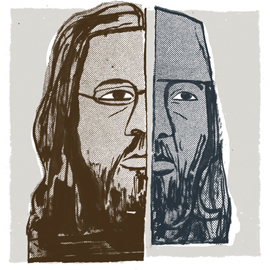
Durantaye_36_2_david_foster_wallace Ships as far as the eye can see. The rising sun glittering on the Aegean. Wind rippling the sails, water lapping the bows, fear, excitement, vengeance, glory, the favor of the gods, the order contemplated, the order given.

Or, expressed differently:

Since obviously under any analysis I have to do either O or O´ (since O´ is not-O), that is, since □(O v O´); and since by (I-4) it is either not possible that I do O or not possible that I do O´, (~◊O v ~◊O´), which is equivalent to (~◊~~O v ~◊~O), which is equivalent to (□~O v □O), we are left with □ (□O v □~O); so that it is necessary that whatever I do, O or O´, I do necessarily, and cannot do otherwise.

Both of these remarks are about fate and free will, necessity and contingency. The first is the scene Aristotle sets; the second is David Foster Wallace’s reformulation of it in his exceptionally promising, and sole, contribution to technical philosophy: his senior honors thesis, newly published in a volume entitled Fate, Time, and Language: An Essay on Free Will.

In On Interpretation Aristotle defends a view about fate, free will, necessity, and contingency that is at once logical, metaphysical, and naval:

A sea battle must either take place tomorrow or not, but it is not necessary that it should take place tomorrow, neither is it necessary that it should not take place, yet it is necessary that it either should or should not take place tomorrow.

This seems clear enough, and is. Nothing in Aristotle’s example is necessary except that something take place or not take place; a sea battle, after all, cannot both happen and not happen. But what of the metaphysical implications of this logical necessity? How should we speak of contingency and potentiality, if such things truly exist? Is the general free to give the order for battle, or is all foreordained to happen, fixed in future place by natural law and supernatural will?

More here.

Posted by S. Abbas Raza at 03:37 AM | Permalink

Comments

This is exquisite, both review and reviewed.

Posted by: Zara | Mar 29, 2011 9:16:38 AM

There was a great analysis of this text in the New York Times about 3 years ago:
http://www.nytimes.com/2008/12/14/magazine/14wwln-Wallace-t.html

Posted by: Kevin McCoy | Mar 29, 2011 10:03:29 AM

Post a comment


Subscribe to this blog's feed  

PayAnywhere with iphone credit card swiper

Android Tablet

Bluetooth Headset

2013 New Style Dresses

Compare Car Rental Prices

DHgate.com Wholesale

3QD on Facebook

3QD on Kindle

3QD by Daily Email

Receive all blogposts at the same time every day.

Enter your Email:


Preview 3QD Email

3QD on Twitter

Miscellany

Lijit Search

AddThis Social Bookmark Button

Add to Google

Recent Comments

Doogle on Why Steven Pinker Is Wrong

Kyle on Syria: Inventing a Religious War

Peter John on Gezi Park

dthoko on The History of Typography - Animated Short

Richard on John Gray’s Godless Mysticism

Abbas Raza on Why Steven Pinker Is Wrong

nogodrod on Syria: Inventing a Religious War

Lusine on Quest for 'Genius Babies'?

Bill on Syria: Inventing a Religious War

j_93 on Gezi Park

j_93 on Syria: Inventing a Religious War

Norman Costa on The Insanity Virus

Dave Ranning on Political Ideology and the Avoidance of Dissonance-Arousing Situations

Sundar on Quest for 'Genius Babies'?

Sundar on Syria: Inventing a Religious War

gaddeswarup on What is ‘smart’ and how does it fit our consciousness?

gaddeswarup on What is ‘smart’ and how does it fit our consciousness?

musafir on Syria: Inventing a Religious War

Lusine on Syria: Inventing a Religious War

Brad Wilson on Gezi Park

Raza Husain on Syria: Inventing a Religious War

Brad Wilson on The Insanity Virus

billy on Syria: Inventing a Religious War

rafiq on The Insanity Virus

Ben Schwartz on Here He Goes Again: Sam Harris’s Falsehoods

Acclaim For 3QD


"I couldn't tear myself away from 3 Quarks Daily, to the point of neglecting my work. Congratulations on this superb site."—Steven Pinker, Johnstone Professor of Psychology, Harvard University.

"I have placed 3 Quarks Daily at the head of my list of web bookmarks."—Richard Dawkins, Charles Simonyi Professor of the Public Understanding of Science at Oxford University.

"Just wanted you to know I’m one of many who reads and enjoys 3 Quarks....almost daily."—David Byrne, musician, former lead-singer of the Talking Heads, artist, intellectual.

Read more here.

The 3QD Prizes

Subscribe to this blog's feed