
March 30, 2011
one of history's most unsuccessful utopias ever
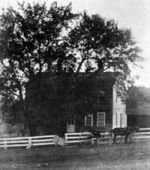
In June 1843, Bronson Alcott, his small family, and three of his Transcendental disciples from Alcott House in England - Charles Lane, who financed the project, his eleven-year-old son William, and their friend Henry Gardiner Wright - went to live in a utopian commune in Massachusetts called Fruitlands. Their six-month effort at being a 'Consociate Family' was traumatic and almost tragic. The philosophers knew nothing about agriculture, disapproved of the use of 'noxious' manure, and did not wish to oppress animals by ploughing the fields. They were extreme vegetarians (what we would call vegans), and by the winter were half-starving on a diet of apples, water and rough bread. For some of the thirteen members, Fruitlands was too fanatical; for others it was not fanatical enough. Gradually some decamped to more sociable environments, while the Lanes went off to a stricter Shaker community nearby, who later did not want to release William: as a celibate community, they needed every child they could get. The Alcotts soldiered on alone - father, mother Abigail ('Abba'), and the four daughters Louisa, Anna, Elizabeth and May - until Bronson had a severe, almost suicidal breakdown. The entire enterprise was a disaster, what Richard Francis calls 'one of history's most unsuccessful utopias ever'.more from Elaine Showalter at Literary Review here.
Posted by Morgan Meis at 09:20 AM | Permalink


Comments
A nice review ...however, this might have been the worst of the communes, or experiments, but the "better" one, Brook Farm, also failed. What then does this teach or tell us about such undertakings?
Posted by: nate zuckerman | Mar 31, 2011 2:34:55 PM
What to avoid next time?
Posted by: Aaron | Mar 31, 2011 9:36:34 PM
@nate said:
"What then does this teach or tell us about such undertakings?"
...that no such enterprise may succeed without a sound economic base: agriculture, industry and tourism (as the kibbutz), hard work, high tech and reasonable religious solidarity as the Bethel Society[Evangelical, Pentecostal holiness group, with a strong emphasis on eschatology, love for Israel, divine healing, and communal living] founded by Emma Berger( that live very near of me and often I saw them with their modest and clean houses, a part of Germany in Israel).
But let's quote from a study:
German Christian Communal-Settlement Activities in and around Zichron Yaakov, Israel, 1963–2004
By Paul Schmidgall and Ruth Kark
Material Culture
The material culture of Bethel Society in Israel is best described under the following headings: homes, community buildings, industrial centers, and agricultural plants. All property is registered in Israel under the name of the society. Property of members living abroad (Germany, Ghana, Canada, Holland, Hungary, Rumania, and Switzerland) is private. Members from abroad that join the Bethel Society in Israel transfer all their assets to the Society. Several of the members who joined had sold everything in Germany and usually would bring with them about DM 400,000–800,000. This is the main reason for the Society’s prosperity. Anyone wishing to leave BS later on does not get back the assets he had earlier made over to the Society. Members from abroad pay tithes and visit Israel in order to help to build up the Bethel Society. Children of members who are not
”believers” may inherit their parents who are members of the Society. All extra assets are to be used to build up the ministry in Israel. “Many a house was not built in Germany because the money was needed to build houses for the Society in Israel”, is how Dr. REIMER summarizes the secret of the Society’s success and prosperity in Israel.
A society with assets of over one hundred million dollars cannot allow itself to have a less than perfect record on its financial transactions. If this principle is not observed, it is only natural that rumors will develop and doubts concerning the trustworthiness of the organization will spring up. At first, all assets were registered in the name of EMMA BERGER, but were always considered to be a “common possession” of all the community members. Today all assets are registered in the name of the Bethel Society and should the Society disband, everything will be bequeathed to the State of Israel. The real estate assets of the commune in Israel are as follows:
Homes: The homes, which are very well kept, are usually resided in by only one family or one person who take care of the house and garden. Most of the homes carry a biblical name. Families and individuals eat breakfast and supper in their homes. In a detailed field study conducted eleven years ago we documented thirty three houses of the Bethel Society in Sichron Yaakov and in Binyamina.
Community Buildings / Dining Hall: The main meal is eaten together in Bethel, the community center. Workers commute from the factory to the dining hall in their own buses. BS produces bread, noodles, and various other food items in its own bakery. Meat, milk, eggs, vegetables, and fruit come from their own farm in Binyamina.
Religious centers: Of greatest importance for the community are the religious services conducted in the spacious central building of the community, called Bethel.
Posted by: Mirel | Apr 1, 2011 12:44:20 PM
Post a comment