
March 21, 2011
I Know Something You Don't Know
by Jen Paton
One good thing could come from this horror: it could spell the end of the age of irony. For some 30 years--roughly as long as the Twin Towers were upright--the good folks in charge of America's intellectual life have insisted that nothing was to be believed in or taken seriously.
--Roger Rosenblatt, then-Editor in Chief of Time Magazine, 16 September 2001.
Rosenblatt’s partial definition of irony is telling: he misses the most dangerous part. The most insidious irony is not the swaggering and droll Alanis Morisette sense of the word. Rather, the most dangerous irony is the irony of distance. In 1979, Dahlgren and Chakrapani argued that the way foreign countries and foreign people are portrayed in Western news is ironic in the sense that the audience is “situated in a position of superior knowledge to the protagonist.” We think we know something that the people on the news – the flood victims, the terrorists, the freedom fighters – don’t know. The West is ordered, stable, developed, and modern. “The Rest” are disordered, underdeveloped, and primitive.
You find this distance playing out in surprising places. My oldest friend attends medical school in one of our most “liberal” cities. Recently, one of the “standardized patients” (actually actors who interact with the students for training) arrived wearing hijab. “She’s wearing a burka!” whispered a classmate to my friend. She corrected him and he was incredulous: how do you know this stuff?
Thirty five percent of Americans know a Muslim person – at the same time, “events and controversies related to Islam dominated U.S. press coverage of religion in 2010 -” beating out Catholic church scandal for the first time this decade. This makes how Islam is portrayed in the American media more important than ever. Unfortunately, the ironic detachment Dahlgren and Chakrapani described over three decades ago seems to persist in coverage even of in-country Islam. When forty percent of Americans say Islam is more likely than other religions “to encourage violence among its believers.”, one wonders where those ideas come from. Especially since, in 2002, only twenty-five percent of us thought so.
Witness those protesters outside the mosque in Orange County – some were protesting the event’s speaker while others seemed more interested in shouting at little American girls in hijabs. “Go home” a few cried. To where, precisely? In Covering Islam, Edward Said wrote that “malicious generalizations about Islam have become the last acceptable form of denigration of foreign culture in the West.” It’s hard not to feel he may be right when a 2007 Survey of London newspapers found 91% of articles in newspapers about Islam were negative. In the U.S. context, its tempting to blame Fox, and indeed isn’t it easy to?
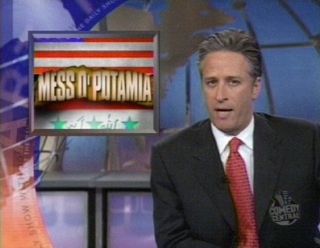
Sorry, but this is too easy. Fox blaming (in the UK, also known as Dail Mail blaming) is the kind of scapegoating by which “the liberal elite” attempt to let ourselves off the hook. Yes, much has been made of the relative “informedness” of, for example, Daily Show viewers, and Daily Show watchers would seem to be the polar opposite of Fox’s viewership. But remember: the Daily Show is a programme that gives us reports on “Mess O’Potamia”, and which, during the 2006 Palestinian elections, told us: “Palestinians flocked to the polls to elect … maybe this guy with a beard … or … I don’t know … maybe that guy with a beard.” (Ross and York 2007). Despite it’s self-conscious and highly ironic tone – or perhaps because of it - Ross and York conclude that The Daily Show “reproduces, rather than interrogates,” the tropes of “conventional news journalism.” (ibid, 2007). Just last week (14 March 2011), a segment satirized a trip to find missing Wisconsin senators as a piece to seek out “warlords” in hiding – complete with jokes about how Wisconsonites “treat their women” and vaguely Middle Eastern music playing over the correspondent’s journey into Midwestern backcountry.
There’s a self satisfaction among American liberals about the Daily Show, that those of us who watch the programme “get it” – both politics and the media – in a way others do not. The polls which show Daily Show viewers tend to know a bit more about politics and current affairs only reinforces this feeling of smugness. It’s a smugness that seems to permeate academic writing about The Daily Show as well: one scholar describes Stewart as “there to help move the nation from a simple submission to the White House's propaganda about 9/11 and the war on terror" to a “more engaged, thoughtful critique of current events.” (Dettmar 2006). But what if something of what Stewart does is equally “propaganda”? And if it is, what is it propaganda for?
Like pornography, we might say we know propaganda when we see it. The trouble with trying to define propaganda, though, is that the definition, unsurprisingly, shifts according to who you’re speaking with. The left likes to sling the word at Fox News, the right at Al-Jazeera, NPR, or the entire mainstream media. Sharon Tuttle Ross (2002) defines propaganda as “an epistemically defective message used with the intention to persuade a socially significant group of people on behalf of a political institution, organization, or cause."
Tuttle Ross goes on to note that Dana Carvey's satire of President George Bush on Saturday Night Live is not an example of propaganda, since neither Dana Carvey nor SNL are a institution...or cause.” By contrast, the Daily Show, I would argue, has made itself a cause: it’s a line Stewart has crossed, or is at least dancing very nimbly along, with his “Rally to Restore Sanity and/or Fear” last fall. With that march, Stewart made his programme a political institution, to ends unknown. In a way, that move should have made The Daily Show less ironic, it should have facilitated a move into the real. Instead, largely because of the inclusion of the outré and consitently satirical Steven Colbert, its’ inchoate definition and purposefully ironic message-as-lack-of-message (“and/or…Fear”,) it muddied the waters.
What does it mean to stand for sanity, anyway? It’s a word that, after all, implies that I know something you don’t, that your beliefs, about God, or guns, or abortion, or religion, or gay marriage, are simply a matter of not knowing enough, of simple ignorance. A sanity/insanity binary as articulated by left leaning American media is the mirror image of the one articulated by right wing American media: you’re closed minded, you are willfully ignoring the facts, you are obviously a moron. In that sense, the Daily Show is propaganda for the idea that left leaning Americans are worldly, that they “get it,” that they aren’t victims of the irony Dahlgren and Chakrapani describe in their attitudes towards “The Rest.” Can we be so sure that we are really so open minded as we’d like to imagine? If insanity does mean doing the same thing over and over, expecting a different result...well, perhaps we should change the kind of conversations we are having.
Posted by Jen Paton at 12:55 AM | Permalink


Comments
Wasn't there a reproduction of that political knowledgeability comparison test not so long ago? Assuming it was based solely on generally relevant, empirical facts, I don't see what would make any measurable differences "relative". If it were to be the case that, on average, a Daily Show viewer scored significantly higher than a viewer of Fox News, this would indicate an important difference between liberal satire in this case and ideological propaganda in general.
Posted by: Andy | Mar 21, 2011 10:21:42 AM
Ironic that such a definition of propaganda is used without irony in an article about propaganda and irony!
Posted by: M73 | Mar 21, 2011 11:12:10 AM
This article has too many unexamined assumptions. For example, the writer seems to assume that the tropes of mainstream journalism are not only wrong, but that he has access to some superior tropes...tropes that would sell better, have better effects on this world or that are closer to "the truth"...what would those tropes be? What propaganda would the writer prefer to see on the daily show? and how does he know that his version would be superior to the existing mildly (very mildly) left-of-center propaganda that the daily show puts out with some considerable skill?
Posted by: omar | Mar 21, 2011 12:46:15 PM
"he way foreign countries and foreign people are portrayed in Western news is ironic in the sense that the audience is “situated in a position of superior knowledge to the protagonist.” We think we know something that the people on the news – the flood victims, the terrorists, the freedom fighters – don’t know."
This is a very insightful point. The rest of the article, however, seems to be more of the same in terms of post-modern relativism and leftist infighting.
How about: Some people do know more about some things than other people, that this knowledge can make a difference, and that they shouldn't be dicks about it?
How about: every left(ish) organization (like the Daily Show) can't be expected to accomplish every remotely progressive end on its own, and all at once, and that the ones that still do a remarkably better job than everybody else---despite the very real constraints of time and space---earn our respect and admiration?
Posted by: shale | Mar 21, 2011 5:05:27 PM
We're still a bunch of crazy apes, all of us. Spare me the bullshit.
Posted by: James F Traynor | Mar 21, 2011 6:43:57 PM
As someone commented already, there is always the possibility that X DOES know more about some things than Y.
Its not a matter of Jon Stewart knowing more than the average Iraqi about every local detail in Iraq. But Jon Stewart may well have a better grasp of some political and social concepts that relate to the more economically developed world and its interactions with less economically developed nations (especially given the prevalence of bullshit conspiracy theories in most middle eastern countries)...I am avoiding the blanket term developed and specifically saying economically developed...but its really closely related to a lot of other things..
And of course, any criticism (including this writers criticism of Jon Stewart) implies that the critic thinks he knows better....
Posted by: omar | Mar 21, 2011 10:30:01 PM
during the 2006 Palestinian elections, told us: “Palestinians flocked to the polls to elect … maybe this guy with a beard … or … I don’t know … maybe that guy with a beard.” ... a segment satirized a trip to find missing Wisconsin senators as a piece to seek out “warlords” in hiding – complete with jokes about how Wisconsonites “treat their women” and vaguely Middle Eastern music playing over the correspondent’s journey into Midwestern backcountry.
Although, when the chips are down, The Daily Show is all too willing to parrot bien pensant American prejudices about Johnny Foreigner, the cited gags are not examples of such but of the show's main project of satirising mainstream media tropes. So the first makes fun of American ignorance of other countries' politics, and the second takes the usual "among barbarians" approach to reporting from farflung foreign backwaters and twits it by using the approach in a story about Wisconsin.
Other than that the piece suffers from the usual inability of US commentators to comprehend the basic and important political distinction between liberals and leftists. TDS stakes out the liberal position, which is to say a position on the centre-right, which is why Stewart's tendency to sneer as much at, say, Code Pink or Ward Churchill as he sneers at the lunar Right is not an indication of balance. And American liberals don't need TDS to teach them to be self-satisfied.
Posted by: weaver | Mar 22, 2011 12:21:38 AM
I am so tired of hearing that liberals are smug and self-satisfied. All the ones I know are self-questioning and and reasonably unassuming. Jon Stewart is widely admired for the humanity that underscores his humour.His brilliant aside to the Pope's announcement that the Jews didn't kill Jesus;"The killers are still out there!" did more than any learned paper to tell it like it is---absurd.
Posted by: Judith Mason | Mar 22, 2011 7:59:05 AM
These people should be ashamed of themselves. There is no way to cure people of this kind of bigotry. Imagine thes poor little kids. They will remember this hate the rest of their lives.
Posted by: Stnaley Hodge | Mar 22, 2011 12:05:48 PM
I don't think the author (or Roger Rosenblatt) has a particularly insightful definition of irony, or appreciation for the uses or function of irony. In the broadest sense, irony is simply the recognition that language is not self-identical with reality, and that any use of language (in Time magazine, on the Daily Show or on Fox News) involves interpreting ("propagandizing," if you will). The fantasy of purely earnest, "un-ironic" language, if it were even possible, would just be dishonest by claiming to be somehow self-identical with reality. (I admit it, I'm a Rortyan liberal ironist through and through.)
Posted by: LeeAnn Deemer | Mar 23, 2011 8:06:55 AM
So, Americans, and the west in general, make assumptions and take this as superior knowledge. And, in liberals, this is ironic. So what? Is this interesting because we are exactly like every other culture in all of human history? Or was this an insight into the authors deep and subtle understanding of irony? Isn't it the least bit ironic that only a liberal would even care that having these assumptions is ironic? See how fun this can be?
Given the earnestness of the quote from Time Magazine, I was hoping for mockery or satire, to tell you the truth. Can I have the five minutes I spent reading this back now?
Posted by: max | Mar 23, 2011 10:34:40 AM
Post a comment