
by Julia Galef

–Groucho Marx
Like most jokes, Groucho’s works almost instantaneously. We hear the joke, we laugh, and we don’t need to think consciously about the process connecting those two points. But what if we played that process in slow motion?
Here’s a plausible account of what that might look like: the joke’s first sentence triggers an image, or at least a concept, of Groucho wearing pajamas and shooting an elephant. But the next phrase, “How he got in my pajamas,” doesn’t make sense in the framework of our current model of the situation, and we’re thrown into confusion. So we think, Hang on, I must’ve missed something, and we go back and re-evaluate the first sentence to see if there was some other, alternative way of interpreting it. Sure enough, now that we’re looking for it, there it is: an alternate meaning of “I shot an elephant in my pajamas” pops out, and you can almost hear the gears grinding as we shift from “I, in my pajamas, shot an elephant” to “I shot an elephant who was wearing my pajamas.”
Groucho’s joke is an example of paraprosdokia, a figure of speech whose latter half surprises us, forcing us to go back and reconsider the assumptions we’d made about what was going on in the first half. Other examples include Mitch Hedberg’s “I haven’t slept for two weeks — because that would be too long,” and Stephen Colbert’s “Now, if I am reading this graph correctly… I’d be very surprised.” The jolt of gratification we feel at converting confusion into clarity is exactly what Incongruity Resolution Theory, a popular theory in the psychological study of humor, predicts: humor is the satisfying “click” of an incongruity within the joke being resolved after you find the appropriate interpretive framework.
One particularly interesting thing about paraprosdokian jokes is how they represent, in miniature, the process of theory-revision in scientific inquiry. You start out with a straightforward working theory, based on your initial observations and on whatever prior assumptions and expectations you bring with you from past experiences. As you collect more observations that don’t seem to fit your theory, you either dismiss them as an anomaly, or find a way to shoehorn them into the framework of your theory, or you go back and try to re-interpret your original data in the framework of an alternate theory that will fit all your data, both old and new.
The third option becomes increasingly compelling as the incongruities mount, which is the basis for Thomas Kuhn’s famous theory of paradigm shifts in science. Scientific theories aren’t immediately discarded when contradictory evidence comes to light, Kuhn observed. Instead, scientists will dismiss contradictory observations as errors or anomalies, or tweak the theory to accommodate them, until the contradictions become numerous enough that they can no longer be plausibly explained within the original theory, at which point the field seeks out a new explanatory paradigm to replace their old, increasingly flawed one.
Although Kuhn’s theory doesn’t describe all scientific practice, it’s nevertheless a strong model for many cases, including – quintessentially – the shift from geocentrism to heliocentrism. Mounting evidence from cosmologists like Kepler, Copernicus, and Galileo became increasingly difficult to reconcile with the idea of a stationary earth at the center of the other planets’ orbits. Many of their contemporaries certainly tried, however, devising ever-more complex modifications to their geocentric model to accommodate new astronomical observations, until it became clear that heliocentrism simply did a better job of explaining the facts.
The satisfying “Aha!” produced by getting a joke or explaining a phenomenon is not all that different from the satisfying “Aha!” produced by certain kinds of art. Think of the modulation, in music, from one key to another. Each musical key signature contains a different subset of all the sharps, flats, and naturals on the scale. Use a note that’s not in your key, and the result is dissonance, which we interpret as tension, or ugliness, or as something being “off.” But since every note is shared by multiple different key signatures, you can use shared notes as pivot points to transition from one key to another. The resultant effect is similar to paraprosdokia: having initially interpreted the pivot-point as belonging to the original key, you’re momentarily disoriented to hear it followed by notes which don’t belong to that key, until you shift your mental framework to a new key in which those notes “make sense.”
Rudolf Arnheim, one of the most celebrated writers on the psychology of aesthetic perception, has a nice example of musical modulation in his 1978 book, The Dynamics of Architectural Form. This is a passage from a violin sonata by Jean Marie Leclair: 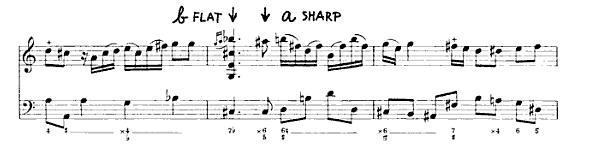
Arnheim explains:
“Two notes refer to the same tone, but they are written differently because the b-flat is experienced dynamically as the outcome of a steep ascent in the key of D, which has, as it were, overshot the mark by a half tone and is straining downward toward the dominant, a. The same tone written as an a-sharp presses upward as the leading tone in the new key of B, thereby assuming a new function in a different structural context.”
Space can be modulated just like sound and meaning to produce a mental paradigm shift. An elegant example is the Hotel de Matignon, a mansion built in Paris in 1725 that now serves as the residence of the French Prime Minister. Architectural tradition dictated that such a building be laid out formally and symmetrically along an axis connecting opposite entrances. But because the site itself was uneven, the front and back entrances were misaligned. So the architect shifted the building’s axis mid-stream, using one axis as an off-center wing of the other axis.
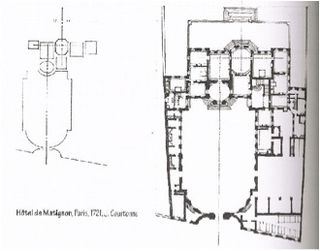
Arnheim dubs it an “ingenious” solution to the site’s constraints, and highlights the parallel to musical modulation:
“The device used by the architect cannot but remind us of what musicians call an enharmonic modulation, that is, the almost imperceptible shift from one key to another, in the course of which certain tones act as bridges by fulfilling different functions in the two keys and thereby display a double allegiance. The transitional moment generates a slight sensation of seasickness, unwelcome or exhilarating depending on the listener's disposition, because the frame of reference is temporarily lost.”
In honor of it being Valentine’s Day, I’ll close with a nod to Alison Gopnik, a developmental psychologist at the University of California, Berkeley, who wrote an article for Minds and Machines called “Explanation as Orgasm.” In it, Gopnik argued that the pleasure we get from the feeling of understanding plays a role analogous to that of the orgasm. Perhaps, she suggests, our enjoyment of those “Aha!” moments evolved to entice us to figure out the world around us, just as orgasms evolved to entice us to reproduce. In a way, I hope that’s the case, because it puts a delightful new gloss on aesthetic enjoyment. How much more delicious are those moments of musical and visual and comedic resolution when you view them as being — like non-procreative sex – our cunning species’ way of bypassing the evolutionary carrot-on-a-string, and instead, harvesting tasty carrots of our own?