

| ABOUT US | ARCHIVES | LINKS | RSS FEED | MONDAYS | |

3quarksdaily

An Eclectic Digest of Science, Art and Literature

« The Great Stagnation | Main | TUNISIAN PROSTITUTES AND THE SPECTRE OF CEAUSESCU: FIRST THOUGHTS ON THE NASCENT ARAB REVOLUTIONS »

February 21, 2011

New York’s Empire State of Mind: The Colonization of ‘Up’ Part I

by Ryan Sayre
11_elevator_inv

Elisha Otis was a solver of problems—practical problems involving bread ovens, steam engines, bed frames, and the like. Faced with the problem of safely bringing debris down from the second floor of his workshop, in 1852 he repurposed a railroad brake into an emergency elevator brake that would stop the lift cold in its tracks should the supporting cables snap. This small innovation opened an entirely new kind of space; a space we might call the 'up'. ‘Up’ had of course always existed, but never before as a habitable territory. As a place for work, life, and leisure, ‘up’ would have to be imagined. While colonial powers in the early 20th century were busy stretching railroad lines across continents, urban engineers in cities like Chicago and New York were beginning to bend Otis' elevator tracks ever further upward into uncharted verticality.

For a short three to four year period in the late 1920s and early 1930s, New York City drove its skyline 70, 87, and then 102 stories into the air. The expedition marked a transformational moment in the city. During these few years city traffic was detoured skyward. The city’s profile was nearly flipped on its axis. The goal of city planners was to rationalize the city and the ‘up’ seemed like the most efficient direction to take a growing population. But rationalization and efficiency are never linear; the stories of buildings are marked by countless twists and turns.

The Empire State Building


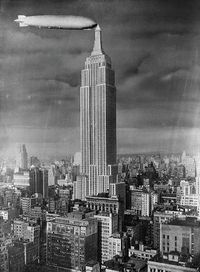
The 102 stories of the Empire State Building stood at the center of this vast if also vastly uncoordinated effort to construct the ‘up’ at the beginning of the 1930s. Stretched like taffy into the passing clouds, it ushered in a new era of air travel. This allusion to flight is not figurative—look up at the Dirigible_empire_state_building building’s spire next time you’re in New York City and you’ll have in view the first and last remnant of a moment in which skyscrapers were planned to serve as transatlantic dirigible terminals. New York, London, and Paris were poised to be knit together by lighter-than-air zeppelins. Built to withstand fifty-tons of horizontal pressure from a hovering airship, the 230-foot long needle atop the Empire State Building had made the first stitch.
Raymond Hood, architect of the 1924 Neo-Gothic Chicago Tribune Tower, gave expression to this moment in a 1931 NY Times spread bearing the title, “The Future of the Skyscraper.” He said:

There will be interesting problems for architects when aeronautical development begins to utilize the tops of city buildings as landing places, and we shall have to provide elevator service not only for the present traffic from the street into the building but also for the additional traffic from and to the landing stations on the roof. Surely the aircraft is going to affect our future architecture.

Raymond Hood no a crack-brained dreamer. Quite the opposite; only
a clairvoyant could have seen that the future would fall so far short of the present then unfolding. He and his colleagues were visionaries; visionaries of the contemporary and champions of the present. They had little need of the future. How very different their present was from the one we inherited from them. Take the modern skyscraper: where we see a cage, they saw a 20090307222008 passageway; where we see towering walls they saw vertical highways; where we see a fist held defiantly against the heavens, they saw a welcoming outstreched finger. Buildings for us are destinations; for them, they were built to become thoroughfares. In their advancing present one would soon be able to ascend Big Ben only to descend into the thick of New York’s busy streets. Before long, parting lovers would be trading adieus for bon voyages at the base of the Eiffel Tower.

A tiny latched door in the spire of the Empire State Building was to serve as a new portal through which Europe would flow into New York City. Behind this door was a crude retractable gangplank over which passengers would squeeze before passing to an even cruder staircase curling down through the spire to an elevator on the 102nd floor. The elevator had but a single button and a single destination. “You are now arriving at the 86th floor. Welcome to the United States of America. Please present your immigration papers at the counter.” And for the briefest of moments, the national border of the country was set, rather arbitrarily, somewhere around here:
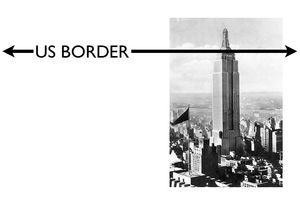
Us_border_1New York in the 1930s was on the brink of inaugurating a kind of vertical citizenship. The 87th floor of the tallest building in the world was international territory, the 85th floor, the United States of America. As the ‘above’ turned into the ‘abroad,’ the US was about to gain a new national border. One can only guess how close we may have come to vertical get-aways, vertical tax-shelters, vertical amnesty. “Whoever owns the land, it is theirs up to the sky and down to the depths.” So reads Roman property law. But what did the Roman’s ever really know about ‘up’ anyway? New York was right smack in the middle of making it, thinking it, and living it.

The Outlook of ‘Up’

Asked to comment on the upper limits of all this madness, another well-known architect of the time had this to say in the aforementioned Times article:

It is not a question of the zoning law,nor yet of the bearing power of the steel… The primary question is whether people prefer to live vertically or horizontally, and when their preference is determined the city will be shaped to meet their requirements.

Gravity, efficiency, zoning laws—all these external constraints—were putty in the hands of American preference. 1930s New York City was taking its marching orders from the why-not and the just-because. Skyscrapers were the material crystallization of this attitude and the material expressions of the city’s own laws of universal druthers. Preference was a casual everyday force promoted in the United States to the rank of ultimate historical determinate. It was an undecorated philosophy. Montaigne once said, I reach for the impossible so that I may achieve the best possible. Tell this to the 1930s American architect and he might ask why anyone should want to risk pulling a muscle reaching for something that ain’t there. The architect of the ‘up’ was no metaphysician and no patience for the impossible. He was busy enough supposing his biases into new material forms. 

The Horizontal 'Up'
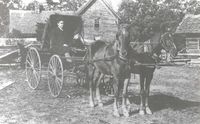
Lockart Farm Horse and Buggy The ‘up’ of the early 20th century was less a direction than an orientation, less a location than a mode of existence. Visiting my folks in Iowa over the winter holidays, I caught an unlikely glimpse of this mode ambling about in the pastures of one of my great uncle’s childhood reminiscences. "You know you're getting old," he once told me, "when your memory starts to become good." Now ninety-five years old, Uncle Ed has a very good memory. During the depression, a farmer from a neighboring town would often come by the family farm in the evenings to get sauced with Ed's father. Once the two had passed out, as they always did, the kids would each grab one of the farmer's limbs, schlep him outside, and heft him into his buggy. With a slap on the horse’s rump, they would watch as the buggy made off down the road to deliver the snoring farmer seven miles back to his homestead. Would but that the automobiles of today were able to perform such feats. How quietly driverless transportation, a matter of course in Uncle Ed's era, gave way to the automobile. How little notice was taken when urban skyscrapers ceded their promise of inter-city transportation to suburban airstrips. How far from the past we’ve fallen. How far down from ‘up’ we’ve come.

Posted by ryan sayre at 12:02 AM | Permalink

Comments

Neat to think about how now we only visit the vertical orientations of cities from the air, but then retreat to our JFK's and LaGuardia's. Hong Kong's old airport was a fantastic exception, of course. But for most places, we get only a glimpse of the vert, but are forced to enter a city on the horizontals by train, bus, or taxi.

I like the cosmopolitan idea of these vertical cities stitching themselves upward and across. Climbing up to the top of these towers and glancing not just down into the urban valleys or out across its expanses, but also up and out! Neat piece!

Posted by: icarus | Feb 21, 2011 8:46:22 AM

Wow. Very enjoyable and tought-provoking.

Posted by: Matt | Feb 22, 2011 10:05:05 AM

Most enjoyable thing I've read in weeks. Thank you.

Posted by: fahima graham | Mar 7, 2011 2:50:27 PM

Great fun to read!

Posted by: Adam | Mar 7, 2011 10:29:01 PM

Post a comment


Subscribe to this blog's feed  

PayAnywhere with iphone credit card swiper

Android Tablet

Bluetooth Headset

2013 New Style Dresses

Compare Car Rental Prices

DHgate.com Wholesale

3QD on Facebook

3QD on Kindle

3QD by Daily Email

Receive all blogposts at the same time every day.

Enter your Email:


Preview 3QD Email

3QD on Twitter

Miscellany

Lijit Search

AddThis Social Bookmark Button

Add to Google

Recent Comments

Sundar on If Only We Had A Leader Like Chavez, Who Solved Real Problems -- Instead Of Debating Fake Ones Like The Deficit

flowers rainbows on Lift up your voices: The century-long battle for women's freedom

mr.ed on wagner in new york?

mirel on Here’s how to change the world

mirel on If Only We Had A Leader Like Chavez, Who Solved Real Problems -- Instead Of Debating Fake Ones Like The Deficit

X on Getting Smarter

Ross Williams on Getting Smarter

oroboe on Lennon's "Imagine" and McCartney/Wings' "Band on the Run" overlaid: One way of reuniting (some of) the Beatles

Richard H. Randall on Obama must Make Fighting Climate Change National Project, or Die the death of a thousand Scandals

seth edenbaum on The First New Atheist? Kierkegaard

waqnis on Mortify Our Wolves

nogodrod on KFC smugglers bring buckets of chicken through Gaza tunnels

waqnis on Here’s how to change the world

Fernando on Mortify Our Wolves

seth edenbaum on The case against empathy

Dredd on Mortify Our Wolves

Max on Here’s how to change the world

Rohana on Mortify Our Wolves

Raza Husain on If Only We Had A Leader Like Chavez, Who Solved Real Problems -- Instead Of Debating Fake Ones Like The Deficit

mirel on If Only We Had A Leader Like Chavez, Who Solved Real Problems -- Instead Of Debating Fake Ones Like The Deficit

araldo on Here’s how to change the world

Elatia Harris on Here’s how to change the world

Sundar on Here’s how to change the world

araldo on Here’s how to change the world

prasad on Here’s how to change the world

Acclaim For 3QD


"I couldn't tear myself away from 3 Quarks Daily, to the point of neglecting my work. Congratulations on this superb site."—Steven Pinker, Johnstone Professor of Psychology, Harvard University.

"I have placed 3 Quarks Daily at the head of my list of web bookmarks."—Richard Dawkins, Charles Simonyi Professor of the Public Understanding of Science at Oxford University.

"Just wanted you to know I’m one of many who reads and enjoys 3 Quarks....almost daily."—David Byrne, musician, former lead-singer of the Talking Heads, artist, intellectual.

Read more here.

The 3QD Prizes

Subscribe to this blog's feed