

| ABOUT US | ARCHIVES | LINKS | RSS FEED | MONDAYS | |

3quarksdaily

An Eclectic Digest of Science, Art and Literature

« "That's funny..." Incongruity in humor, art, and science | Main | PLAYING BY THE BOOK (*MSTRRC) »

February 14, 2011

Identity Politics in the 21st Century

by Akim Reinhardt

During the 1990s, Brad Shwidock, 'Fractured Face' there was much hand-wringing in some quarters at the prospect of America’s beautiful mosaic fracturing into an unworkable, divided society.  Doomsayers fretted that Americans were no longer identifying themselves as, well, Americans first and foremost.  

Critics claimed that identity politics were the culprit in this emerging crisis.  That too many people’s allegiances, identities, and agendas were based on their membership in various sub-groups of ethnicity, gender, and/or class.  None other than Arthur Schlesinger, an eminent American Historian and former adviser to President John Kennedy, complained that America was suffering from “too much pluribus and not enough unum.”  Another term that became popular among critics was “hyphenated Americans,” a jab at those who were supposedly not content to simply be “American.”
Theodore Rex and Whoopi Of course identity politics were nothing new to the United States.  Indeed, the very term “hyphenated Americans” was first popularized by former President Theodore Roosevelt back in 1915 when he gave a Columbus Day speech in which he derided anyone, whether immigrant or nativist, who did not identify solely as American. “There is no such thing as a hyphenated American who is a good American,” he decreed.  “The only man who is a good American is the man who is an American and nothing else.”

The issue girding identity politics in Roosevelt’s time was foreign immigration.  Immigrants had been washing over America’s shores by the millions for 35 years when TR gave his speech at a Knights of Columbus meeting in New York City, to an audience comprised mostly of Irish immigrants no less.  But identity politics in American history go back much further than that.

Historians, though they don’t necessarily use the term in this context, are keenly aware that Andrew Jackson’s rise to the presidency came as he rode a wave of unprecedented identity politics.  Although their candidate was a wealthy land speculator who owned a cotton plantation nearly two square miles in size and over 150 slaves, Jackson’s campaign presented him as an every man.  They starkly contrasted him against and even mocked the well-heeled, blue blood elitism of his main rival, John Quincy Adams.
Old Hickory Bourbon Ad,1963 The timing of this approach was not coincidental.  By the 1820s, most states had lifted property requirements for voting.  Universal, white male suffrage had arrived, and the elections of that decade pivoted on an expanded electorate that now included poor and working white men previously shut out of politics.  Jackson capitalized on this by casting himself as a man of the people despite his own wealth and standing.

Going back even further, one could argue that the first case of identity politics in U.S. history was the Revolution itself.  After all, prior to the 1770s, there weren’t too many Americans who really thought of themselves as, you know, Americans.  Rather, they viewed themselves as British, as did most of the loyal subjects in Great Britain’s twenty-two Atlantic colonies that ran from Canada to the Caribbean.

Although their grievances began stockpiling in 1763 at the conclusion of the French and Indian War, most Americans continued to see themselves as British.  Even as late as July of 1775, leaders of the Continental Congress tried to make nice with King George, sending him the so-called Olive Branch Petition, in which they openly avowed their obedience and brotherhood.  They carefully accorded King George all of the niceties due His Most Gracious Sovereign Majesty, and referred to themselves as his “faithful subjects.”  The letter closed with men like Hancock, Franklin, Jefferson, Henry, Jay, and the Adamses proclaiming their desire to be:

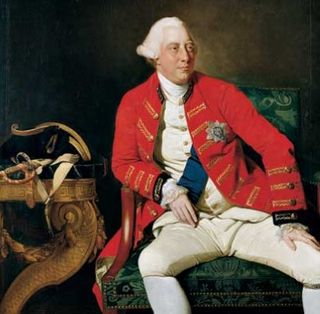
. . . the most dutiful subjects and 'King George III',  Johann Zoffany, 1771 the most affectionate colonists.  That your Majesty may enjoy a long and prosperous reign, and that your descendants may govern your dominions with honor to themselves and happiness to their subjects is our sincere and fervent prayer.
But alas, in a more modern parlance, the letter was a day late and a dollar short.  There was too much water under the bridge, and too much of it in the Atlantic Ocean for the mails to reach London in a timely manner.  In August, before ever seeing the petition, King George declared New England to be in a state of rebellion.  And after he saw and dismissed it, Parliament tacked on the other nine colonies the following December.
                                
Waging a successful political revolt partially hinged on Americans inventing new identities as just that: Americans.  And in fact, not everyone bought into the notion that you’re British one day and something called “American” the next.  Historians estimate that as many as one-third of the colonists remained loyal British subjects, known as tories.  Another third wavered for various reasons and trod a neutral path until the rebellion actually started going well.  But a feisty third or more engaged in a revolutionary form of identity politics, reclassifying themselves as Americans.  Meanwhile, roughly 80,000 tories either abandoned or were chased out of the colonies, re-settling in other parts of the British Empire.
                                
It would seem then that identity politics has a long and tempestuous history in the United States.  So perhaps it is not surprising that the worried teeth gnashers of the 1990s were not in fact prescient prophets; rather they simply misread the tea leaves and misinterpreted the zeitgeist.  After all, terms like African American, Asian American, and Native American are rather mundane at this point, and no longer come off as terribly fractious.  In fact, they are often easily interchanged with other, older terms such as black, Chinese, and Indian.  
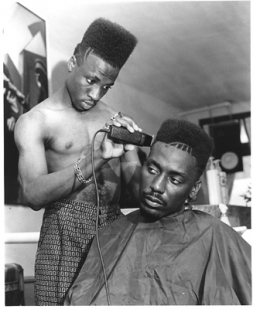
. In retrospect, it seems the new terms were less about driving wedges into society and more about historically marginalized groups demanding respect.  If anything, it was a de-escalation of the Pride and Power politics of the 1970s.  It was creating a new language to usurp the common derogatory epithets and suddenly-arcane terminology (“negro,” anyone?) of pre-civil rights America.  It was about being new, more so than it was about being divisive.  Multiculturalism and Diversity were less about building fences and more about increasing America’s cultural flexibility.  Of course reading Shakespeare is wonderful.  But adding Zora Neale Hurston to the list doesn’t water it down, it strengthens it.

So here in the 21st century, have identity politics in America gone the way of the Dodo bird?  Hardly.  They’ve simply evolved.  Hi-top fades and Amy Tan have just been replaced by Whole Foods and Ayn Rand.  
                                
So with that, here is my own very personal take on what I see as identity politics in modern America, as expressed through viable, major American political movements.  I’ve avoided dealing directly with parties because, quite frankly, in our duopolistic system the two biggies are far too large to have a coherent identity, no matter how hard they may try.  Instead, I focus on those movements that turn common words into proper nouns.  Behold.  

Liberals Liberals - I trim my cat’s claws by myself instead of having a groomer do it.  I like doing it, and she seems to enjoy it as well, often purring as I move across her paws from nail to nail.  One time, before I realized I needed glasses, I clipped just a little too close to the nerve.  And oh did she yelp, a heart-wrenching screech that made me feel just awful, and rightly so.  Ever since then, I wear glasses and take extra care when tending to her paws.  But if I were a narcissist, I mean Liberal, who instead of engaging in genuine empathy, mostly just reveled in faux sympathy driven by how everyone else’s experiences would make ME feel, then it would probably have driven me to demand universal healthcare coverage.  You know, it just hurts me too much to see other people suffer.

As is, I think universal healthcare really is a good idea, largely because I believe think it would be good for the economy in the long run, and it’s also the moral thing to do.  It’s not because I can’t bear to watch other people suffer.  I can.  You know why?  Because I”m a grown up.  I don’t like to, I’m not sadistic, I don’t get off on it, and if someone’s in trouble, I’ll go over and help them without whimpering or crowing about it.  But the fact is, I don’t care if someone decides to kill themself in a responsible way or if some dumbass blows his fingers off with fireworks.  I’m also not gonna breakdown in tears if the local news team tells me some kid fell down a well.  It’s awful, but I don’t know the kid, I won’t pretend, and I’m not going to personalize that tragedy.  Why?  Because countless thousands of people around the world die in tragic circumstances everyday, and I think getting emotional about the one complete stranger you hear about instead of the thousands you don’t is actually quite selfish and self-induglent.  In fact, I don’t even watch the local news.  Oh, and I’m not giving Sally Struthers any of my goddamn money either.  I’d rather give it to P.T Barnum.

Conservatives Conservatives - Tim Kreider is probably the best cartoonist you’ve never heard of.  A sure sign of this is that he’s the only person to have not one, but two cartoons magneted to my fridge.  The creation debate between science and Norse mythology is brilliant.  But the one I’m thinking of right now dates back to the outbreak of the second Iraq war and features portraits of two candidates, one Liberal and one Conservative.  The Liberal is a nervous, smiling white woman pandering at length about the war.  The Conservative is a smirking, heavy-set white guy in a suit whose platform is quite simple:

    -More money for us.  
    -Fuck you.

And these are your Conservatives: smug, self-absorbed, self-satisfied assholes completely incapable of sympathizing with anyone.  Indeed, they are they exact inverse of Liberals.  Both of course are far too narcissistic to actually walk a mile in anyone’s shoes.  The difference is that Liberals externalize and soft-peddle their bullshit while Conservatives internalize and brag about it.  The result is that Liberals pretend to care about you, while Conservatives pretend to care about America.

Libertarians Libertarians - I remember the first time I saw the mighty Thomas Sowell speak.  It was on C-SPAN nearly fifteen years ago.  After mumbling shyly into the microphone, he pushed his glasses up his nose with his forefinger, told a not very funny joke, and then loudly snorted and guffawed like a Trekkie watching a Monty Python film in his mother’s basement.  And that’s when it hit me.  Just about every Libertarian I’ve ever met fits a mold.  Overwhelmingly male, white (apologies to Sowell), and middle class or higher, they were generally smart but socially awkward people who as teens were doomed to not lose their virginity until it was way too late, and they made up for it by showing off in class and always having the right answers, thereby watering the seeds of their mild megolomania.      

As adults, they continued to read voraciously, and not just science fiction.  Through their bookishness they accumulated ever more right answers, and they reveled in the mythology of individualism as a means to fantasizing about their greatness.  I could rule the world if the world would just get out of the way!  But of course, who else but megalomaniacal, educated, white men (and maybe some pampered Asian men) with money would ever believe that they’re in firm control their own destinies; at least when some jock’s not giving them a wedgie.  And who else but men who couldn’t get laid would turn Ayn Rand into an intellectual sex symbol?  

Libertarians, that’s who.
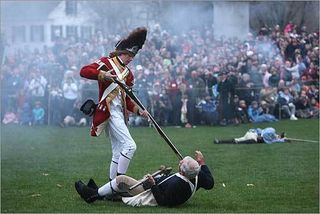
Tea Party Tea Party - More so than any other current political movement, the Tea Party seems to have a real attraction to American history, particularly the Revolution.  Their very name gives it away, and the historical actors who show up to their rallies in nickers, white stockings, and buckled shoes are cute, sort of, but it clearly runs much deeper than that.  To them, real Americans have a strong connection to some misty, bygone era, the Golden Age of fighting for freedom and doing God’s bidding by founding His nation.  They fetishize the Revolutionary leaders, and of course they molest our actual history in the process.  

While all of the groups mentioned here want to establish themselves as the “real” Americans, Tea Partiers are not only the most anachronistic of the bunch, but also perhaps the most willing to warp reality to make their case.  A sure sign of this is that their movement is a clearinghouse for Birthers, people who are willing to ignore every copy of Obama’s birth certificate or the August 13, 1961 Honolulu Advertiser birth announcement that you put in front of them, and insist beyond all reason that the guy was born in Kenya.  Fucking Kenya.  You know why?  Because real Americans are white.  And if the president is half-black, then he can’t possibly be a real American.  And real Americans love all of the founding fathers.  All of them.  Including the ones who absolutely despised and detested each other.

I hate it when mommy and daddy fight.
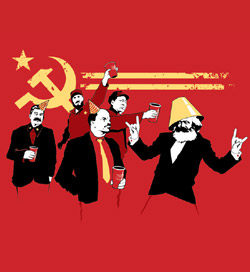
Communists Communists - Remember them?  No?  Not really?  Okay, never mind then.

So what have we learned?  Well, there will probably always be various forms of identity politics in the United States because the nation is so damned big, and getting bigger.  In a small community of a few hundred or even a few thousand people, it’s much more feasible for members to craft a single identity that works for everyone, or at least the vast majority.  But in a nation/empire of well over 300,000,000?  Not a chance.

Once you’re dealing with a population in the millions, as has this nation since its inception, a single identity for everyone is no longer plausible.  Because in order to work, it would have to be hopelessly vague.  Memorize the Pledge of Allegiance, take off your hat during the anthem, and stare at fireworks on the 4th.  Great, but what about the really big stuff?  You know, like an actual culture.        

The United States has always beeThe Benjaminsn too wonderfully and impossibly diverse for any single, specific culture to triumph as the official American identity from top to bottom.  Hell, Benjamin Franklin infamously believed that the German immigrants of the 18th century were a bunch of lazy, mother-beating brutes (literally) who would never fit in, and that because of their presence, “great disorders and inconveniences may one day arise among us.” 
As someone named Reinhardt, whose patrilineal family has been here for centuries, Franklin’s concern about Germans seems downright comical.  As someone named Akim, I get it.  

The bottom line is that so long as there is a U.S.A., there will always be contests between various factions from among its millions of people to determine what it really means to be American.  It will never end because culture is dynamic and always changing, so by necessity what it means to be American will also always be changing.  
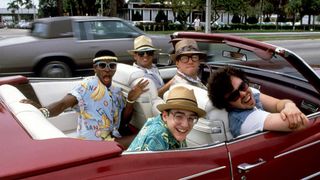
Revenge of the nerds But don’t worry.  It’s not always a bad thing.  Funnel that through participatory democracy and our vaunted freedom of expression, and you have an endless tussle and countless variations manifesting themselves through identity politics.

And perhaps, in some strange way, that’s what it actually means to be American.

And besides, at least we’re not French. [Insert Thomas Sowell-styled guffaw here].   

Posted by Akim Reinhardt at 12:50 AM | Permalink

Comments

I watched the second Revenge of the Nerds over the holidays. Its amazing to think how much of that movie was prophetic or actually gave courage to all the dorks, nerds, geeks, gays, and weirdos to take active roles at center stage as they have today. Great piece perfect choice for you last photo.

Posted by: ryan | Feb 14, 2011 12:40:39 PM

Thanks Ryan. I know that photo is from the second movie because it's missing Anthony Edwards; that, and the actor playing the boy genius has transformed from a cute kid into an ode to awkward puberty. But I've never actually seen the second one. I saw the original in the movie theater one Summer while on vacation with my parents.

I went w/ that pic b/c in its own way I think it captures the essence of how Multicutluralism has gone from something controversial to something innocuous and mundane. The Nerds were outcasts and outsiders, a threat to the WASPish social order of their university's greek system. It's no coincidence that in 1984, the movie's collective symbol of underdog threat to American identity was Gay, Asian, Black, Jewish, etc.

Nowadays, a similar collection could easily represent the power structure in American art: a multicultural collection of martial action heroes or a president and his cabinet. You look at that picture today and it doesn't scream "Under dogs!" I just looks like some dorks out cruising and having a good time.

Come to think of it, I could have also used one of those old United Colors of Benetton ads. God, I hated those ads.

Posted by: Akim Reinhardt | Feb 14, 2011 1:14:33 PM

A few days ago a video with Slavoj Zizek and Tariq Ramadan was posted here on 3quarks daily. Zizek spoke with some real beauty on the difference between universal solidarity and multicultralism. here is the clip of those few words... http://www.youtube.com/watch?v=QyLB7BSvCl4 .

The 2nd Nerds film really was speaking to this notion of solidarity and universal pursuit of freedom.

In the film the different factions all banded together in the rock concert to confront there common tyrant. Not to justify themselves, or receive permission or acceptance, but to take part of the power process, to be players in the process of defining what cool meant, to get the chicks, to undermine the wasp hold on the ivy league elite.

Those that have made the ipods have really reshaped the world. I think movies like this, teen wolf, back to the future, goonies really played a big role in defining what the last decade has been about.

Half of the green bay packers looked like Donald Gibbs the Ogre in Nerds II. Its funny to think of how the image of the average sports star is now in line with those that used to be at the margins.

Posted by: ryan | Feb 14, 2011 2:24:49 PM

In general I think part of the change has come not from a re-definition of cool but an abandoning of the concept. I was particularly struck by theis when I saw The Hold Steady in concert a few years ago: absolute nerds, and not in a hip New Wave way, and the crowd couldn't have cared less.

Whereas New Wave was seeking to challenge archetypes of cool, it seems to me that today's 20-somethings don't much think of it in those terms anymore. I think many of them find the concept itself outdated.

Posted by: Akim Reinhardt | Feb 14, 2011 2:48:05 PM

Sure, I was only using it within the context of 1987.

This is also the goal of universalism, to abandon the concepts that keep people separated and in conflict with one anther.

Here are Zizek's words so linking the video is not necessary....

"You know how often in our multicultural era, where we’re all suspicious of universalism, we like to hear how democracy as we understand it is something specifically Western."

"But, what affected me tremendously when I was not only looking at the general picture of Cairo, but listening to interviews with participants, protesters there, is how cheap, irrelevant all this multicultural talk becomes. There, where we are fighting a tyrant, we are all universalists. We are immediately solidary with each other. That’s how you build universal solidarity, not with some stupid Unesco multicutural respect. It’s the struggle for freedom. Here we have a direct proof that a) freedom is universal, and b) especially, proof against that cynical idea that somehow Muslim crowds prefer some kind of religiously fundamentalist dictatorship.”


We we step on the stage and act, we are asserting our universality. When we step in and act we are asserting what it means to be an American, or which ever country we may Identify with.

The Nerds, were not willing to let the Alpha Beta define what it meant to be a fraternal member. But neither were they interested in defining it, they were a fraternity made of up geek, dork, gay, and ogre; much like Paul's "there is not Greek, Jew, or Gentile."

So asserting a singular political identity misses the point and lessens the effect and potential of power. What it means to be an American is always empty, therefore also constant. We can fill it with some thing if we choose. But I and many others can operate without political identity, or are comfortable embracing contradiction.

I often work in China and other places abroad. I spend a lot of time thinking about how the majority of abroad are blind and uninterested in the differences, of liberal, conservative, teaparty, etc that you describe. But for them there is clearly something that defines myself and others as American. I think it has something to do with a how I assert myself, or other Americans assert themselves in the public and private spheres of their respective countries.

I think this mode of assertion, above all else is what the democratizing/capitalizing world both loves and despises. And unavoidably, albeit sometimes with hesitance inches towards

Do you not feel there is something that makes you American when abroad?

Posted by: ryan | Feb 14, 2011 3:50:48 PM

My time abroad has not been that long or that far flung, so I'm reticent to address on those grounds, though my interactions with foreign visitors and immigrants have been substantial.

I find that while some peoples, such as western/central Europeans and east Asians (though I don't want to generalize too much) are amazed or put off by Americans' open assertiveness, other peoples, such as those from the Middle East or parts of sub-Saharan Africa are often befuddled by what they consider our unwillingness to engage.

I don't disagree with much of what Zizek is saying in a larger sense, but it's a cheap shot for him to call multiculturalism cheap. It's easy to bash MC because it doesn't seem particularly relevant to what's going on in Egypt at the moment.

To me, MC is a tool used by people who face repression because of their otherness; it's not a program for attaining final political ends, but simply a means to combat bigotry. Obviously a large scale political revolution isn't necessarily about that, so it's easy to mock multi-culturalism as shallow amid what's going in Egypt. But then again, I wonder what Egypt's Nubians think about all this.

Thank you for the very thoughtful engagement.

Posted by: Akim Reinhardt | Feb 14, 2011 4:08:29 PM

Post a comment


Subscribe to this blog's feed  

PayAnywhere with iphone credit card swiper

Android Tablet

Bluetooth Headset

2013 New Style Dresses

Compare Car Rental Prices

DHgate.com Wholesale

3QD on Facebook

3QD on Kindle

3QD by Daily Email

Receive all blogposts at the same time every day.

Enter your Email:


Preview 3QD Email

3QD on Twitter

Miscellany

Lijit Search

AddThis Social Bookmark Button

Add to Google

Recent Comments

JM on Physicists Create Quantum Link Between Photons That Don't Exist at the Same Time

SteveRR on Daniel Dennett's seven tools for thinking

jo smith on Mohsin Hamid: 'Islam is not a monolith'

Grace on Daniel Dennett's seven tools for thinking

Elatia Harris on Daniel Dennett's seven tools for thinking

Abbas Raza on Daniel Dennett's seven tools for thinking

Jonathan on Daniel Dennett's seven tools for thinking

Bill on Daniel Dennett's seven tools for thinking

Louise Gordon on The need for critical science journalism

omar on Mohsin Hamid: 'Islam is not a monolith'

Jonathan on Daniel Dennett's seven tools for thinking

Bill on Daniel Dennett's seven tools for thinking

jo smith on Mohsin Hamid: 'Islam is not a monolith'

carlos on Daniel Dennett's seven tools for thinking

freddie on Daniel Dennett's seven tools for thinking

Eli on "Everybody Hurts" by Sachal Studios, Lahore, Pakistan

Jalees Rehman on The need for critical science journalism

Dredd on Why Rational People Buy Into Conspiracy Theories

Dredd on Why Rational People Buy Into Conspiracy Theories

Scrutineer on Why race as a biological construct matters

prasad on the culture animal

Mitt Romney's Dog on Why race as a biological construct matters

Elatia Harris on The Moral Status of Rocks

prasad on The Moral Status of Rocks

Raza Husain on The Moral Status of Rocks

Acclaim For 3QD


"I couldn't tear myself away from 3 Quarks Daily, to the point of neglecting my work. Congratulations on this superb site."—Steven Pinker, Johnstone Professor of Psychology, Harvard University.

"I have placed 3 Quarks Daily at the head of my list of web bookmarks."—Richard Dawkins, Charles Simonyi Professor of the Public Understanding of Science at Oxford University.

"Just wanted you to know I’m one of many who reads and enjoys 3 Quarks....almost daily."—David Byrne, musician, former lead-singer of the Talking Heads, artist, intellectual.

Read more here.

The 3QD Prizes

Subscribe to this blog's feed