
| ABOUT US | ARCHIVES | LINKS | RSS FEED | MONDAYS | |

3quarksdaily

An Eclectic Digest of Science, Art and Literature

« How to Write Like an Historian | Main | Monoculturalism is Dead: Multiculturalism has Yet to Come »

February 25, 2011

Further Reflections on Discrimination

FlatEarthRichard Dawkins in Boing Boing:

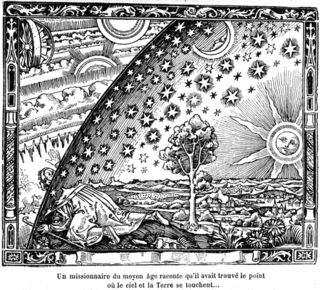
[Image, via Wikipedia: The Flammarion engraving (1888) depicts a traveller who arrives at the edge of a flat Earth and sticks his head through the firmament.]

A scientific experiment avoids confusion by holding as much as possible constant, while systematically varying some factor of interest. When you are trying to think through a complex train of thought it can be helpful to do something similar, especially when sorting out separate arguments that might be confused. My previous Boing Boing post, "Should employers be blind to private beliefs?," could be seen as raising four separate questions. These were in danger of being confused with each other, and it is helpful to consider them one at a time, setting the others on one side temporarily--the equivalent of holding other variables constant in an experiment. The four questions were:

1. Should Martin Gaskell have been turned down by the University of Kentucky? I got rid of this one by explicitly stating that I was not concerned with it. I shall continue to ignore it here.

2. Should employers ever discriminate on grounds of the beliefs of candidates? If the answer to this is no, there is no point in going on. I tried to dispose of it by reductio ad absurdum. I postulated hypothetical extremes (flat earth geographer, stork theory doctor, astronomer who thinks Mars is a mongoose egg). I presumed that everybody would agree to discriminate against such obviously preposterous extremes, and that we would therefore have a non-controversial baseline from which to move on to more subtle questions. As it turned out, I was wrong: I underestimated the emotive impact of the very word 'discrimination'. I may also have underestimated the power of the relativist doctrine that all opinions are equally worthy of respect. But in any case my purpose was not to erect a straw man and knock it down. I wanted to find a baseline of agreement, which would enable us to set Question 2 on one side, while we went on to the other questions.

3. Should employers discriminate on grounds of religion per se? Here, I had thought we could establish a baseline agreement that there are at least some religious beliefs that nobody would wish to discriminate against. None of us, certainly not I, would rule out Georges Lemaître when employing a physics professor, on the grounds that he was a Catholic priest. But there could be beliefs, which might happen to have their origins in religion, but which some people might otherwise have considered grounds for rejecting a candidate under Question 2. We are not talking about discriminating against religion per se but against a counterfactual belief that happens to come from religion, and this leads me to Question 4:

4. Suppose you are one of those who will allow a yes answer to Question 2, and are prepared to contemplate at least some discrimination, say against flat-earthers. Would you allow religion to serve as a special, privileged, protective shield against such otherwise-agreed discrimination: a shield not available to non-religious flat-earthers?

Posted by Robin Varghese at 03:19 PM | Permalink

Comments

Dawkins writes like a man who has never had to find a job to pay his rent. He oozes entitlement. I actually agree with him that discrimination on the grounds of religious belief is sometimes justified, but I disagree with him on what he takes to be a less controversial point -- that someone who does not honestly believe something should never be hired to teach or advocate it. Hell, if that rule were followed, nobody would be allowed to work in sales, or marketing, or legal litigation, or any other field that regularly requires the advocacy of positions you might not believe in personally. A job is a job. Dawkins ought to get out of his ivory tower more often. A little perspective would make his arguments much more persuasive. He also ought to consider the history of his argument that examining a candidate's personal life tells you "what kind of person they are" in some general sense, and that this should be the basis for hiring decisions -- that's an argument that has always been used to discriminate against people for their private sexual practices, ethnic origins, political views, and so on, and Dawkins sounds like a real creep for getting on board with it.

Posted by: Picador | Feb 25, 2011 5:29:00 PM

4) seems to hinge on the philosophical queston of whether religious people sometimes use "belief" and similar terms in a special sense. If people like Martin Gaskell or Kurt Wise can honestly say, "I know all the evidence points to X, but by divine revelation I -believe- it's really not-X", then I'm content to say that their religious "belief" is qualitatively different than the everday secular sense of the word, and would oppose discriminating based on that, provided they kept their metaphysical beliefs to themselves when lecturing.

That's different than the case of e.g. a physicist who doubted relativity theory, a historian specializing in European history who denied the holocaust, or a less sophisticated creationist of the Ken Ham variety. In these cases I would say that these people either don't understand the evidence, are incapable of drawing correct inferences from the evidence, or simply don't want to. It would be irresponsible to have them teaching in those fields.

But I don't see any reason to discriminate against people teaching in fields for which they are qualifed, despite heterodox beliefs in an unrelated field. My dentist believes in UFOs and even attends conferences. She is nonetheless a very good and very knowledgeable dentist, and would probably also be an excellent dental instructor.

(However, if an individual's bizarre beliefs seem like an indicator of mental illness, that's a different case. And this also happens sometimes. But there have to be corroborating symptoms for a diagnosis of that kind.)

Posted by: JoshM | Feb 26, 2011 12:12:54 AM

Richard simply being cheeky!

Posted by: Alice Reid | Feb 27, 2011 1:11:25 AM

Post a comment


Subscribe to this blog's feed  

PayAnywhere with iphone credit card swiper

Android Tablet

Bluetooth Headset

2013 New Style Dresses

Compare Car Rental Prices

DHgate.com Wholesale

3QD on Facebook

3QD on Kindle

3QD by Daily Email

Receive all blogposts at the same time every day.

Enter your Email:


Preview 3QD Email

3QD on Twitter

Miscellany

Lijit Search

AddThis Social Bookmark Button

Add to Google

Recent Comments

Eleutheria on Positive Failure - a review of "The Power" by Rhonda Byrne

Eleutheria on Positive Failure - a review of "The Power" by Rhonda Byrne

Matt on The Science Mystique

Eleutheria on Why is Europe so Messed Up? An Illuminating History

Elatia Harris on I am dust and ashes and full of sin

PeteChapman on I am dust and ashes and full of sin

Raza Husain on the culture animal

Chris on Positive Failure - a review of "The Power" by Rhonda Byrne

DAS on Why is Europe so Messed Up? An Illuminating History

DAS on Is the Brain No Different From a Light Switch? The Uncomfortable Ideas of the Philosopher Daniel Dennett

DAS on the culture animal

Raza Husain on Unknown Mathematician Proves Elusive Property of Prime Numbers

Dredd on NORTH KOREA’S NERVE WAR

Dredd on Unknown Mathematician Proves Elusive Property of Prime Numbers

Raza Husain on Is the Brain No Different From a Light Switch? The Uncomfortable Ideas of the Philosopher Daniel Dennett

Dana on germ houses

musafir on Tuesday Poem

soubriquet on Tuesday Poem

Eli on Unknown Mathematician Proves Elusive Property of Prime Numbers

Jim on Tuesday Poem

Josef Stern on Unknown Mathematician Proves Elusive Property of Prime Numbers

Shelley on Is the Brain No Different From a Light Switch? The Uncomfortable Ideas of the Philosopher Daniel Dennett

Bill on The Beautiful German Language

Eleutheria on The Bystander Effect in Medical Care. Why Do I Have So Many Doctors Not Taking Care of Me?

Eleutheria on Tuesday Poem

Acclaim For 3QD


"I couldn't tear myself away from 3 Quarks Daily, to the point of neglecting my work. Congratulations on this superb site."—Steven Pinker, Johnstone Professor of Psychology, Harvard University.

"I have placed 3 Quarks Daily at the head of my list of web bookmarks."—Richard Dawkins, Charles Simonyi Professor of the Public Understanding of Science at Oxford University.

"Just wanted you to know I’m one of many who reads and enjoys 3 Quarks....almost daily."—David Byrne, musician, former lead-singer of the Talking Heads, artist, intellectual.

Read more here.

The 3QD Prizes

Subscribe to this blog's feed