
February 14, 2011
Fundamentalism in the age of Facebook
by Feisal H. Naqvi
It is a cold hard fact of nature that those who start revolutions often do not get to enjoy them. Many of the sans culottes who stormed the Bastille in 1789 paid for their temerity with their lives. In 1917, the Tsar was ousted not by the Bolsheviks but by Kerensky and other socialists of the Provisional Government. And as for the 1978 Revolution in Iran, does anybody but their descendants really remember Shahpour Bakhtiar and Mehdi Bazargan?
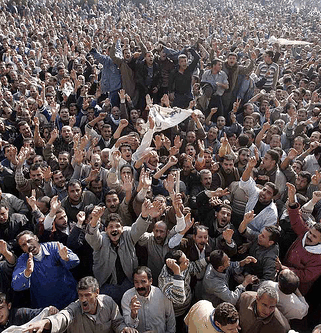
The question of what to do with a revolution in a Muslim country has gained new relevance in the past few days because of the tumultuous events in Egypt and Tunisia. In both of those countries, popular dissatisfaction has led to the unceremonious ouster of well entrenched autocrats. As a consequence, many observers have jumped to the conclusion that the old choice between a secular dictator and a fundamentalist democracy a la Iran is now dead.
Is that really so? Have Facebook and Twitter really killed all the monsters lurking in the hearts of Muslims? I am not so sure.
Let me begin my thoughts with a plethora of caveats. I have never been to either Egypt or Tunisia. I know very little about the history and the culture of either country. I am in no position to prognosticate about their future with any degree of confidence. But like many other writers before me, I am not going to let my complete ignorance stop me from making a complete fool of myself.
In my defence, I am not trying to make sense of either the Egyptian or the Tunisian revolutions. What I am interested in is how these two countries will make sense of themselves in the years ahead. Both of these countries are predominantly Muslim. Both of these countries are now going to try and develop a popular form of democracy. If either of these countries can develop an intellectually sustainable form of Islam and liberal democracy, my life as a Pakistani will be different (as will the lives of all Muslims). And while I hope I am wrong, history certainly gives me great reason to be cautious.
Let me begin with the simple stuff: Facebook is not going to kill fundamentalism. Within 24 hours of the assassination of Salman Taseer, there were pages on Facebook extolling his assassin’s glorious services to Islam. Facebook is a tool which people use to connect, just like the internet generally. Some people use the internet to debate high philosophy. Other people use the internet to deliver death threats and to learn how to make dirty bombs. Most of Pakistan uses it to watch pictures of nekkid girls.
What then is the real issue?
The basic problem facing all Muslim countries is that there is a fundamental antipathy between Islamic legalism and liberal democracy. The essence of liberal democracy is that legitimacy proceeds from the freely granted consent of the governed. The essence of Islamic legalism is that legitimacy proceeds from fidelity to a set of rules ordained by Allah and that no government, democratic or otherwise, can be legitimate if it wanders outside those rules. Between the will of the people and the will of Allah, there can be only one which is supreme
At this point, the standard response on behalf of the Islamists is that Islam can too be democratic. At the end of the day, the Quran is but a constitution freely adopted by Muslim citizens of a state. And just like Western regimes cannot go outside their constitutional confines, Islamic regimes cannot go outside the confines of the Quran.
The analogy, though enticing, is wrong at multiple levels. The first problem is theoretical: a constitution takes its legitimacy from the fact that it is a living compact between citizens, not in the fact that it was revealed by God. Even if all the citizens of a country declare repeatedly and passionately that they wish nothing else than to be bound by the Quran, that will not turn the Quran into a constitution because the theoretical possibility of amending the Quran will not be present.
The second problem is more substantive. A constitution tends to consist of broad generalities and leaves much to the legislature. However, even within those broad confines, elements of conflict are inevitable. One consequence of this conflict is that the judges of the superior courts in every country with a constitution are engaged in a continuous reinterpretation of that constitution. However, no such reinterpretation of Islamic law is acceptable. In other words, Islamic jurisprudence simply does not allow for the interpretation of the Quran as if it were a constitution.
Let me explain further. I am not – repeat, not – trying to say that there is no room for interpretation in Islamic law. Every text requires interpretation and the Quran is no different in this regard. However, there is a huge difference between the norms of constitutional interpretation and legal interpretation as generally accepted within Islamic jurisprudential theory. To be more precise, Islamic jurisprudence differs from constitutional jurisprudence by not having a theory of change. Instead, Islamic jurisprudence only has a theory of error.
Let me explain this difference with some examples. The First Amendment to the US Constitution states in extremely blunt terms that Congress shall make “no law” respecting the freedom of the Press. What the words “no law” mean has been the subject of great debate over centuries. Justice Hugo Black, for one, thought that “no law” meant just that, i.e. no law, period. Most jurists have, however, conceded that some “reasonable” restrictions of free speech are permissible and then go on to discuss whether particular restrictions are “reasonable or not.” And at different moments in time, jurisprudential consensus as to what constitutes a reasonable restraint of free speech has varied enormously over time. The same Congress which passed the First Amendment also passed the Sedition Act of 1789, a law which would almost certainly fail to pass judicial scrutiny today.
The response at this stage is likely to be “so what?” After all, Islamic jurists spend their time engaged in heated debate as to what is the correct interpretation of particular verses. How then is Quranic interpretation different from constitutional interpretation?
To understand how Islamic legal interpretation is different, take the oft-debated issue of the number of wives a man may have under Islamic law. As is well known, the Quran says that a man have up to four wives provide he treats them equally. The Quran then adds a further injunction that no one can treat their wives equally.
The traditional legal interpretation of this point is that a Muslim man may indeed have up to four wives. The Quranic statement that no man can treat all four wives equally is thus taken to mean that absolute equality is impossible and that reasonable equality of treatment is sufficient.
Compared to this, we have the modern day reformist perspective. The reformist argument is that when the Quran states that it is impossible to treat all four wives equally, it should be taken literally and that Islamic law only allows Muslim men to have one wife at a time.
The heated debate over this issue tends to hide the fact that both the reformist and traditional schools of interpretation assume that there can only be one truly Islamic law which is valid for all times. Thus, the traditional scholar argues that a Muslim man could have four wives in 611 A.D. and that he can have four wives in 2011. The reformist argues that a Muslim could actually only have had one wife back in 611 AD and that the same holds true in 2011. What neither school is willing to concede is that Islamic law in back 611 allowed for four wives at a time but that Islamic law in 2011 only allows for one wife. This is because neither traditional scholars nor reformers allow for the possibility of change in Islamic law: both approaches assume that what is true in Islamic law is true for all times – past, present and future. And it is in this sense that Islamic jurisprudence differs from constitutional jurisprudence. Constitutional jurisprudence has no problems stating that what was true yesterday is no longer true today while at the same time conceding that was true yesterday was indeed true yesterday. Islamic jurisprudence does not allow for that: either something is true for both yesterday and today or it is not true at all. There is no temporal variation permitted in Islamic jurisprudence.
To understand why this is so, one has to go back back into Islamic history and the debate over the createdness of the Quran. To explain, there are two general schools of thought in Islamic jurisprudence when it comes to the nature of the Quran. The first school of thought holds that while the Quran is divine in origin, it was created at a particular moment in time at a particular place and consequently, the meaning of the Quran can only be fully understood through an appreciation of the temporal and historical context within which it was revealed. The second school of thoughts holds that the Quran is not just divine in origin but divine in essence. The Quran was thus not “created” at any moment in time. Instead, the Quran is “uncreated,” existing like Allah outside space and time.
The reason why the createdness of the Quran has jurisprudential consequences is because the Quran is the primary source of law for all Muslims. If the Quran exists outside space and time, then so too does Islamic law. And if Islamic law exists outside time and space, then it cannot vary over time. And if it cannot vary over time, then what is true today must have been true yesterday and vice versa. On the other hand, if the Quran was created at a particular moment in time at a particular place, then Islamic law is contextual. And if it is contextual, then what is Islamically true can vary with time and geography.
At one level it may seem absurd to have an argument over whether or not Islamic law can vary with time. After all, if Islamic law does not provide for variations in time and space, then one can with a straight face argue that both slavery and concubinage are Islamically valid, even today.
I do not have a good explanation for the jurisprudential poverty of modern Islamic thought (and yes, my own ignorance may well be relevant). One answer though can be found in Khaled Abou el Fadl’s book, “The Great Theft” which details how a flood of Wahabi money has led to a world in which a thousand years of legal scholarship is being systematically overwritten in favour of the simplistic theology preferred by the House of Saud. But as innately sympathetic as I am to that argument, I am not sure if that really captures the entire picture.
The missing element lies, I think, in the fact that Islamic jurisprudential thought is both tremendously advanced and tremendously irrelevant. Let me explain: Islamic jurisprudential thought is tremendously advanced because for more than a thousand years, the brightest minds of the Muslim world have devoted their energies to teasing out the finest details of Islamic law. That scholarship cannot and must not be taken lightly. Indeed, as George Makdisi has demonstrated, the very foundations of the system of colleges made famous by Oxford and Cambridge most likely lie in systems of Islamic scholarship imported by the West.
At the same time, the most important aspect of Islamic jurisprudence is that it has for the vast majority of its thousand plus years of existence resigned itself to being an ivory tower construct. What one finds in Islamic legal history is thus a Faustian bargain where the sultan de jour would ceremoniously bow towards the ulema and the ulema would in return obligingly rubber-stamp all that the sultan wanted. Since Islamic law was politically irrelevant for all but very small parts of history, it never needed to change.
Let me now try and put together all of these disparate elements into a coherent analysis. First, Islamic jurisprudence is serious business. That means the average person cannot just get up on a soapbox and argue that a particular course of action is “Islamic.” Instead, the only people who get to wield the stamp of Islamic legitimacy are professional Islamic scholars. Second, Islamic jurisprudence has been politically irrelevant for the vast majority of its existence. With obvious exceptions, it did not seek to challenge power; it sought only to preserve its own little zone of autonomy. As a consequence, it operates largely as an idealistic construct and does not recognize reality, economic or otherwise, as a constraint.
If the ruler of a Muslim country is an autocrat, the traditional relationship between the ruler and his scholars continues to function. The introduction of democracy, however, changes everything. Because the citizenry is Muslim, it wants its laws to be “Islamic.” Because of the deeply entrenched nature of the Islamic legal community, this hands power to a small group of scholars. Because of their historically isolated nature, it means that those scholars are entirely unequipped to deal with the modern world. And because of the massive influence of Saudi money, those scholars are being encouraged to adopt a particularly regressive approach to Islam. Islam in a democracy can therefore operate like a one-way ratchet into a progressively Talibanised world.
Obviously, my theory is grossly simplistic. To begin with, it does not take into account the immense common sense of the average Muslim who has happily survived the past thousand plus years by ignoring most of the stupidities mouthed by the average mullah. At the same time, common sense can only last so long. At least so far as Pakistan is concerned, the state has, up until now, been unable to prevent the ever-increasing exploitation by fundamentalists of the general desire for some sort of an Islamic imprimatur. As shown by the murder of Salmaan Taseer and the subsequent glorification of his killer, ideas which were once derided as ignorant or extremist have now moved into the mainstream of political thought.
My hunch though is that Egypt will certainly fare better in dealing with the challenge of political Islam than Pakistan. To begin with, Egypt is unlikely to share Pakistan’s neurotic obsession with the purpose of the state if only because Egypt has existed as a distinct nation for all of recorded history. The good news though is that if more countries succeed visibly in balancing Islam, modernity and democracy, the fundamentalist hold on the Muslim imagination will necessarily be weakened. And for that reason, the advent of democracy in Egypt can truly be the harbinger of something momentous.
Let me return now to my jurisprudential meanderings and the theory of the uncreated Quran. What is important to remember about this theory is that it is just that; a theory. The Quran itself does not say whether it is created or uncreated: both views are man-made additions to the corpus of Islamic thought. More importantly, the reason why a jurisprudential theory as visibly open to challenge as the theory of the uncreated Quran has continued to survive is self-evidently because it has not been challenged in public debate till now. Yes, one of the dangers of introducing democracy in a Muslim country is that democratic norms may become subordinated to the views of a narrow-minded few with the power to define that which is Islamic. At the same time, the reason why Islamic political thought has yet to reach an accommodation with liberal democracy is because the two concepts have not been forced to cohabit for any length of time. If and when that happens, the lives of Muslims will change radically for the better.
Posted by Feisal Naqvi at 01:05 AM | Permalink


Comments
"...neither traditional scholars nor reformers allow for the possibility of change in Islamic law: both approaches assume that what is true in Islamic law is true for all times – past, present and future."
This is also true of the Catholic Church. As a Catholic, I am always amused when the Church changes its mind about something that up until that minute it said would never change. "Oh did we say the bible proves the sun goes around the earth? Never mind."
Fortunately for civilization, the secular power of the Vatican peaked some time ago.
Posted by: Frank | Feb 14, 2011 8:36:16 AM
On a positive note, Muslim communities in many non-Muslim majority countries (e.g. the US and Australian) have found ways to live peacefully in those countries.
The other thing most Muslims can and should recognise is that the Qur'an is not a constitutional document. It is a religious document.
Posted by: Martin | Feb 14, 2011 9:35:55 AM
Very acute writing Feisal...
Thank you for a thought provoking (and clear) Monday morning read!
S.
Posted by: Sid | Feb 14, 2011 10:34:54 AM
Feisal, Well written, as always.
Feeling rather cynical this morning, I will offer a cynical extreme view to complement your sober and well-thought out one: there is no such thing as an Islamic theory of politics or economics. There never was. Islam provided solidarity and motivational tools and a personal law code. It never had anything beyond that. The state was improvised as best as could be managed and as the first wave of conquests brought civilized areas under Arab rule, the more pragmatic and capable Arab rulers (aka Muawiya and company) created an empire using whatever was at hand. Islamic solidarity was married to several wives (four being permitted), including Byzantine and Persian bureaucracies and political culture. Over time, the Ulama cooked up a legal code that could live with the empire as best as could be managed. The rest is history.
There is no there there. There has never been a modern state run on "Islamic principles" and there never will be. But there WILL be modern states that will give Islamic-sounding names to modern notions of political organization and economic life. That process, unfortunately, is hindered by all sincere attempts to find an Islamic alternative.
It would have worked with less bloodshed if Islamist mythmaking and propaganda had not gotten this far on wings of oil, but the myths have acquired a life of their own, so this simple process is now going to go through some iterations of "Islam is the solution" and subsequent disasters (in some countries, hopefully not all) before things settle down. And some well-meaning Westerners and their proteges in good Universities are not helping. In their own small and ineffectual way, they too will feed the mess for a few years by providing postmodern cover for premodern empty slogans.
But, have no fear; most Islamicate societies managed to find their way to successful kingdoms and empires when kingdoms and empires were the way things worked. I am sure they will also find their way to republics and democracies now that these are the preferred norms....
Posted by: omar | Feb 14, 2011 11:05:36 AM
The clarity and precision of your writing is amazing, Feisal. "One-way ratchet" is such an apt metaphor... Thank you!
Posted by: M73 | Feb 14, 2011 12:57:21 PM
Very well written.
I am not good in law and its interpretation by any means, but my argument about the subject is very simple.
As in every scientific field, Professionalism is key for the religious scholars, and is unfortunately lacking in muslim world at this time we are living, or for that matter, if there are educated people around, they do not know FACEBOOK or similar forums. Interpreting the needs of humanity according to Quran in ever changing world and modern age and for coming future can be deducted so easily if educated literate “MULLA” is able to tackle the matter without any influence, pressure, fear and personal bias. We can always argue on how to create such a generation of religious scholars and keep them out of any influence, but my firm belief is that Quran is both LAW and HIKMAT and if there was a need for any other book, then it would not have been saved by ALMIGHTY.
We need to think about how to educate our society and your good self has very bright prospect of becoming expert since you already know the law :).
In the end again, very well written
Posted by: Muhammad Imran Hasan Khan | Feb 14, 2011 2:43:00 PM
Good analysis, Feisal.
...but my firm belief is that Quran is both LAW and HIKMAT and if there was a need for any other book, then it would not have been saved by ALMIGHTY.
This is why we should all despair.
Posted by: Ruchira | Feb 14, 2011 4:40:08 PM
You're right, of course. Organized religion and constitutional government are not miscible - never were, never will be.
Posted by: James F Traynor | Feb 14, 2011 5:10:44 PM
Ruchira, dont despair. Notice that Khan sahib is actually admiring Feisal's article. If people want to believe that their modern notions are based on the quran, why stop them? The quran is a very general and rather obscure text, its very malleable.
Posted by: omar | Feb 14, 2011 6:15:51 PM
Nice analysis Feisal and good points Omar. I think many Muslims believe that the Qu'ran and sunnah can provide an all encompassing and multifarious system of belief, incorporating the spiritual, social and political. The best book I have read recently is 'Sayyid Qutb and the Origins of Radical Islamism' by John Calvert. The book not only provides analysis on how the islamist mindset materializes but also how fervently and strongly the belief is held. The use of generalised and sometimes obscure readings from the Qu'ran and sunnah can be molded to reinforce the positives of Islam as a total belief and organisational system. By using non-Muslim countries as a binary opposite and example of the failures of other societies they can position, in the minds of many Muslims, why Islamic governance is the answer to all the Muslim worlds woes. Qutb and many of his contemporary apprentices are skilled at presenting convincing arguments that are backed up by unquestionable texts. As many Muslim majority countries continue to struggle with their development, these islamist 'solutions' can be intoxicating to both devout and politically minded Muslims.
Posted by: Troy | Feb 14, 2011 9:02:44 PM
Egyptians have moved on...may I suggest that the discourse in the peanut gallery move on too from the tightly bound paradigm of the last 60 years and the hyperventilation about Islam of the last decade?
Posted by: Maniza | Feb 14, 2011 9:08:32 PM
" Revealed religion is one thing, revealed legislation, another.The state has physical power and uses it when necessary; the power of religion is love and beneficence. " - Moses Mendelssohn .
Feisal, such clarity on such a difficult topic. Haven't ever read anything this good, apart from Mendelssohn.
Posted by: Ratnesh | Feb 14, 2011 9:55:51 PM
@Maniza
The dissolution of government, the deposition of Mubarak and the imposition of military rule in the interim would hardly constitute moving on. Judging by the posts of Egyptian bloggers over the last two days this is the exact mindset they wish to prevent. The battle is far from over and the period immediately after such events have historically been the most tumultuous.
On another note, I think you may well have provided the definitive definition for Islamophobia.
Posted by: Troy | Feb 14, 2011 11:52:07 PM
@Ruchira and Omar Ali -- the two of you need to cut Imran some slack. Given what I know of him, I am deeply impressed with his courage in exploring his beliefs this far.
@OmarAli -- Omar Bhai, there is no ONE Islamic theory of law or politics, but there are certainly several. I don't think it is appropriate for you to dismiss 1400 years of history as just stuff cooked up from time to time. There were real Islamic scholars and there were multiple attempts to construct an Islamic world. We don't have to accept them but we should recognise them.
I don't think Islam is the solution for Pakistan but I do think that the solution has to include and honour that part of our heritage which is Islamic. Our job is to try and figure out a jurisprudence which both honours the past and yet liberates the present. That task requires engagement with the history of Islam, not a dismissal of it.
@Maniza -- I don't think Egypt is done and dusted quite yet. The Egyptians still have to figure out what they are going to do with themselves. They may decide to be totally secular but i would be surprised if such an enterprise was attempted, let alone sustainable. instead, like Pakistan, they will try and find some way to mix Islam and democracy. In my view, any such mixing requires a new Islamic jurisprudence, or to be more accurate, a revival of the old Mutazilite rationalism buried under a 1000 years of dust. I don't have the scholarship to do that. But I am looking for somebody who does, just like I think many others are in the Muslim world.
Posted by: Feisal Naqvi | Feb 15, 2011 12:34:50 AM
I saw a doco on TV last night in which an Egyptian gentleman was talking of what-now. He said, in an attempt to reassure Israel, I think, "In Egypt we have always rejected the idea that our politics is Islam. Islam is our religion."
The trouble with Muslim jurisprudence, and indeed any discussion of the Quran, it seems to me, is that this distinction is all too infrequently made. I am with Marx, Hitchins and Dawkins on the subject of religion.
Posted by: sheila | Feb 15, 2011 3:35:03 AM
"Let me return now to my jurisprudential meanderings and the theory of the uncreated Quran. What is important to remember about this theory is that it is just that; a theory".
It would help if, like the Big Bang, Origin of the Species, Out of Africa et al, we just called it hypothesis until proven beyond dispute.
Otw, quite brilliantly written.
Posted by: E.S.Shankar | Feb 15, 2011 4:10:24 AM
I can't help but notice a glaring similarity to the place of the Jewish religious laws in the democratic state of Israel.
If it was up to the religious parties in Israel, the only law in Israel would be orthodox religious law, and the 80% of non-religious jews there would be forced to live by these rules and be punished if they didn't.
Thankfully (or to some - disappointingly), the religious parties only have a 20% representation in government, and therefore their influence on Israeli law is limited. They have enough political influence, for instance, to prevent the use of public transport on the sabbath, and to force marriage, divorce and death rites in Israel according to religious laws, but as long as the majority of the voters do not wish the religious laws to take a stronger hold, their influence will be limited.
In my opinion there is no conflict between democracy and religion (to me Islam and Judaism are in exactly the same predicament). If the majority of the people wish islamic law to prevail, they will vote for islamic parties and have their way enforced on the minority. If the majority prefer secular laws, they will vote this way and end up with a government similar to Turkey's, but in this case chosen by the people.
I think it's fantastic that Egypt's people will (hopefully) now have the chance to cast their vote.
They should have the last word.
Posted by: Jeremy | Feb 15, 2011 5:22:41 AM
Feisal
Searching for someone to prescribe a synthesis of reason and revelation.
What interested me most about the Qutb biography, which is an objective and thoroughly researched book, were his formative years. He sincerely wished to achieve the synthesis of reason and revelation although he proscribed more religion and less non-Islamic influence and secularism. He wasn't recognised by the ulema and had no formal education in Islamic jurisprudence, yet he convincingly managed to combined Islam with European styled socialism in his earlier writings. In my opinion he had a sharp and inquisitive intellect and a lot of flair and it is a shame events conspired to produce a resolute islamist over time.
I re-read your piece, it displays great foresight.
Posted by: Troy | Feb 15, 2011 5:38:52 AM
Egyptians have moved on...may I suggest that the discourse in the peanut gallery move on too from the tightly bound paradigm of the last 60 years and the hyperventilation about Islam of the last decade?
@Maniza: They have? Moved on to what? To where? Please tell us. The news hasn't reached us in the Peanut Gallery.
@Feisal: Sorry if I was unduly harsh with Mr. Khan. I don't know him and in the blogosphere, until one has had sufficient and frequent exposure to another reader's thoughts, it is hard to always know where he/she is coming from. The sentence that led me to despair is pretty unequivocal that Mr. Khan doesn't want to look beyond the Quran to seek appropriate jurisprudential view points. Perhaps, as an outsider I have no clue about how much of an emotional and intellectual hold religious laws have on the minds of the average pious and observant Muslim in Islamic nations. But I would have said the same thing had Mr. Khan been a Christian, Jew or a Hindu who wished to go forward only by going back to ancient texts. Perhaps, there is no other way except such compromises, in societies where religion, especially religious orthopraxy guides one's private as well as public life. I commend you for bringing this up for debate. I wonder though how rational and fair such debates can be when one side firmly believes that it has incontrovertible proof and knowledge of both the first as well as the last word.
Posted by: Ruchira | Feb 15, 2011 9:57:17 AM
Feisal, I was not prescribing, I was describing. There is a difference. If Sherry Rahman wants to amend the blasphemy law she has to calculate HOW to get there from here. I, on the other hand, am just presenting what I see as happening in a cynical and uncalculated manner.
I think real scholars have done real work in a thousand fields, but not all of it is relevant to my discussion. My point was that orthodox Islamic scholars (especially Sunni scholars, shias are in a slightly different boat) took a particular road a thousand years ago (or were forced to take said road by the rulers of the day). On that road, they can argue about the number of wives and the way to wash your bottom until kingdom come, but they have nothing useful to say about political science or economics. That does not mean they have nothing to say. That means they have nothing USEFUL to say. That's a very sweeping statement and like all sweeping statements, its actually not true in its entirety. But its true enough for guvmint work. OUTSIDE of the orthodox domain, much may have been thought and said, but that is not what we are talking about.
Turkey is a good example. The current Islamist regime is still democratic, the state is still a modern republic (in fact, a more democratic republic than it was under the Kemalists) and the Islamists have their own modern ideologues who are trying to synthesize their Islamic heritage with modern democracy (for now at least). Good. My point is that:
A. These ideologues did NOT grow out of the orthodox Islamic tradition.
B. the democracy part is indistinguishable from what you would argue about or learn in any Western or Indian or Japanese University. The "Islamic" gloss is added on for sentimental reasons and contributes nothing more to it than the kind of gloss the Japanese put on democracy by calling their parliament the Kokkai. I am NOT saying thats a bad idea. I am NOT saying its not needed. I am just saying that it will get you exactly where the modern world is (if there) and no further.
And that is because from 1000 AD to 1999 AD, the Islamicate core did not see any systematic advance in political science or economics that came from within the world of the Islamic scholars. AND I am saying that there is no adequate political or economic theory present in early Islamic texts to which they can go back. These two claims mean that WITHIN the parameters of orthodox Sunni scholarship (which is based on the early texts and the thousand year development of arguments about those texts) there is no USEFUL political theory and no useful economic theory. They will have to go out to the infidels to bone up on those two and then give them suitable Islamic names. There is no other way its going to happen.
Posted by: omar | Feb 15, 2011 10:25:50 AM
Oh, and about "stuff cooked up". I dont see that as a negative. Everything is stuff cooked up to fit a particular need or satisfy a particular drive or whatever. Cooking stuff up is how humans make things happen. That the Ommayads and Abbasids cooked stuff up is a given. What else could they have done? My point was that it was cooked up using whatever was at hand (mostly Byzantine, Persian and older notions of kingdom, empire and ruler) and the texts the Arabs brought with them (or claimed they brought with them; as you know, there is some dispute about how much of the texts is actually Hijazi in origin) had very little to say about state formation, constitutions, ways of electing or selecting a ruler and so on. These two claims are obviously contrary to any notion of "Islam is the solution". They are also contrary to what many or most Muslims say they believe. But they are what it looks like to me....
Posted by: omar | Feb 15, 2011 10:32:53 AM
I agree with Feisal & Omar, and with Jeremy's comment that Jewish fundamentalists are trying to create a similar trap in Israel. I would point out that Christianity was more succesful in intergrating itself with politics, because Constantine and the Christian emperors that followed him made sure that Christianity didn't interfere with their political control. True, the Catholic church claimed influence and partial control over peoples' lives, but it also annointed kings with holy oil, thus giving them a basic legitimacy and right to make laws. It is interesting that all Arab kings have claimed some sort of ancestral link to Mohamed, I suspect this is because Islam has never institutionalised any method of transfering soveignty, so claims of tribal lineage are the only ploy for aquiring legitimacy.
The way out of this connondrum? Well, Muslims are not about to abandon religion, so what is needed is a conscious, forthright aceptance of contradiction and double standards: pray to Allah yet accept Western-evolved law. Drink alcohol and eat pork, but not at home. Get used to the fact that a mixed culture is better than a pure one, be partly Muslim (or Jewish or whatever) but don't reject the other, more open and freer part of one's being.
Posted by: aguy109 | Feb 15, 2011 10:47:08 AM
@ Omar: I want to respond to this part of your argument:
And that is because from 1000 AD to 1999 AD, the Islamicate core did not see any systematic advance in political science or economics that came from within the world of the Islamic scholars. AND I am saying that there is no adequate political or economic theory present in early Islamic texts to which they can go back. These two claims mean that WITHIN the parameters of orthodox Sunni scholarship (which is based on the early texts and the thousand year development of arguments about those texts) there is no USEFUL political theory and no useful economic theory. They will have to go out to the infidels to bone up on those two and then give them suitable Islamic names. There is no other way its going to happen."
My problem as a confused Muslim is how to get infidel stuff that I like into the politics of my nation. Simply renaming stuff is a bit crude though it has obviously been done from time, see e.g., Shariati's contention that socialism/Marxism was all there in the Quran. I'm actually not too bothered by what specific stuff we find and more bothered by the question of how to get stuff in that I like (though I obviously have policy preferences). My argument/theory is that in order to get there we first have to get rid of that bit of Islamic jurisprudence which mandates that law is an unchanging platonic essence which in turn flows out of the contention that the Quran is uncreated. What I want to say (like a good legal realist) is that law is a means to social ends and that any law is only as good as the ends it produces. If the Quran is to be understood contextually, then law is to be produced contextually, which in turn means that I (in my social scientist/reformist mode) can argue that law x (i.e. no interest, period) can be ditched and instead replaced by law y (some degree of interest is inevitable and actually beneficial). Unfortunately, I just don't have the legal/religious chops to build the jurisprudential foundations for the theories that I want (apart from not having the religious credentials either). My sense is that this type of jurisprudential foundation did exist earlier in the works of the Mutazilites about 1000 years ago but again, I don't know how enough about them to make that statement convincingly, and more importantly, I don't know how to deconstruct current Islamic jurisprudence and replace it with my desired variant.
My point was also that Islamic law can afford to be practically useless because it has been an ivory tower construct. We therefore wind up in a strange position where the law is useless but cannot be changed unless it is first demonstrated to be useless, which requires a fair amount of social pain.
Anyways, the point was that given where I am, i do not have the option of blithely advising everybody to adopt infidel ways. People are surprisingly attached to their religion and therefore one needs to try and work within their religious beliefs to try and get change, rather than force them to ditch their religious beliefs as a matter of unfortunate necessity.
Cheers,
feisal
Posted by: Feisal Naqvi | Feb 15, 2011 12:40:13 PM
Feisal, You have my admiration and support in your work and I am not advising you to tell people to ditch their religion. The need to learn some infidel ways is there, the need will be fulfilled. But not by me. I will fulfill other needs, for example:
1. You can always cite me as an example of "going too far". In that way, wherever you are going becomes "not going too far". If I was not there, you would have to invent me because "not going too far" is meaningless unless there is such a thing as "going too far".
2. Someone has to tell people that there IS no such thing as an Islamic political system or an Islamic economic system. Sure, we can make one up tomorrow (why not?) but it aint there in those books you put away on top of the cupboard 3 years ago. Believe me, I have read the books. There is no there there. Now, if you say this, you are out of the room, but if I say this, you can still stay in the room and actually make up the stuff. In fact, you can even claim it was there all the time (if you are so inclined...it is an honorable and well-established way of doing these things. In fact, when the doctors of Islam used to make stuff up with great success, that was a very popular theme).
Posted by: omar | Feb 15, 2011 2:41:34 PM
Post a comment